For cooperation and more details, feel free to email us or call directly for consultation.

Home > News & Blog > Knowledge > How Does a Radio Frequency Welding Machine Work?
A radio frequency (RF) welding machine joins compatible thermoplastic materials by using high-frequency electromagnetic energy to generate heat inside the material. Unlike conventional heat sealing, which transfers heat from a heated surface, radio frequency welding generates heat internally through an alternating electric field. Mechanical pressure is then applied to form a strong, consistent bond.
Also known as dielectric welding or high-frequency welding, the RF welding process is widely used to manufacture inflatable products, medical devices, industrial fabric products, automotive components, and flexible PVC assemblies.
For manufacturers, understanding how RF welding works helps with selecting the right welding machine, optimizing cycle times, improving weld consistency, and reducing material waste. The results depend on the material's dielectric properties, electrode design, applied pressure, RF power, and cooling conditions.
Radio frequency welding is a thermal joining process that uses high-frequency electrical energy to heat and bond suitable dielectric materials. It is also called RF welding, radio frequency sealing, dielectric welding, or high-frequency welding.
In this process, the materials are placed between conductive electrodes connected to an RF generator. The electrodes establish an alternating electric field across the material. As the field changes direction rapidly, polar molecules within the material respond to the electrical energy. This molecular movement and associated dielectric losses convert electrical energy into heat.
The heat softens the material at the intended joint, allowing the surfaces to fuse under pressure. After the RF energy is removed and the joint cools, the bonded area forms an integrated connection.
Radio frequency welding is particularly suitable for polyvinyl chloride (PVC) and certain other polar thermoplastics. Not every plastic can be welded effectively with RF energy. Material selection must account for dielectric properties, thickness, additives, and the specific welding requirements.
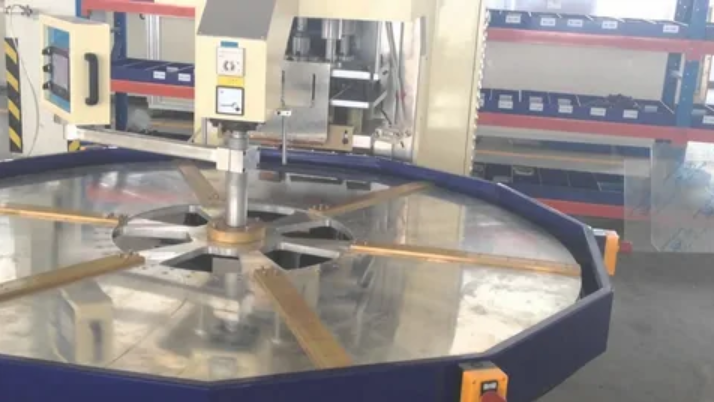
An RF welding machine uses high-frequency electromagnetic energy, commonly at 27.12 MHz, to heat compatible dielectric materials such as polyvinyl chloride (PVC). The alternating electric field causes molecular polarization within the material, generating heat internally. Once the material reaches the appropriate welding temperature, pressure is applied through electrodes to bring the softened surfaces together. The RF energy is then switched off, and the joint is held under pressure while the material cools and solidifies, creating a durable weld.
The basic RF welding cycle consists of five stages: material positioning, RF energy application, internal heat generation, pressure-assisted bonding, and cooling under pressure.
The process begins by placing two or more compatible material layers between the welding electrodes. The material may consist of PVC film, coated fabric, flexible sheet, or another RF-weldable thermoplastic.
The operator or automated handling system positions the materials according to the required weld pattern. The electrode, often called a welding die, defines the shape and dimensions of the bonded area.
Accurate positioning helps maintain consistent seam width, alignment, and weld quality.
Once the material is in position, the RF welding machine applies high-frequency electrical energy through the electrodes.
A commonly used industrial frequency is 27.12 MHz, although other permitted frequencies and machine configurations may be used depending on the application and applicable regulations.
The alternating electric field continuously changes direction. Polar molecules in the dielectric material respond to this changing field, and the resulting dielectric losses convert electrical energy into heat.
This is why radio frequency welding differs from conventional thermal welding: the material itself generates heat in the energized region rather than relying primarily on heat transferred from an external heat source.
Internal heat generation is the defining feature of the RF welding process.
When the alternating electric field acts on a suitable dielectric material, the material's molecular polarization repeatedly responds to the changing field. Because this response is not perfectly lossless, part of the electrical energy becomes thermal energy.
The amount of heat generated depends on several factors, including:
The internal heat softens the thermoplastic material around the weld interface. With suitable process settings, the surfaces become sufficiently mobile to fuse when pressure is maintained.
The material does not need to be heated uniformly throughout its entire thickness or across the entire product. The objective is to generate sufficient heat in the intended welding zone while avoiding overheating, arcing, or damage to adjacent material.
Once the material reaches the required welding condition, pressure is applied through the electrodes.
The pressure brings the softened surfaces into close contact, helps eliminate gaps at the interface, and supports the formation of a continuous bond. In many machines, the electrode applies pressure before RF energy begins and maintains it throughout the heating and cooling stages.
The combination of heat and pressure allows the thermoplastic surfaces to fuse. The appropriate pressure depends on the material, thickness, electrode design, and product requirements.
Too little pressure may produce an incomplete or inconsistent weld. Excessive pressure may squeeze softened material out of the joint, distort the product, or create an uneven seam. Welding parameters therefore need to be established for the specific material and application.
After the required heating period, the RF generator stops supplying energy. The material may remain softened or molten in the weld zone, so the electrodes continue to hold the joint under pressure while the material cools.
As the thermoplastic material cools, it solidifies and the bonded interface develops its final strength. Releasing the pressure too early can cause deformation, separation, or inconsistent weld quality.
The cooling stage is particularly relevant when working with thicker materials, multilayer structures, or products that must retain a defined shape.
After sufficient cooling, the electrode opens and the welded component is removed. Depending on the production requirements, the part may undergo visual inspection, dimensional checks, leak testing, peel testing, tensile testing, or other quality-control procedures.
A finished weld should meet the applicable requirements for seam appearance, bond strength, airtightness, watertightness, or other specified performance characteristics.
Once the process has been validated, the machine can repeat the same sequence to produce consistent welds across successive production cycles.
RF welding relies on dielectric heating, a process in which electrical energy is converted into heat within a nonconductive material exposed to an alternating electric field.
The molecular structure of the material influences its response to an electric field. In suitable polar materials, electric dipoles respond to the field as it changes direction. Their response involves energy losses that generate heat.
This effect is commonly described as dielectric loss. It explains why some thermoplastics heat effectively under RF energy while others respond poorly.
PVC is widely used in RF welding because its dielectric properties generally make it suitable for this process. Certain polyurethane formulations and other dielectric materials may also be weldable, but compatibility must be confirmed for the specific grade and formulation.
Materials such as polyethylene and polypropylene generally have low dielectric losses and are more difficult to weld directly using conventional RF welding. Specialized formulations, compatible layers, or alternative joining technologies may be needed.
The frequency 27.12 MHz is one of the internationally designated industrial, scientific, and medical (ISM) frequencies used by industrial RF equipment, subject to applicable national regulations.
It is widely adopted in RF welding because it provides a practical operating frequency for dielectric heating in many industrial applications.
However, frequency alone does not determine weld quality. Generator power, electric-field distribution, material properties, electrode design, welding time, pressure, and cooling conditions must all work together to produce a reliable joint.
During RF welding, the material passes through a sequence of physical changes.
First, the alternating electric field produces dielectric heating. The temperature of the energized region rises, increasing the mobility of polymer chains in the thermoplastic material.
Next, the internal heat softens the welding interface. Under pressure, the contacting surfaces conform to each other, and polymer chains can move and interpenetrate across the interface. This process helps create a continuous bonded region.
Finally, the material cools and solidifies. The resulting joint behaves as a fused thermoplastic connection rather than a joint held together solely by an adhesive or mechanical fastener.
The precise molecular behavior varies with polymer chemistry, temperature, material formulation, and process conditions. This is why welding parameters developed for one material cannot automatically be transferred to another.
An industrial RF welding machine combines electrical, mechanical, and control systems to deliver repeatable welding results.
The RF generator produces the high-frequency electrical energy used for dielectric heating. Its power capacity and control characteristics influence the range of material thicknesses, weld areas, and production requirements the machine can handle.
The electrodes deliver the RF energy to the material and define the weld pattern. Their geometry, surface condition, alignment, and electrical characteristics affect the electric field and the consistency of the resulting seam.
The pressing mechanism applies the force required to bring the material layers together. Depending on the machine design, it may use pneumatic, hydraulic, or mechanical actuation.
The control system manages welding time, power settings, pressure-related functions, cooling time, and other process parameters. More advanced systems may provide recipe storage, production monitoring, interlocks, and fault detection.
Cooling arrangements help control machine temperature and support stable production. RF welding equipment also requires suitable electrical shielding, grounding, interlocks, and protection against unintended RF exposure and arcing.
Machine configuration varies by application. A small benchtop unit for medical accessories has different capacity and automation requirements from a large industrial RF welding machine used for inflatable structures or coated-fabric assemblies.
RF welding is most commonly associated with polar thermoplastics that respond effectively to dielectric heating.
| Material | RF welding suitability | Typical considerations |
|---|---|---|
| Polyvinyl chloride (PVC) | Excellent in many formulations | Common for films, coated fabrics, bladders, and flexible products |
| Thermoplastic polyurethane (TPU) | Possible with suitable grades | Requires formulation-specific trials and parameter development |
| Certain polyurethane materials | Application-dependent | Confirm whether the specific formulation is thermoplastic and RF-compatible |
| Polyethylene (PE) | Generally difficult | Low dielectric losses make conventional RF welding less effective |
| Polypropylene (PP) | Generally difficult | May require alternative joining methods or specialized material systems |
| Non-thermoplastic materials | Generally unsuitable for direct fusion | May need adhesive bonding, mechanical joining, or another process |
The term dielectric welding describes the heating mechanism, not a guarantee that every dielectric material can be welded. Before selecting a welding machine, manufacturers should verify material compatibility and test representative production samples.
RF welding is used wherever a controlled, repeatable thermoplastic seam is needed.
Medical applications include blood pressure cuffs, inflatable medical bladders, fluid bags, and certain medical-device components made from compatible materials.
For example, blood pressure cuffs may use RF welding to create sealed air chambers and joining seams. The process can support repeatable geometry and airtightness when the material and machine settings are properly controlled. Medical products must also meet the relevant regulatory, biocompatibility, and quality requirements.
RF welding is widely used to manufacture inflatable boats, air mattresses, water toys, air chambers, and other products made from RF-weldable coated fabrics or films.
The process can create continuous seams that help resist air leakage and withstand repeated inflation and deflation.
Applications include flexible tanks, protective covers, tarpaulins, flexible ducts, and industrial enclosures. The electrode pattern can be designed to create straight seams, shaped seals, or defined joining areas.
RF welding can join compatible flexible thermoplastic components used in selected vehicle interiors, protective covers, cushions, and fluid-containing assemblies.
Some flexible packaging, stationery products, promotional items, and consumer goods use RF welding to form decorative seams, sealed compartments, or shaped edges.
The best application depends on the material, required seam strength, production volume, dimensional tolerances, and performance specifications.
The primary difference is how heat is generated and delivered to the joint.
| Feature | RF welding | Conventional heat sealing |
|---|---|---|
| Heating mechanism | Dielectric energy generates heat internally | Heated surfaces transfer heat to the material |
| Common materials | RF-compatible polar thermoplastics | Materials compatible with the selected heating and sealing method |
| Heat distribution | Can concentrate heating in the energized welding zone | Heat moves from the heated tool into the material |
| Pressure | Usually applied through electrodes or tooling | Applied through sealing jaws or another mechanism |
| Cycle time | Depends on heating, pressure, cooling, and material properties | Depends on tool temperature, material thickness, dwell time, and cooling |
| Tooling | RF electrodes designed for the weld pattern | Heated sealing jaws or other heat-transfer tools |
| Typical applications | PVC products, inflatable assemblies, selected medical products | Packaging films, laminates, and compatible thermoplastic products |
RF welding is not automatically faster or better than heat sealing in every application. It can offer advantages when the material responds well to dielectric heating and the product requires a repeatable, well-defined fused seam.
Conventional heat sealing may be more suitable for materials that do not respond effectively to RF energy or for applications where heated tooling is simpler and more economical.
The welding cycle must balance energy input, material response, pressure, and cooling. Several variables influence both product quality and production efficiency.
Different polymer formulations absorb RF energy at different rates. Thicker materials may require more energy or a longer heating period, while multilayer materials can behave differently from single-layer sheets.
Too little energy may result in a weak or incomplete bond. Excessive energy can cause overheating, material degradation, arcing, or damage to the weld surface.
The target is sufficient energy to form the required bond without damaging the material.
Electrode geometry determines the weld shape and influences the electric field distribution. Poorly designed or misaligned electrodes can produce uneven heating, narrow weld sections, or localized hot spots.
Pressure helps establish intimate contact between the softened surfaces. Consistent force and proper alignment improve repeatability, but the correct setting depends on the product and material.
The material must remain stable while the joint solidifies. Reducing cooling time may improve throughput, but releasing the part too early can compromise the seam.
Machine calibration, electrode maintenance, grounding, shielding, material positioning, and process monitoring all affect production consistency.
Manufacturers should establish welding parameters through controlled trials, record the validated settings, and use appropriate quality checks before increasing production speed.
Selecting a suitable welding machine starts with the product and material rather than the machine's rated power alone.
Consider the following factors:
Before purchasing an RF welding machine, request sample welding trials using the actual production material and electrode configuration. The results should be assessed against the product's defined performance criteria.
RF welding machines use high-frequency electrical energy and mechanical pressing systems. Equipment must be installed, operated, and maintained according to the manufacturer's instructions and applicable safety requirements.
Appropriate safeguards may include RF shielding, effective grounding, safety interlocks, emergency stops, electrode-area protection, and controls that prevent unintended operation. Operators should receive training on safe setup, material handling, maintenance procedures, and fault response.
Arcing can damage electrodes and materials and may indicate an unsuitable combination of power, pressure, material condition, or equipment setup. Persistent arcing, inconsistent heating, or unexplained changes in weld quality should be investigated rather than addressed solely by increasing power or welding time.
Process records and routine inspection help manufacturers identify changes in material batches, tooling condition, or machine performance before they affect a larger production run.
A radio frequency welding machine applies a high-frequency alternating electric field to compatible thermoplastic materials. Dielectric losses convert electrical energy into heat inside the material. Pressure brings the softened surfaces together, and the joint is held under pressure while it cools and solidifies.
RF welding and dielectric welding generally refer to the same joining process when high-frequency electrical energy generates heat inside a dielectric material. High-frequency welding is another commonly used term for this technology.
27.12 MHz is a designated industrial, scientific, and medical frequency widely used by industrial RF equipment. It is suitable for many dielectric heating applications, but weld quality also depends on material properties, RF power, electrode design, pressure, and heating time.
PVC is one of the most widely used materials for RF welding. Certain TPU and other compatible thermoplastic formulations may also be welded. Polyethylene and polypropylene are generally more difficult to process using conventional RF welding because of their low dielectric losses.
No. RF welding generates heat internally through dielectric losses caused by the alternating electric field. It does not rely primarily on an external heated tool to transfer heat into the joint, although the machine may contain other heated or temperature-controlled components for specific applications.
Pressure brings the softened material surfaces into close contact and helps them fuse into a continuous joint. It is commonly maintained during cooling to reduce deformation and support consistent weld quality.
Cycle times vary with material type, thickness, weld area, RF power, electrode design, pressure, and cooling requirements. A complete cycle includes loading, electrode closure, RF heating, cooling under pressure, and unloading. Actual production times should be established through application-specific trials.
Yes. RF welding is used to join compatible thermoplastic materials in blood pressure cuffs and related inflatable medical components. The finished product must meet applicable airtightness, durability, biocompatibility, and medical-device quality requirements.
Common causes include incompatible materials, insufficient or excessive RF energy, unsuitable pressure, uneven electrode contact, inadequate cooling, material contamination, and arcing. A systematic review of material properties, tooling, and validated machine settings is usually more effective than adjusting a single parameter without testing.
Neither process is universally better. RF welding can be effective for compatible polar thermoplastics that benefit from internal dielectric heating. Conventional heat sealing may be more appropriate for other materials, simpler products, or applications where heated tooling provides sufficient performance at a lower overall cost. The best choice depends on the material, product design, production requirements, and quality s.pecifications
A radio frequency welding machine works by applying high-frequency electromagnetic energy to compatible dielectric materials, generating heat internally, and using pressure to fuse softened thermoplastic surfaces. After the RF energy stops, the joint cools under pressure and solidifies into a finished weld.
The 27.12 MHz frequency is commonly used in industrial RF welding, particularly for PVC products and other suitable thermoplastics. However, reliable results depend on the complete process: material selection, RF power, electrode design, welding time, applied pressure, and cooling.
For manufacturers evaluating RF welding equipment, the most effective starting point is to test the actual material and product geometry, establish validated process parameters, and confirm that the finished weld meets the required performance standards.