For cooperation and more details, feel free to email us or call directly for consultation.

Home > News & Blog > Knowledge > How to Choose the Right RF Welding Machine for Your Production
Choosing the right RF welding machine requires more than comparing power ratings and prices. Manufacturers need to consider material compatibility, weld dimensions, production volume, seam strength, automation requirements, and long-term operating costs. The right equipment should match the welding process to the product while delivering consistent results throughout the production cycle.
Radio frequency (RF) welding is widely used to join compatible thermoplastic materials in applications such as inflatable products, medical bags, flexible containers, automotive components, and industrial plastic assemblies. By using high frequency electromagnetic energy to generate heat within suitable materials, RF welding can create strong, repeatable weld seams without relying primarily on an external heat source.
This guide explains how RF welding machines work, which specifications to evaluate, and how to choose equipment that meets your production requirements.
An RF welding machine is industrial equipment that uses radio frequency electromagnetic energy to generate heat within compatible dielectric materials and join them under pressure. The process is also known as high frequency welding or dielectric welding.
When the machine applies a high-frequency electric field, polar molecules in a suitable thermoplastic material respond to the changing field. Dielectric losses generate heat inside the material, softening the joining surfaces. Pressure brings the softened surfaces into contact, and the joint is held under pressure while it cools.
Radio frequency (RF) welding differs from conventional heat sealing and hot air welding because the heat is generated within the compatible material rather than being supplied primarily by an external heated surface or stream of hot air.
The suitability of the process depends on the material's dielectric properties, formulation, thickness, product design, and required joint performance.
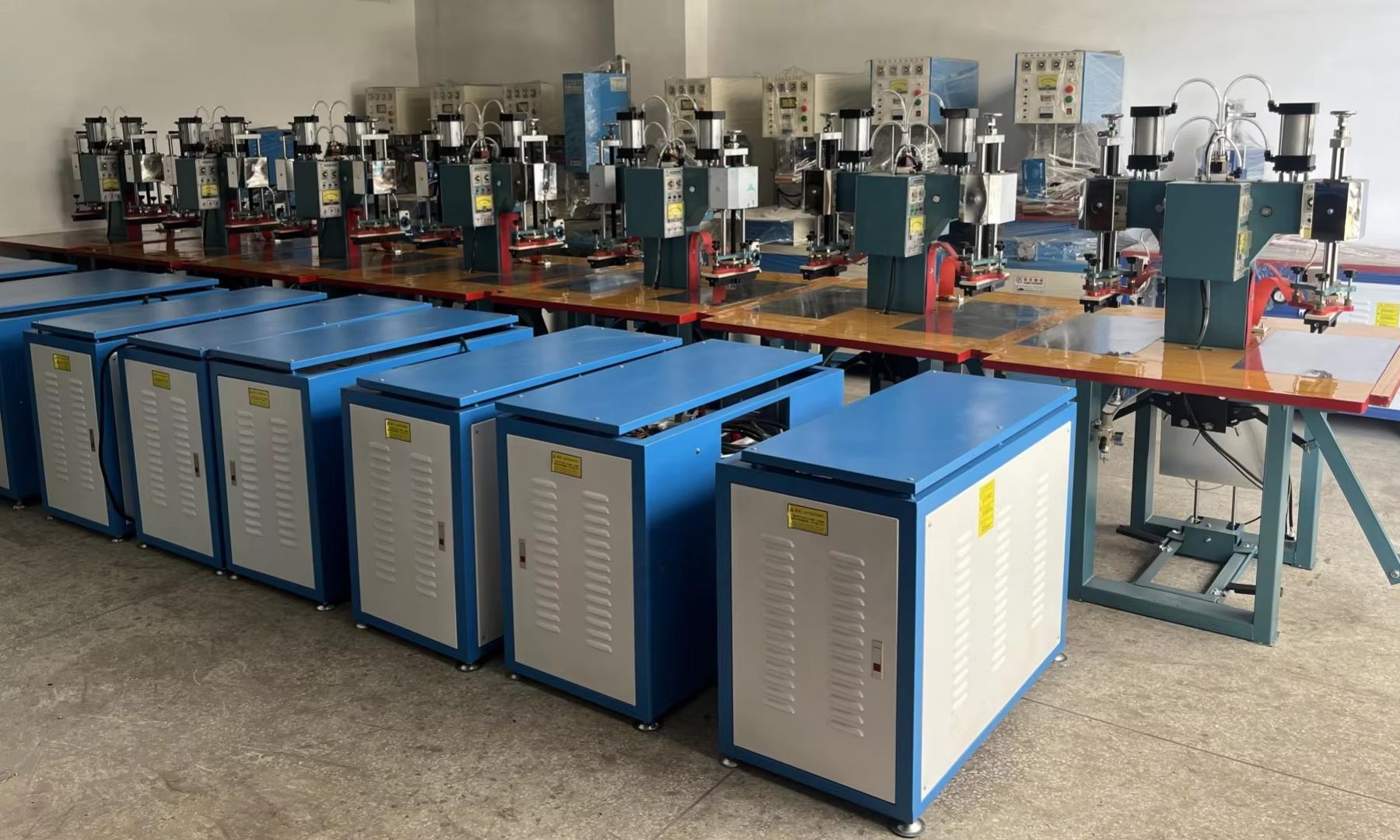
To choose the right RF welding machine, evaluate these seven factors:
Before purchasing, test representative materials and finished components on the proposed machine. Actual welding trials provide a more reliable basis for selection than rated power or machine price alone.
Understanding how RF welding works helps manufacturers identify which machine specifications matter for their application.
The operator places the materials between the welding electrodes or dies. The parts must be aligned correctly so that the intended joint receives uniform heating and pressure.
Fixtures, positioning guides, and automated handling systems can improve repeatability, especially in high volume production.
The RF generator supplies high frequency electromagnetic energy to the welding area. Polar molecules in the suitable thermoplastic material respond to the alternating electric field, and dielectric losses generate heat.
The rate of heat generation depends on factors such as dielectric properties, field strength, operating frequency, material thickness, and welding time.
When the material reaches the required welding condition, the machine applies pressure through the electrodes or dies. The softened surfaces bond to form a weld seam.
Correct electrode geometry, pressure distribution, and RF output help achieve the required joint dimensions and strength.
Once the RF output stops, pressure is maintained while the material cools and the joint stabilizes. Releasing the workpiece too early can cause deformation or affect the finished seam.
The finished part is inspected according to its intended use. Depending on the application, quality checks may include visual inspection, peel-strength testing, tensile testing, pressure-decay testing, or leak testing.
For products that must retain air or liquids, the welding process should be validated against defined acceptance criteria.
Material compatibility should be the first consideration when evaluating RF welding machines. A machine with a high power rating will not reliably weld a material that does not respond adequately to dielectric heating.
Materials include several thermoplastic polymers and formulations with suitable dielectric properties.
| Material | RF welding suitability | Typical considerations |
|---|---|---|
| PVC | Widely used | Common in flexible films, inflatable products, and medical bags |
| TPU | Grade-dependent | Requires testing of formulation, thickness, and dielectric response |
| Polyurethane (PU) | Formulation-dependent | Suitability varies with polymer chemistry and material construction |
| Polyethylene (PE) | Generally unsuitable for conventional RF welding | Low dielectric losses; alternative joining methods are often preferred |
| Polypropylene (PP) | Generally unsuitable for conventional RF welding | Low dielectric losses; material-specific alternatives may be needed |
These are general guidelines rather than universal rules. Additives, plasticizers, coatings, reinforcement layers, and moisture can affect welding behavior.
Before choosing a machine, provide the equipment supplier with the exact material grade, thickness, layer structure, and technical data available from your material manufacturer.
Two materials described by the same polymer name may behave differently under RF energy. A flexible PVC film and a heavily filled PVC sheet, for example, may require different welding conditions.
Material trials help determine whether the proposed RF welding technology can produce the required seam without burning, thinning, or damaging the material.
If the material is unsuitable for RF welding, hot air welding, hot wedge welding, or conventional heat sealing may be a better option.
The RF generator produces the electrical energy used to heat the material. Its output capacity affects how much energy the machine can deliver during each welding cycle.
However, choosing an RF welding machine is not simply a matter of buying the highest available power rating.
Consider the following variables:
A larger weld area or a thicker material may require greater output capacity, but the exact requirement depends on the complete welding setup.
Insufficient RF energy can result in weak or incomplete welds. Excessive energy may cause burning, material thinning, discoloration, or arcing.
The objective is to select a generator that provides sufficient and controllable output for the intended workpiece. Representative welding trials should establish the operating window before full production begins.
When comparing RF welders, ask suppliers to demonstrate performance with your actual material and tooling rather than relying solely on nominal generator power.
The welding electrode determines the shape and dimensions of the seam. It also affects how the electric field and pressure are distributed across the workpiece.
The machine's working area and press dimensions must accommodate the product and its tooling.
Evaluate:
For example, inflatable products may require long, continuous weld profiles to create airtight seams. Medical bags may need precise sealing patterns around their perimeter or connection areas.
Custom electrodes can improve product fit and repeatability, but the design should be based on the actual product drawings and material structure.
The maximum working area is not necessarily the same as the maximum usable weld area. Allow space for fixtures, material positioning, electrode mounting, and safe operator access.
For large products, also consider the press stroke, platen parallelism, and the ability to maintain consistent pressure across the entire weld path.
Production volume affects the machine configuration, labor requirements, cycle time, and level of automation.
A machine suited to prototypes or small batches may not be the most economical option for continuous manufacturing.
Manual machines are often suitable for small production runs, customized products, and applications requiring flexible operator positioning.
Potential advantages include a relatively simple setup and lower initial equipment costs. However, output may depend heavily on operator skill, loading time, and material alignment.
Semi-automatic equipment combines operator loading with programmed welding cycles. It can improve consistency while retaining flexibility for products that require manual positioning.
This configuration may suit manufacturers moving from small batches toward more standardized production.
Automatic RF welding machines integrate programmed control with automated positioning, material handling, or other production operations.
They may be appropriate for high volume production where cycle time, repeatability, and labor efficiency justify the additional investment.
Automation does not automatically guarantee better quality. The material, tooling, process settings, and inspection procedures must still be properly controlled.
Before selecting a machine, calculate the required output per shift, available operating hours, average cycle time, changeover frequency, and expected equipment utilization.
Include loading, unloading, inspection, and maintenance time in the calculation. The shortest theoretical welding cycle does not necessarily translate into the highest daily output.
High quality RF welding requires consistent material heating, appropriate pressure, suitable tooling, and controlled cooling.
The finished seam should meet the mechanical and functional requirements of the product.
Different products require different performance criteria. A decorative plastic component may need an acceptable appearance and mechanical bond, while an inflatable product may also require long-term air retention.
Depending on the application, test requirements may include:
The test method should match the product's intended service conditions and applicable industry requirements.
A machine should produce consistent results across repeated cycles and representative material batches.
Ask the supplier how the equipment controls welding time, RF output, pressure, and hold time. Where appropriate, evaluate monitoring functions that can identify abnormal cycles.
For products with strict quality requirements, establish a documented process window and define how deviations will be detected and handled.
RF welding is not suitable for every thermoplastic material or product design. Comparing the available welding techniques helps prevent investment in equipment that does not fit the application.
Conventional heat sealing uses heated surfaces to transfer heat into the material. RF welding uses high frequency electromagnetic energy to generate heat within compatible dielectric materials.
RF welding can be effective for suitable polar thermoplastics, especially PVC. Heat sealing may be preferable for materials that are not suitable for conventional RF welding.
The best option depends on the polymer, thickness, seam design, production speed, and required joint performance.
Hot air welding directs heated air toward the joining surfaces. RF welding generates heat through dielectric losses within the material.
Hot air welding is commonly used for suitable thermoplastic films, coated fabrics, and membranes. RF welding is often selected for compatible materials requiring shaped or repeatable weld seams.
Hot wedge welding uses a heated wedge positioned between joining surfaces. Pressure then brings the softened materials together.
This method is used for suitable films, coated fabrics, and membrane seams. RF welding may be preferable when the material responds well to dielectric heating and the product requires specific electrode-defined weld patterns.
No single method is best for all applications. Material trials and production requirements should determine the final selection.
RF welding equipment combines high-frequency electrical energy with mechanical movement. Safety systems should be assessed as part of the purchasing process.
Ask whether the machine includes appropriate RF shielding, grounding, interlocked guards, electrical protection, and emergency-stop functions.
The equipment should be designed and installed according to applicable regulations and manufacturer instructions. Safety features must not be bypassed during normal production.
Evaluate access to the welding area, the movement of the press, the loading method, and the need for additional guarding.
Training should cover normal operation, material setup, fault handling, cleaning, and safe maintenance procedures.
Check whether technicians can inspect electrodes, electrical connections, the press mechanism, and pneumatic or hydraulic systems safely.
Clear maintenance procedures and accessible replacement parts can reduce downtime and improve long-term reliability.
The initial purchase price is only one part of the cost of an RF welding machine.
A machine with a lower upfront price may become more expensive if it has high maintenance requirements, limited tooling support, inconsistent output, or frequent production interruptions.
Consider:
Estimate the expected improvement in output, reduction in scrap, labor savings, and maintenance costs.
For example, automation may be worthwhile when consistent high volume production reduces repetitive manual handling. For low-volume customized products, a simpler machine may provide better overall value.
Use realistic production figures and include downtime rather than assuming the machine will operate continuously at its maximum rated speed.
The supplier's technical support can affect commissioning, process development, and long-term machine performance.
A suitable supplier should be able to explain the equipment's capabilities and demonstrate how the proposed configuration matches your production needs.
Whenever possible, provide sample materials, product drawings, weld specifications, and target output requirements.
A practical trial should evaluate weld appearance, strength, consistency, cycle time, and any application-specific requirements, such as airtightness.
The trial results should be documented so that the proposed equipment configuration and process settings can be reviewed before the purchase is finalized.
Avoiding common purchasing mistakes can reduce commissioning delays and prevent unnecessary operating costs.
A low purchase price does not necessarily mean lower production costs. Compare machine capability, tooling, maintenance, process stability, and supplier support before making a decision.
Not every thermoplastic material can be welded effectively using RF energy. Confirm compatibility with the exact material formulation before committing to equipment.
Custom electrodes may represent a significant part of the tooling budget, especially when manufacturing multiple product designs. Ask about electrode replacement, repair, storage, and future design changes.
A machine that meets today's output target may not support future demand. Consider anticipated product changes, additional shifts, automation, and expansion of the product range.
A successful demonstration on a different material does not prove that the machine will work for your product. Request testing with representative samples and document the resulting process settings and quality measurements.
Start with material compatibility. Confirm that your material can be joined using radio frequency energy, then evaluate weld dimensions, required seam performance, generator capacity, production volume, automation, and safety features.
PVC is one of the most widely used materials for RF welding. Certain grades of TPU, polyurethane, and other polymers may also be suitable. Compatibility depends on dielectric properties, material formulation, thickness, and the intended application.
Yes. In most industrial manufacturing contexts, RF welding, radio frequency welding, and high frequency welding describe the same basic process. The terms generally refer to equipment that uses a high-frequency electric field to generate heat within compatible dielectric materials.
The required power depends on the weld area, material thickness, dielectric properties, electrode design, and required cycle time. Larger or thicker workpieces may need greater output capacity, but the appropriate rating should be established through engineering evaluation and welding trials.
Yes. RF welding machines can be configured for high volume production using programmable controls, automated material handling, specialized tooling, and integrated production systems. Actual output depends on the product, welding cycle, loading time, changeovers, and inspection requirements.
RF welding uses high-frequency electromagnetic energy to generate heat within compatible dielectric materials. Conventional heat sealing transfers heat from heated surfaces to the material. Material compatibility and the required production process determine which method is more suitable.
Use compatible materials, correctly designed electrodes, suitable RF output, consistent pressure, and appropriate hold time. Maintain the equipment, standardize process settings, and test finished products against defined quality criteria.
Automatic machines may improve throughput and repeatability in standardized production, while manual machines can offer flexibility for smaller batches and customized products. The better option depends on production volume, product complexity, labor costs, and investment budget.
Evaluate RF shielding, grounding, interlocked guards, emergency stops, electrical protection, and safeguards for moving press components. The required features depend on the machine design and applicable regulations. Operators should follow manufacturer instructions and never bypass safety systems.
Compare the initial investment and ongoing costs with expected savings from labor, scrap reduction, improved output, and lower downtime. Include tooling, energy, maintenance, training, and realistic machine utilization in the calculation.
Yes, suitable RF welding machines can produce airtight or liquid-tight seams when the material, joint design, process parameters, and quality controls are properly matched. Products intended to contain air or liquids should undergo appropriate leak testing.
Provide the material type and thickness, product drawings, required weld dimensions, target production volume, required seam strength, and any airtightness or liquid-tightness requirements. Sample materials and finished parts can help the manufacturer recommend and test an appropriate machine configuration.
Choosing the right RF welding machine starts with understanding the material and the product requirements. Generator capacity, electrode design, press performance, process control, automation, safety, and maintenance support all influence whether the equipment can meet production targets consistently.
For manufacturers working with compatible thermoplastic materials, RF welding technology can support repeatable seams, efficient production, and high quality products. However, the best machine is not necessarily the most powerful or the most automated. It is the machine that can meet your material, quality, output, and cost requirements under real production conditions.
Before making a final decision, request a material trial, verify the required seam performance, compare the total cost of ownership, and confirm the supplier's technical support capabilities. This approach provides a practical basis for selecting RF welding equipment that fits both current production needs and future growth.