For cooperation and more details, feel free to email us or call directly for consultation.

Home > News & Blog > Knowledge > RF Welding Machine Power Selection: What kW Rating Do You Need?
Choosing the right power rating is one of the first decisions when purchasing RF welding machines. A machine with insufficient output may struggle to produce consistent seals at the required speed, while an oversized system can increase equipment costs, electrical demands, and process-adjustment requirements without improving the finished product.
The right kW rating depends on several factors, including the type of thermoplastic material, the total welding area, electrode design, product geometry, required cycle time, and production volume. Applications such as medical bags, medical devices, and inflatable products can have very different power requirements, even when they use similar materials.
This guide explains how high frequency welding power works, what affects energy demand, how to estimate the appropriate machine capacity, and what to check before choosing an RF welder for your production line.
The kW rating of an RF welding machine indicates its specified power capacity, but the exact meaning depends on the manufacturer's rating convention. It may refer to the RF generator's rated output or another defined power specification. Buyers should confirm whether the published value represents RF output power, electrical input power, or a different machine rating.
Radio frequency welding, also known as high frequency welding, uses high frequency electromagnetic energy to heat suitable thermoplastic materials. Under an alternating electric field, polar molecules within compatible materials respond to the field and generate heat within the material. Pressure from the electrodes then helps form a bonded seam as the material heats and cools under controlled conditions.
In practical terms, the kW rating describes available power capacity. It does not directly tell you how strong the finished weld will be, how much energy every product requires, or how many products the machine can complete per hour.
A higher rating may provide more capacity for a larger welding area or a shorter heating stage, but the finished result also depends on frequency, material properties, electrode geometry, pressure, tuning, cooling, and process control.
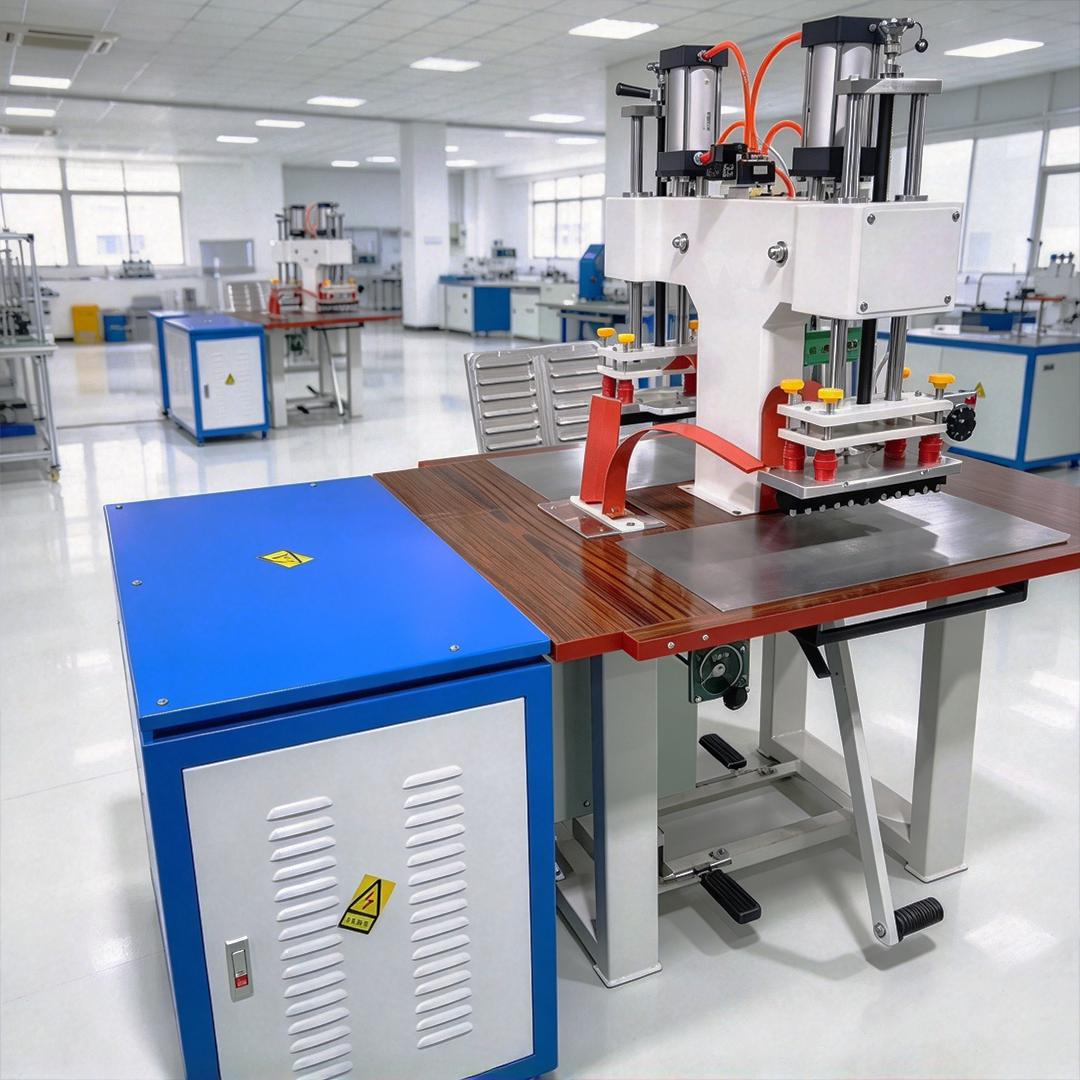
The required kW rating for an RF welding machine depends on the material being welded, the effective welding area, the electrode design, and the production cycle time. Small components and narrow seals may work with lower-power equipment, while large sealing areas, multiple welds in one cycle, and high-volume production may require higher-power machines.
As an initial screening guide, buyers can compare equipment within broad power categories:
These categories are descriptive rather than universal kW specifications. Manufacturers use different machine configurations, electrode designs, and rated-output conventions, so there is no single kW value that fits every product in each category.
The best selection method is to start with the actual product, calculate the effective welding area, define the required output per hour, and validate the machine through production-representative welding tests.
Radio frequency technology differs from conventional heating methods because it generates heat within suitable materials through the interaction between the RF electric field and the material's dielectric properties.
During the welding process, the machine typically follows several stages:
This process creates strong, integrated seams when the material and process settings are suitable.
The amount of power needed depends on how much material must be heated, how efficiently energy couples into the material, and how quickly the production process must reach the target welding condition.
A large electrode does not automatically require a particular kW rating. Electrode shape, the distribution of the active welding area, material thickness, and the way the electric field behaves across the workpiece all affect the actual power demand.
Material selection is one of the first factors to evaluate. RF welding works with suitable polar thermoplastics, but different formulations can respond differently to the RF field.
Common materials include PVC and certain other RF-weldable thermoplastic formulations. Some polyurethane materials can also be welded using RF under suitable conditions. However, not every grade, coating, laminate, or multilayer construction behaves the same way.
The material's dielectric properties, thickness, additives, moisture condition, and surface structure can affect heating behavior and weld consistency.
For example, two PVC-based products may require different settings because one uses a thicker construction or a different formulation. A multilayer medical bag may also behave differently from a single-layer film, even if both appear similar from the outside.
Before selecting an RF welder, confirm:
Material trials should be completed before finalizing the machine power specification.
The effective welding area is the portion of the electrode that actively forms the weld. It is usually more useful for power selection than the overall dimensions of the product.
A small product may have a long perimeter seal, several narrow seams, or multiple welding points. Conversely, a larger product may require only a small localized weld.
When evaluating the welding area, consider:
A larger active area generally increases the amount of material being heated at one time and can increase power demand. However, the relationship is not always linear because material properties, field distribution, electrode design, and process settings also influence energy transfer.
For this reason, two machines with the same kW rating may perform differently on the same product if their electrode configurations and RF systems are different.
Thicker materials often require more energy or a longer heating stage to achieve the required weld condition. However, simply doubling the material thickness does not mean the machine power must double.
The result depends on the material's dielectric behavior, the thickness of the welded layers, the seam geometry, and the required production cycle.
Reinforced fabrics, multilayer films, coated materials, and products containing inserts may introduce additional variables. These constructions can affect how heat develops across the welding zone and whether the material bonds evenly.
For applications involving medical devices or inflatable products, material construction should be tested in its actual production configuration rather than evaluated using a single material sample.
Cycle time is the total time needed to complete one production cycle. Depending on the machine and application, it can include loading, electrode closing, RF heating, pressure holding, cooling, opening, and unloading.
The RF heating stage is only one part of the cycle, but it can strongly influence overall production efficiency.
If the current process requires a long heating stage, additional usable RF output may help reduce that stage when insufficient power is the limiting factor. However, a higher kW rating will not necessarily shorten the complete cycle if loading, cooling, handling, or other stages take most of the time.
For example, a production line may be limited by manual positioning rather than heating capacity. In that situation, automation or improved fixture design may increase output more effectively than buying a higher-power machine.
Before choosing a rating, define the target cycle time and identify which stage currently limits production.
The required machine capacity changes with the number of products produced in each cycle and the total production target.
A machine that produces one item per cycle has a different workload from a system that welds several products simultaneously. Multiple electrodes, repeated seams, and larger fixtures can increase the effective welding area and energy demand.
High-volume production also requires consistent operation across repeated cycles. A suitable machine should provide enough capacity for the required workload while maintaining stable welding conditions.
Evaluate:
The objective is to select enough usable capacity for the actual production workload, rather than choosing the highest available rating.
Electrode design affects the distribution of the RF field and the amount of material heated during each cycle.
A well-designed electrode concentrates energy in the intended welding zone and helps achieve consistent seams. Poor geometry, unsuitable spacing, or an inappropriate fixture may cause uneven heating even when the generator has sufficient rated output.
Machine configuration also matters. Generator design, frequency, impedance matching, tuning controls, electrode movement, pressure control, and cooling arrangements all influence the machine's performance.
When comparing RF welding machines, ask the manufacturer to evaluate the complete system, including the generator, press, electrode, fixture, and intended material.
Different products place different demands on an RF welder. The following examples explain what to evaluate rather than prescribing universal power ratings.
Medical bags often use flexible thermoplastic films and require reliable seals around the product perimeter or designated ports. Some medical devices also contain multiple layers, connectors, or formed components.
Power selection should account for the material formulation, seam length, seal width, product thickness, and required output per cycle.
For medical applications, high quality cannot be judged by appearance alone. Depending on the product, validation may include seal-strength testing, leak testing, dimensional checks, process documentation, and other requirements defined by the applicable quality system.
A larger machine is not automatically better for medical production. The chosen equipment must provide a repeatable process and support the product's documented manufacturing requirements.
Inflatable products include air mattresses, inflatable boats, advertising structures, water sports equipment, and other sealed flexible products.
Their power requirements vary with product size, film or coated-fabric construction, seam length, and the number of seams welded simultaneously.
Large products may need a generous working area and carefully designed electrodes. However, the overall product dimensions alone do not determine the required kW rating.
For inflatable products, the goal is to achieve a consistent seam that withstands the intended pressure and use conditions. Testing should reflect the actual material, seam design, and finished product.
RF welding can be used for suitable thermoplastic components, including selected interior trim, protective covers, and technical fabric products.
The required capacity depends on the component geometry, number of weld locations, production rate, and fixture arrangement. Automated handling may also influence the most suitable machine configuration.
Where several welds must be completed during one cycle, assess the combined active welding area rather than sizing the machine for only one seam.
There is no reliable universal formula that converts product dimensions directly into the correct kW rating for every RF welding application. Nevertheless, a structured estimation process can narrow down the machine options before physical trials.
Document the material type, formulation, thickness, number of layers, and product dimensions. Identify whether the product contains coatings, reinforcements, or inserts.
For a simple rectangular seam, an initial geometric estimate is:
Welding area = seam length × seam width
For example, a seam 300 mm long and 5 mm wide has a nominal area of:
300 mm × 5 mm = 1,500 mm²
This figure describes the geometric seam area only. It does not account for electrode details, field distribution, material behavior, or the complete electrical load.
For several welds made in one cycle, calculate the total active area of all welds.
Determine the required number of completed products per hour and the number of products produced per cycle.
As a simplified estimate:
Theoretical output per hour = 3,600 ÷ cycle time in seconds × products per cycle
For example, a 12-second cycle producing two products has a theoretical output of:
3,600 ÷ 12 × 2 = 600 products per hour
Actual output will be lower when loading delays, operator handling, quality checks, maintenance, and unplanned stops are included.
Determine the heating time needed to produce an acceptable weld using the intended material and electrode. If the process takes too long, investigate whether power capacity is the limiting factor or whether electrode geometry, tuning, material compatibility, pressure, or other settings need adjustment.
This step is best completed with production-representative samples and a supplier's application engineering support.
Request technical specifications for each candidate machine. Confirm whether the kW value refers to rated RF output, electrical input, or another defined parameter.
Also compare operating frequency, electrode dimensions, tuning capability, available press force, working area, cooling arrangements, and electrical supply requirements.
Two machines with the same advertised kW rating may not offer equivalent performance for a particular application.
Run trials using the actual production material, electrode, and intended cycle. Measure seam strength, leak resistance where relevant, consistency, appearance, and cycle time.
The final rating should be based on demonstrated process capability and realistic production requirements, not on a theoretical estimate alone.
No. A higher-rated RF welding machine provides more potential power capacity, but it does not automatically deliver stronger welds or better production results.
Excessive or poorly controlled energy can damage the material, produce inconsistent seals, cause localized overheating, or increase the risk of arcing. The correct result depends on how the machine's power is delivered and controlled.
A lower-rated machine may be suitable for a small product with a limited welding area. A higher-rated system may be more appropriate for a large active area or a process that requires several welds in one cycle.
The objective is to match the available capacity to the application while preserving a stable process window.
Before paying for additional power, check whether the actual production limitation comes from:
Addressing the real limitation can improve production efficiency without unnecessary equipment expenditure.
Radio frequency welding is one of several welding methods used in manufacturing. Its suitability depends on the material and product requirements.
Heat sealing generally applies heat to the material through heated tooling or another external heating method. RF welding uses a high frequency electromagnetic field to generate heat within suitable materials.
RF welding can be advantageous for compatible polar thermoplastics when the application requires shaped seams or integrated sealing. Heat sealing may be more appropriate for materials and products designed for conventional thermal bonding.
Neither method is universally superior. Compare the material compatibility, seal geometry, cycle time, tooling, and quality requirements.
Hot air and hot wedge welding apply heat externally to soften the joining surfaces before pressure forms the seam. These methods are widely used for selected films, coated fabrics, and other compatible materials.
RF welding heats suitable materials through dielectric losses. It may suit products that benefit from shaped electrodes or a defined press cycle, while hot air or hot wedge systems may be preferable for continuous seams or specific material constructions.
Power ratings in kW should not be compared directly across these different technologies as if they described equivalent heating performance.
A good purchase decision considers the entire production system rather than the generator's kW rating alone.
Provide the supplier with the exact material specification and representative samples. If several materials are used, test the most demanding construction and confirm whether different products need separate settings or tooling.
Request information about:
A demonstration using a different material or a small sample may not reflect actual production performance. Ask the supplier to test the intended product or a representative sample using the proposed tooling and cycle.
For applications that require traceable quality records, define the necessary test methods, acceptance criteria, and documentation before ordering.
The purchase price is only one part of the investment. Consider energy use, tooling, maintenance, operator training, production downtime, consumables where applicable, and the cost of rejected products.
A machine with a higher initial price may offer value if it consistently meets the production target. Conversely, unnecessary power capacity may increase the investment without improving the finished output.
Choosing by product size alone. Overall dimensions do not necessarily reflect the active welding area. Evaluate the actual seams and number of welds per cycle.
Assuming thicker material always needs proportionally more kW. Material formulation, dielectric properties, seam design, and cycle time also influence power requirements.
Comparing ratings without checking their definitions. Rated RF output and electrical input power are not interchangeable specifications.
Buying excess capacity without identifying the bottleneck. If cooling, handling, or tooling limits the line, a larger generator may not improve total output.
Skipping material trials. The welding process must be validated with the actual material construction and intended electrode design.
Ignoring quality and safety requirements. A suitable machine must support stable welding conditions, appropriate guarding, RF safety measures, and the applicable product-quality controls.
The best kW rating is the one that meets the application's welding-area, material, cycle-time, and production requirements with sufficient usable capacity. There is no universal rating for all RF welding machines. Confirm the manufacturer's rating convention and validate the machine with actual product samples.
A larger active welding area generally increases the amount of material heated during a cycle and can increase power demand. However, the exact requirement depends on material properties, electrode geometry, field distribution, and the desired heating time.
It can reduce the RF heating stage when available power is the limiting factor. It may not shorten the complete cycle if cooling, loading, unloading, or another process stage takes most of the time. Production trials are needed to establish the actual improvement.
RF welding is commonly used for suitable polar thermoplastics, particularly PVC and selected polyurethane formulations. Compatibility depends on the exact grade, formulation, coating, and material construction. Not every plastic can be welded effectively using RF energy.
Yes, RF welding is used for certain medical bags and flexible medical products made from compatible materials. The equipment and process must meet the application's seal-performance, validation, cleanliness, documentation, and applicable regulatory or quality-system requirements.
Yes. RF welding is used for many compatible inflatable products, including selected flexible PVC and polyurethane constructions. Machine selection depends on seam length, material properties, electrode design, pressure requirements, and target output.
No. Weld strength depends on material compatibility, energy delivery, pressure, electrode design, and process control. Excessive energy may damage the material rather than improve the seam. Testing should establish the correct operating window.
RF welding uses high frequency electromagnetic energy to generate heat within suitable materials. Heat sealing typically transfers heat from a heated surface or tool. The better option depends on material compatibility, seam design, production rate, and quality requirements.
RF output power refers to the power delivered by the generator as defined by its specification. Electrical input power refers to the power drawn from the electrical supply. Conversion losses mean the two values are not identical. Always check which rating a supplier quotes.
Start by identifying the process bottleneck. Optimize electrode design, material handling, RF settings, pressure, cooling time, and operator workflow. If the RF heating stage limits output, additional usable power may help. Measure the complete cycle before deciding which change will provide the greatest benefit.
Provide the material grade and thickness, product drawings, seam dimensions, number of welds per cycle, required cycle time, target hourly output, and required weld-quality criteria. Representative samples and details of the intended production environment help the supplier make a more reliable recommendation.
Confirm that the machine can meet the target cycle time with the intended material and electrode while maintaining consistent weld quality over repeated cycles. Evaluate realistic output, downtime, cooling, handling, and maintenance requirements rather than relying solely on the rated kW value.
Selecting the right RF welding machine power rating requires more than matching a product to a number on a specification sheet. Material properties, effective welding area, electrode design, cycle time, and production volume all influence the amount of usable RF power required.
A well-matched RF welder should meet the production target without excessive power capacity, maintain consistent weld quality, and support the actual requirements of the finished product. For medical bags, medical devices, inflatable products, and other industrial applications, representative material trials provide a more reliable basis for selection than general power estimates alone.
Before making a purchase, share your material specifications, seam dimensions, product drawings, and target output with the equipment manufacturer. This gives the supplier the information needed to recommend a suitable machine configuration and verify its performance under realistic production conditions.