For cooperation and more details, feel free to email us or call directly for consultation.

Home > News & Blog > Knowledge > RF Welding Applications in Medical Bags and Healthcare Products
RF welding, also known as radio frequency welding or high-frequency welding, is a manufacturing process that uses electromagnetic energy to generate heat inside compatible thermoplastic materials. Under controlled pressure, the softened material fuses to form a continuous, strong seal without relying solely on external heat sources. In the medical industry, RF welding is widely used to manufacture blood bags, IV bags, drainage bags, medical fluid containers, pressure cuffs, inflatable medical devices, and other healthcare products that require consistent seams and dependable leak resistance.
The advantages of RF welding include precise heat generation, repeatable sealing, clean weld profiles, and the ability to produce complex shapes. When manufacturers select suitable materials, RF welding equipment, and validated process parameters, the technology can support the production of high-quality medical devices and disposable healthcare products.
RF welding is a joining process that uses a high-frequency electromagnetic field to heat compatible thermoplastic materials from within. The material is placed between an electrode and a supporting surface. When the RF welding machine applies electromagnetic energy, polar molecules in the material respond to the alternating field, generating heat that softens the material at the joint.
Pressure brings the softened surfaces together, allowing them to fuse. After the RF energy stops, the joint cools under controlled conditions and forms a welded seam.
In medical device RF welding, the process is used to join flexible films, coated fabrics, and other compatible thermoplastics into sealed products. Compared with some conventional joining methods, RF welding can create consistent seams without adhesives or stitching at the welded joint.
Not every plastic is suitable for this process. Polyvinyl chloride (PVC) and certain polyurethane (PU) formulations are common RF-weldable materials, while other polymers require specific formulations or testing to establish compatibility. Material selection must be based on the product design, intended use, and applicable manufacturing requirements.
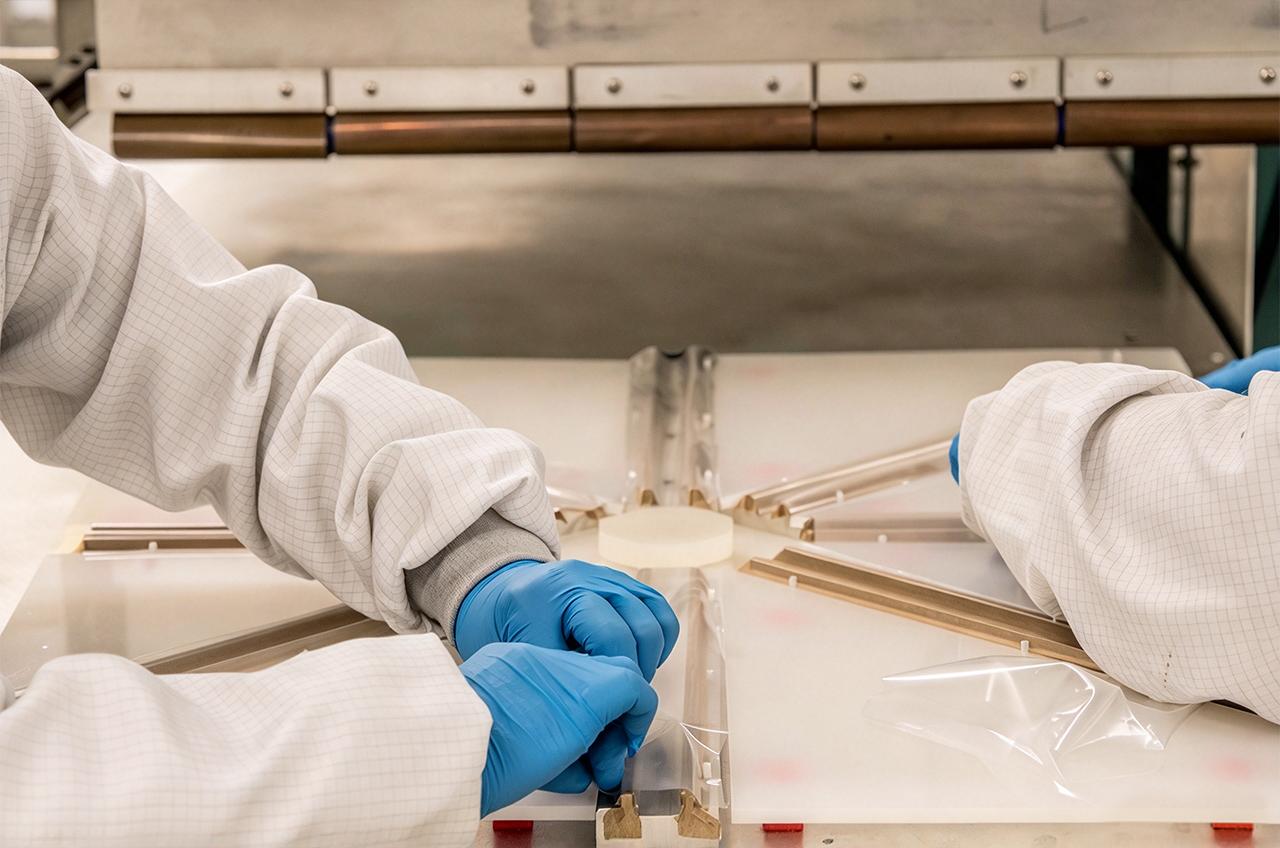
The RF welding process combines electromagnetic energy, pressure, time, and controlled cooling to produce a sealed joint. Each parameter affects the appearance, strength, and consistency of the finished product.
Manufacturers select thermoplastic materials according to the intended medical application. Factors include flexibility, chemical compatibility, transparency, barrier properties, biocompatibility requirements, and resistance to repeated use or sterilization where applicable.
Before welding, material surfaces should be clean, properly aligned, and free from wrinkles, contamination, or damage that could interfere with the joint.
The material layers are positioned between the RF electrode and the lower tooling surface. The electrode defines the shape of the weld, which may be straight, curved, circular, or customized to match the product design.
The machine applies pressure to maintain contact between the material layers during the welding cycle. Uniform pressure helps reduce inconsistent seams and localized weak spots.
During the RF welding cycle, the machine generates a high-frequency alternating electric field. Suitable polar molecules within the thermoplastic material respond to this field, producing molecular movement and heat.
This internal heat generation softens the material at the intended joint. The process is different from conventional heat sealing, which generally transfers heat from an externally heated surface into the material.
As the material reaches the required processing condition, pressure helps the softened layers fuse together. The RF energy is then switched off, and the joint is allowed to cool under the required pressure or restraint.
The completed seam should have suitable strength, continuity, and dimensions for the product's intended function. Manufacturers establish the process window through trials, testing, and documented process validation.
Finished products may undergo visual inspection, dimensional checks, seal-strength testing, and application-specific leak testing. Medical products that contain fluids or gases may require additional verification based on their intended use and risk profile.
A repeatable RF welding process helps manufacturers control variation, but machine settings alone do not prove that a finished medical device is safe or fit for use.
Medical bags often use flexible thermoplastic films that need reliable seams to contain liquids, prevent leakage, or maintain a defined internal pressure. RF welding is suitable for many of these products when the selected material is compatible with the process.
Blood bags and associated collection components may require multiple sealed sections, tubing interfaces, ports, and flexible walls. RF welding can form seams in compatible films and support customized bag geometries.
For these applications, manufacturers need to assess seal integrity, material compatibility, and the effects of the intended storage and handling conditions. Products intended for blood collection or storage also require applicable biological, chemical, and regulatory evaluations beyond the welding operation itself.
Intravenous (IV) bags are designed to contain fluids while supporting handling, storage, and connection to delivery systems. RF welding can be used to join compatible film layers and create the perimeter seams of flexible containers.
The welding process must be controlled to avoid incomplete fusion, excessive thinning, deformation, or other defects that could compromise containment. Port attachment methods and interfaces must also be evaluated as part of the complete product design.
Urine collection bags, drainage pouches, and related fluid collection products commonly use flexible films with welded edges and connection points. RF welding can produce custom seam patterns and help maintain a consistent shape across production batches.
For products exposed to liquid for extended periods, manufacturers should evaluate leakage, joint durability, and the effects of storage and use conditions.
Specimen collection bags and compatible sample pouches may require secure closures and clearly defined compartments. RF welding can form seams in suitable films and support designs that incorporate separate sections or customized outlines.
The required performance depends on the sample type, containment requirements, handling conditions, and whether the product is designed for transport, storage, or laboratory use.
Fluid reservoirs and irrigation bags may use flexible walls to hold a specified volume of liquid. RF welding allows manufacturers to create seams that follow the required container geometry.
The design should account for filling conditions, internal pressure, fluid compatibility, and the performance of any ports or connectors. Seal testing should reflect the product's intended conditions rather than relying on visual inspection alone.
Beyond medical bags, RF welding is used to manufacture a range of healthcare products made from compatible thermoplastic materials.
Pressure cuffs used in blood pressure monitoring and other medical applications may contain inflatable chambers that must retain air at a specified pressure. RF welding can form the seams of compatible cuff bladders and inflatable components.
The process is also suitable for selected inflatable positioning pads, therapy cushions, and support devices. These products need consistent seams that can withstand the intended inflation pressure, handling, and repeated use.
For pressure cuffs, the design and testing program should consider pressure retention, weld geometry, material fatigue, and the effects of repeated inflation cycles. A visually smooth seam does not necessarily indicate adequate pressure resistance.
Some medical mattresses, positioning products, and patient support systems use welded thermoplastic films or coated fabrics to create air chambers and fluid-resistant surfaces. RF welding can produce long seams, shaped joints, and compartment boundaries.
The equipment and electrode design should match the product's size, material thickness, and seam layout. Where the product includes multiple air chambers, each chamber and its connecting features may require separate performance checks.
Certain reusable or disposable healthcare covers use compatible thermoplastic materials to provide a barrier against fluids or contamination. RF welding can join selected films and coated materials without introducing stitching holes along the welded seam.
Material selection and product testing must establish the required barrier performance. Welding does not by itself make a product sterile, biocompatible, or suitable for a specific clinical application.
Some healthcare products combine flexible films with ports, tubing interfaces, or custom-shaped pouches. RF welding may be used for suitable film-to-film joints and certain compatible component assemblies.
Not all tubing materials or rigid fittings can be directly RF welded. The joining method must be selected according to the materials, geometry, and performance requirements of each interface.
RF welding offers several advantages for medical device manufacturers when the material and product design are suitable for the process.
Automated RF welding machines can control key parameters such as energy application, pressure, and cycle time. With a validated process and suitable tooling, manufacturers can produce repeatable seams across multiple production cycles.
Repeatability depends on material consistency, electrode condition, machine maintenance, and the effectiveness of process monitoring.
Because the RF field generates heat within compatible materials, the process can concentrate heating in the intended weld area. This can reduce dependence on transferring heat through the entire material thickness from an external hot surface.
Actual heat distribution depends on the material formulation, thickness, geometry, and electrical characteristics. Process trials are necessary to determine suitable settings.
Custom electrodes allow RF welding equipment to create curved seams, perimeter seals, circular joints, and selected multi-section designs. This flexibility is useful for medical bags, pressure cuffs, inflatable products, and other components with specialized geometries.
Tooling design should account for material flow, pressure distribution, seam width, and access to the weld area.
RF welding can join compatible thermoplastic layers without adding adhesive to the welded interface. This may simplify certain manufacturing steps and avoid adhesive-related variables at that joint.
However, the finished product may still use adhesives or other joining methods in separate areas. Manufacturers must evaluate all materials and processes that contact the product contents or the user.
RF welding machines can be integrated into manual, semi-automatic, or automated production lines. Depending on the product, automation may support consistent positioning, cycle control, handling, and production records.
Automation does not remove the need for operator training, preventive maintenance, inspection, and process validation.
Choosing suitable RF welding equipment involves more than selecting a machine based on output power. Manufacturers should consider the product's materials, dimensions, seam design, output targets, and quality requirements.
Identify the exact material grade, formulation, thickness, coating, and layer structure. PVC and some PU materials are commonly used in RF welding, but compatibility can vary among formulations and suppliers.
Conduct welding trials using production-representative materials before finalizing the equipment configuration.
The dimensions of a medical bag or inflatable component affect the required electrode size, working area, and machine arrangement. Complex outlines may require custom tooling, while large products may need specialized table layouts or multiple welding stations.
Tooling should provide stable positioning and uniform pressure across the intended seam.
Machine output must be appropriate for the material, weld area, thickness, and cycle requirements. Excessive energy may damage or thin the material, while insufficient energy may lead to incomplete fusion.
Look for suitable controls for RF energy, welding time, pressure, cooling, and repeatable cycle operation. The final process settings should be established through documented testing rather than estimated from power rating alone.
Manual systems may suit prototypes, low-volume products, or operations that require frequent setup changes. Semi-automatic machines can improve handling consistency, while automated systems may be appropriate for stable, higher-volume production.
The best configuration depends on throughput targets, product variation, tooling-change frequency, available floor space, and traceability requirements.
Medical device manufacturers may need documented equipment qualification, process validation, maintenance records, operator training, and product-specific inspection procedures.
The appropriate approach depends on the device classification, intended use, market, and applicable regulatory requirements. RF welding equipment suppliers should be able to explain machine capabilities, process controls, maintenance needs, and available documentation.
Quality assurance should evaluate both the welded seam and the performance of the complete medical product. A seam that looks uniform may still fail under pressure, flexing, or long-term storage.
Inspect seams for incomplete fusion, wrinkles, scorching, holes, excessive flash, uneven width, and visible material damage. Visual acceptance criteria should be defined for each product.
Peel or tensile testing can measure the force required to separate a welded joint. The test method, sample preparation, specimen dimensions, and acceptance limits should be established for the specific material and application.
Medical bags, inflatable chambers, and fluid containers may require leak testing or pressure testing. The method should reflect the product's intended function and expected operating conditions.
Depending on the application, testing may include pressure decay, vacuum decay, immersion, or other validated techniques. No single method is appropriate for every medical product.
Manufacturers should establish acceptable processing ranges, identify relevant process variables, and determine how production consistency will be monitored. Where required, process validation should demonstrate that the defined process consistently produces output meeting established requirements.
Changes to materials, tooling, machine settings, or production conditions may require review and additional verification.
RF welding is one of several technologies available for manufacturing medical bags and healthcare products. The most appropriate method depends on material compatibility, design, production requirements, and product performance.
| Joining method | How it works | Potential advantages | Main considerations |
|---|---|---|---|
| RF welding | Uses an electromagnetic field to generate heat in compatible materials | Custom seam shapes, repeatable processing, no adhesive required at the welded interface | Limited to suitable materials and requires compatible equipment and tooling |
| Heat sealing | Uses heated surfaces to soften and join material layers | Widely used for flexible packaging and films | Heat transfer, dwell time, and pressure must be controlled |
| Ultrasonic welding | Uses high-frequency mechanical vibrations to generate heat at the joint | Suitable for selected rigid and semi-rigid components and some films | Joint geometry, material properties, and vibration transmission affect results |
| Hot-air welding | Uses heated air to soften material surfaces before joining | Useful for selected films, coated fabrics, and continuous seams | Depends on heat delivery, material handling, and process consistency |
| Adhesive bonding | Uses an adhesive to connect surfaces | Can join materials that are not suitable for direct welding | Requires adhesive compatibility, curing or setting control, and additional material assessment |
RF welding is a strong option when the product uses compatible thermoplastics and requires controlled, shaped seams. It is not automatically superior to every alternative. Manufacturers should compare process capability, product requirements, validation needs, and total production cost before choosing a joining method.
Possible causes include insufficient energy, unsuitable pressure, poor material contact, or incompatible material formulations. Manufacturers should review the process window, check electrode condition, and verify material specifications.
Excessive energy, uneven pressure, poor electrode alignment, or unsuitable tooling can damage the material. Adjustments should be made through controlled trials, with attention to the strength and thickness of the finished seam.
Misalignment, electrode wear, inconsistent pressure, and material movement can produce uneven seams. Fixture design, tooling maintenance, and controlled loading can help improve consistency.
Corners, narrow features, and component interfaces can create areas where pressure or energy distribution differs from the main seam. Review the electrode design and joint geometry, then test the finished product using an appropriate leak-detection method.
Variation in film thickness, formulation, surface condition, tooling, or machine settings can affect welding performance. Incoming material checks, preventive maintenance, documented recipes, and production monitoring can help reduce variation.
The requirements for medical products vary according to their intended use, risk classification, and target market. Manufacturers should distinguish between the capabilities of the welding process and the regulatory status of the finished device.
For example, a welded seam may meet a specified strength requirement, but that result alone does not establish biocompatibility, sterility, chemical safety, or suitability for patient contact.
Medical device manufacturers should assess applicable quality management requirements, such as ISO 13485 where relevant, as well as market-specific regulatory obligations. Products intended for sterile applications may require additional controls for packaging integrity, sterilization compatibility, and shelf-life performance.
Material suppliers should provide appropriate specifications and supporting documentation. Any change in material formulation, thickness, supplier, sterilization method, or process parameters should be assessed to determine whether further testing or validation is needed.
RF welding can be used for compatible blood bags, IV bags, drainage bags, medical fluid containers, specimen pouches, inflatable pressure cuffs, patient support products, and selected protective covers. The specific application depends on material compatibility and the performance requirements of the finished product.
The RF welding machine generates an alternating electromagnetic field that heats suitable thermoplastic materials internally. Pressure brings the softened surfaces together, allowing them to fuse. The joint then cools under controlled conditions to form a welded seam.
PVC and certain polyurethane formulations are commonly RF weldable. Other polymers may require specialized formulations or may not be suitable for direct RF welding. Manufacturers should test the exact material grade and structure before selecting a process.
The main advantages include repeatable seam formation, customizable weld shapes, internal heat generation in compatible materials, and the ability to join material layers without adhesive at the welded interface. Actual results depend on tooling, material properties, and process control.
RF welding can produce strong, leak-resistant seams when the materials, tooling, and process parameters are suitable. However, leak performance must be demonstrated through product-specific testing. A successful weld does not guarantee that every finished bag will be leak-proof.
Yes. RF welding is used for compatible inflatable chambers and pressure cuffs because it can create shaped seams that retain air. The finished product should be evaluated for pressure retention, seam strength, dimensional consistency, and performance over the intended number of inflation cycles.
RF welding uses an electromagnetic field to generate heat within compatible materials, while conventional heat sealing generally transfers heat from heated surfaces. RF welding can offer advantages for certain materials and complex seam shapes, but the best method depends on the product and production requirements.
Manufacturers can improve quality by confirming material compatibility, optimizing energy and pressure settings, maintaining electrodes, controlling material alignment, and using documented inspection and testing procedures. Process validation and ongoing production monitoring help establish consistency.
No. RF welding is a joining process and does not by itself establish sterility or biocompatibility. These characteristics must be addressed through the product's material selection, manufacturing controls, sterilization process where applicable, and relevant testing.
Manufacturers should evaluate material compatibility, product size, seam geometry, required production volume, process-control features, tooling options, and documentation support. Representative material trials and product testing help confirm whether a machine can meet the application's requirements.
RF welding is a practical manufacturing technology for compatible medical bags, inflatable healthcare products, pressure cuffs, and other thermoplastic components that require consistent welded seams. Its performance depends on material selection, electrode design, machine settings, cooling conditions, and product-specific quality testing.
For medical device manufacturers, the goal is to establish a repeatable process that meets the finished product's strength, leakage, dimensional, and regulatory requirements. Selecting suitable RF welding equipment and validating the process against actual production conditions can help support consistent manufacturing outcomes.
Looking for RF welding equipment for medical bags or healthcare products? Share your material type, product dimensions, seam design, and production requirements, and contact us to discuss your needs.