For cooperation and more details, feel free to email us or call directly for consultation.

Home > News & Blog > Knowledge > How to Evaluate RF Welding Quality and Seal Integrity
RF welding quality is evaluated by checking seal appearance, seal strength, leak resistance, and consistency across production batches. Common methods include visual inspection, seal strength testing, burst testing, vacuum decay test procedures, and other suitable leak tests. The correct method depends on the product design, material properties, internal pressure, and applicable industry requirements.
Radio frequency welding, also known as high frequency welding, uses electromagnetic energy to generate heat within suitable thermoplastic materials. When the material reaches the required softening range, pressure brings the surfaces together to form a welded seam. The material cools and solidifies to create the finished joint.
To verify seal integrity, manufacturers should combine process monitoring with appropriate physical tests. A strong-looking seam does not necessarily indicate a leak-free package, and a package that passes a leak test may still have insufficient mechanical strength for its intended use.
RF welding quality refers to the consistency, strength, appearance, and performance of a welded joint produced using radio frequency welding technology. Seal integrity describes the ability of a sealed package or component to prevent unintended leakage through the seal or other potential leakage paths under specified conditions.
For flexible packages, medical packaging, inflatable products, and other sealed thermoplastic components, quality evaluation typically considers four areas:
These characteristics should be assessed separately because each test measures a different aspect of welding performance.
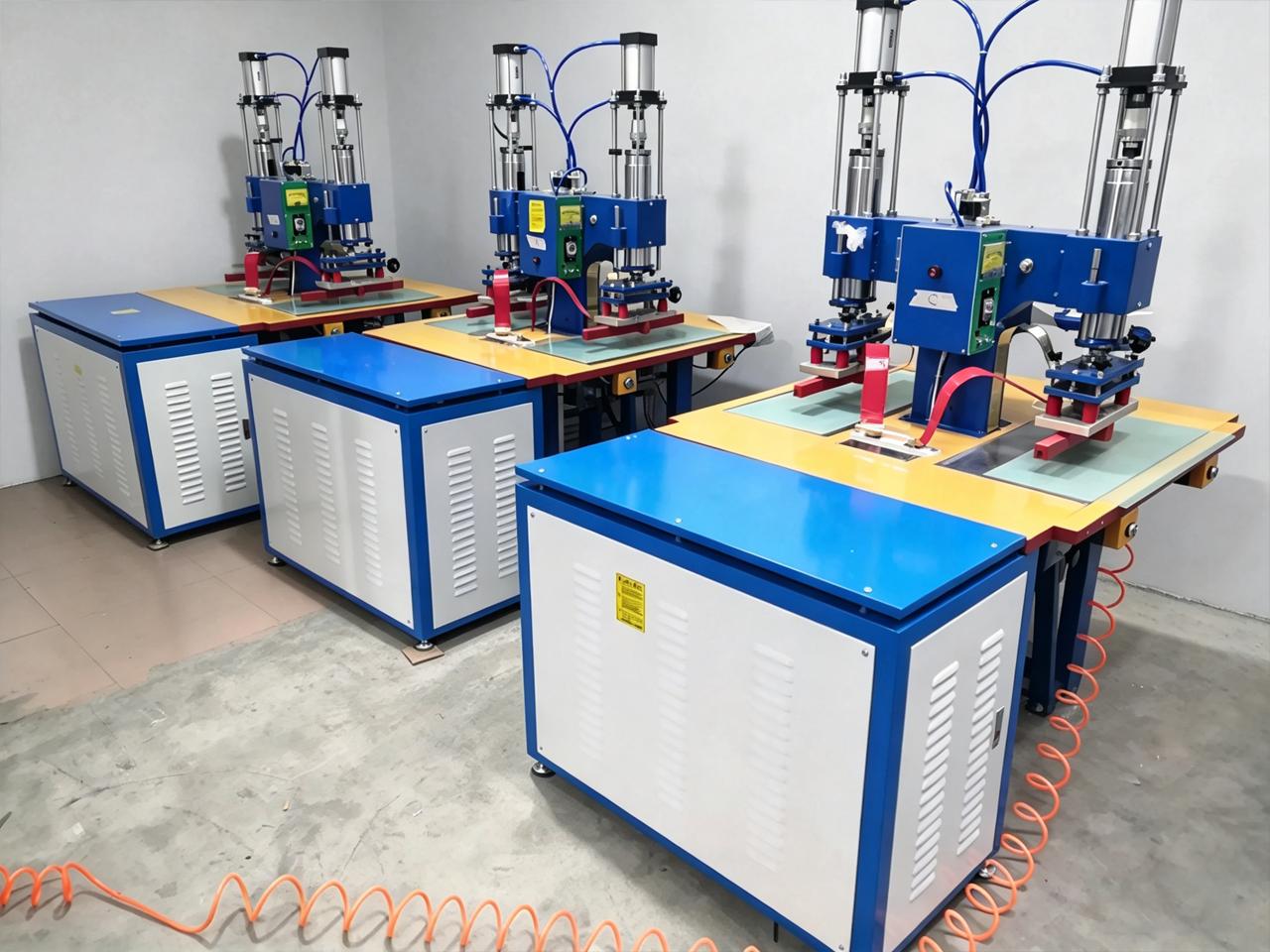
Radio frequency welding uses a high-frequency electromagnetic field to generate heat inside compatible dielectric materials. The process is particularly suitable for materials such as PVC and certain polyurethane formulations.
When an RF welding machine applies the electromagnetic field, polar molecules within the material respond to the changing field. Their movement and associated dielectric losses generate heat within the material. Pressure then helps the softened surfaces form a bonded interface.
The welding process generally involves four stages:
The exact sequence and parameter settings depend on the machine design and application. Some systems separate RF heating, pressure holding, and cooling into distinct stages.
Several factors influence the resulting seal integrity:
Excessive energy may cause material degradation, thinning, or burn marks. Insufficient energy may result in incomplete fusion and weak seals. Uneven pressure can produce inconsistent bonding along the weld seam.
For this reason, manufacturers should evaluate both the finished product and the process conditions used to produce it.
A sealed package may appear intact while containing a small leak, a weak section, or an incompletely bonded area. These defects may become apparent only after the package experiences pressure changes, vibration, bending, or repeated handling.
A structured quality control program helps manufacturers identify these problems before products leave the production line.
Leak detection helps determine whether gas, liquid, or other contents can escape through the seal or package wall. This is particularly relevant for flexible packages, liquid containers, inflatable products, and medical packaging.
Seal strength testing evaluates the force required to separate a welded seam. It helps manufacturers determine whether the joint can withstand the stresses expected during packaging, handling, and use.
Testing samples from different production cycles can reveal changes in RF output, electrode condition, material thickness, pressure, or dwell time.
Some applications require documented testing procedures and acceptance criteria. Medical packaging, for example, may require validated sealing processes and specific package integrity tests based on the packaging system and intended use.
A test method should be selected according to the product's risks and requirements rather than applied simply because it is available on the production floor.
Different tests provide different information. A manufacturer may need more than one method to evaluate both mechanical strength and leak resistance.
Visual inspection is usually the first step in RF welding quality control. It helps identify obvious defects before more time-consuming tests are performed.
Inspect the complete weld seam for:
A uniform appearance is a useful initial indicator, but it does not prove that the seam is strong or leak-free.
Inspection criteria should define acceptable weld width, appearance, alignment, and defect limits. Consistent lighting, magnification when needed, and documented inspection procedures can improve repeatability.
Seal strength testing measures the mechanical resistance of a welded joint when a separating force is applied. The test may involve peeling apart the material layers or pulling the welded sections under controlled conditions.
The results help manufacturers compare welding parameters, material batches, electrode designs, and production conditions.
Depending on the test method, measurements may include:
Results should be reported using the test method's specified units and calculation procedure. Specimen width, pulling speed, conditioning, and sample preparation can affect the outcome.
A seal may fail within the weld, along the interface, or through the base material. These failure patterns provide useful information about the process.
For example, separation along the bonding interface may indicate insufficient fusion, contamination, or material incompatibility. Tearing through the base material may suggest that the joint is stronger than the surrounding material under the test conditions, but this alone does not prove that every seal meets its specification.
Manufacturers should establish minimum acceptance limits based on product requirements and applicable standards.
Burst testing evaluates how a sealed package responds when internal pressure increases. The test typically measures the pressure at which the package or seal fails, depending on the method and equipment configuration.
It is useful for flexible packages, inflatable products, and other components that must withstand internal pressure.
A burst test can help identify:
The failure location matters. If the package wall ruptures before the seal separates, the result may demonstrate that the seal withstands at least the pressure reached during the test. However, it does not establish the exact burst strength of the seal itself.
Use burst testing when the product's intended function involves internal pressure or when the relevant product specification requires it.
The procedure should define the pressure application rate, specimen preparation, test environment, and acceptance criteria. Because burst testing is destructive, samples are generally selected from a controlled sampling plan rather than tested individually across all finished products.
A vacuum decay test is a nondestructive or potentially nondestructive leak detection method, depending on the equipment, package design, and test configuration. It detects pressure changes within an evacuated test chamber or suitable test system to identify leakage.
The package or test chamber is placed under a specified vacuum condition, isolated from the vacuum source, and monitored for changes in pressure over a defined period.
If leakage occurs, gas entering the evacuated space may produce a measurable pressure increase.
Vacuum decay testing can help identify leaks in compatible packaging systems without requiring the package to be submerged in liquid or deliberately burst.
However, the method is not suitable for every package configuration. Flexible packages may deform under vacuum, and the test system must account for package movement, outgassing, temperature effects, and other sources of pressure variation.
A vacuum decay test should be validated for the specific package type, expected leak size, and test conditions.
The most appropriate leak test depends on package geometry, material flexibility, contents, required sensitivity, and whether testing must be destructive.
Common options include:
Pressure decay testing: A package or test volume is pressurized, isolated, and monitored for a pressure drop. Temperature changes and package expansion can affect the results.
Bubble emission testing: The package is pressurized or immersed according to the procedure, and escaping gas is observed as bubbles. The method can be useful for locating leaks but may be unsuitable for some products or very small leaks.
Tracer gas testing: A suitable tracer gas is used to detect leakage through a package or seal. The method requires appropriate equipment and a test configuration designed for the product.
Dye penetration testing: A suitable dye is applied under specified conditions to reveal certain channels or defects in a seal. This is generally a destructive test and must be validated for the packaging materials and intended application.
Electrical or instrument-based leak testing: Specialized equipment may be used for particular package constructions and validated detection requirements.
No single leak detection method is appropriate for every product. The selected test must be sensitive enough to identify defects relevant to the package's intended use.
| Test method | Main purpose | Typical application | Main limitation |
|---|---|---|---|
| Visual inspection | Identify visible seam defects | Most RF-welded products | Cannot confirm leak-tightness or internal bonding |
| Seal strength testing | Measure mechanical resistance of a seal | Flexible packages, welded films, medical packaging | Usually destructive and does not directly measure leakage |
| Burst testing | Evaluate failure under increasing internal pressure | Inflatable products and pressure-containing packages | Usually destructive; results depend on package design |
| Vacuum decay test | Detect leakage through pressure changes under vacuum | Compatible sealed packages and containers | Requires a suitable, validated test configuration |
| Pressure decay testing | Detect leakage through pressure loss | Sealed components and suitable packages | Sensitive to temperature, deformation, and system volume |
| Bubble emission testing | Locate leakage paths through escaping gas | Suitable pressurized or immersed packages | May not detect all small leaks and can be destructive |
| Dye penetration testing | Reveal certain seal channels or defects | Suitable packaging systems | Usually destructive and material-dependent |
For reliable quality control, manufacturers should choose tests that correspond to the failure modes the product is expected to resist.
RF welding and heat sealing both join compatible materials by applying heat and pressure, but they generate heat differently.
RF welding generates heat within suitable dielectric materials through a high-frequency electromagnetic field. The process can provide localized heating and is commonly used for PVC and certain polyurethane products.
Its performance depends on dielectric properties, material construction, electrode design, RF power, pressure, and dwell time.
Heat sealing relies on external heat sources, such as heated bars or plates, to transfer heat to the material surfaces. The material softens at the interface, and pressure helps form the seal.
This process is widely used for flexible packages, films, pouches, and many thermoplastic packaging applications. The required temperature, pressure, and dwell time depend on the sealing layer and package structure.
Hot air sealing uses heated air to soften compatible thermoplastic surfaces before pressure joins them. It can be suitable for selected films, coated fabrics, and applications where heated airflow can reach the sealing area.
The choice between RF welding, heat sealing, and hot air depends on material compatibility, product geometry, production volume, and required seal performance.
| Factor | RF welding | Heat sealing | Hot air sealing |
|---|---|---|---|
| Heat generation | Dielectric heating within suitable materials | External heated tooling | Heated air transfers heat to the material |
| Material suitability | Commonly PVC and certain polyurethane formulations | Many heat-sealable films and thermoplastics | Suitable heat-sealable films and coated materials |
| Tooling | RF electrodes and supporting tooling | Heated bars or plates | Hot air delivery system and pressure tooling |
| Process considerations | Dielectric properties and RF field distribution | Temperature, pressure, and dwell time | Air temperature, airflow, contact, and dwell time |
| Quality verification | Strength, visual inspection, and suitable leak tests | Strength, visual inspection, and suitable leak tests | Strength, visual inspection, and suitable leak tests |
Regardless of the welding technology, seal integrity must be verified using tests appropriate for the final product.
A reliable quality control plan connects machine settings, material properties, inspection procedures, and finished-product performance.
Identify the performance requirements before selecting test methods. Consider whether the product must resist internal pressure, bending, repeated handling, fluid exposure, or environmental changes.
For medical packaging, confirm the applicable packaging validation and integrity requirements rather than assuming that a generic seal-strength test is sufficient.
Check the exact polymer formulation, material thickness, coating, reinforcement, and layer construction. Two materials with similar trade names may respond differently to RF welding.
Confirm compatibility through material documentation and controlled welding trials.
Determine the suitable ranges for RF power, pressure, dwell time, and cooling conditions. Record the machine settings used to produce acceptable specimens.
Avoid making several uncontrolled changes simultaneously, because doing so makes it difficult to identify the cause of improvement or deterioration.
Combine visual inspection with strength or leak testing according to the product's requirements.
For example, a flexible package may require seal strength testing and a validated leak test. An inflatable product may require burst testing, while a medical package may require a validated package integrity test in addition to seal strength evaluation.
Define how many samples will be tested, how often tests will be performed, and what results constitute acceptance.
Sampling frequency should reflect product risk, production variability, customer requirements, and applicable standards. A passing sample should not be treated as proof that every package is defect-free.
Track material batches, RF power, pressure, dwell time, electrode condition, test results, and any process adjustments.
When test results change, review these records to identify patterns. Consistent documentation helps distinguish a machine problem from a material or tooling issue.
A new material formulation, electrode redesign, machine replacement, or major parameter adjustment may change seal performance.
Conduct appropriate verification or revalidation before applying the revised process to routine production, especially when the product has defined safety, pressure, or packaging integrity requirements.
Medical packaging may require more stringent controls than general-purpose flexible packages because packaging failure can affect sterility maintenance, transportation, and product usability.
RF welding may be used in selected medical products when the materials are compatible with the process. However, suitability depends on the complete packaging construction and the intended application.
A medical packaging quality plan may include:
Seal strength and package integrity are related but different properties. A package may have adequate average seal strength while still containing a localized leak path. Conversely, a package may pass a leak test but have a seal that is too weak for normal handling.
For medical packaging, select and validate test methods according to applicable requirements, such as relevant ASTM or ISO standards and the packaging system's intended use. Do not assume that a method suitable for one package type is automatically suitable for another.
A smooth, continuous seam may still contain weak bonding or microscopic leakage paths. Combine visual checks with performance tests when required.
Seal strength testing measures resistance to separation. It does not directly establish whether a package is leak-free.
Use a suitable leak test when leakage prevention is part of the product specification.
Weak seals may result from material incompatibility, poor electrode contact, contamination, or incorrect pressure. More RF energy can increase material damage without resolving the underlying problem.
A test that works for a rigid container may produce misleading results on a flexible package. Confirm that the test method is appropriate for the package geometry, material, and expected leakage characteristics.
The material must cool and solidify sufficiently to retain the intended joint geometry and strength. Releasing pressure too early may contribute to distortion or inconsistent results in some applications.
Without records of machine settings, materials, and test outcomes, recurring defects become harder to diagnose. Documented results help manufacturers maintain consistent quality and identify process changes.
Start with visual inspection to identify burns, gaps, wrinkles, and uneven weld width. Then use seal strength testing, burst testing, or an appropriate leak test according to the product's performance requirements. No single test verifies every aspect of weld quality.
Seal strength measures the mechanical force required to separate a welded joint. Seal integrity refers to the seal's ability to prevent unintended leakage under specified conditions. A complete quality assessment may require both mechanical and leak testing.
The best method depends on the package material, geometry, contents, and required leak detection sensitivity. Vacuum decay, pressure decay, bubble emission, and other validated methods may be appropriate. The selected method should be demonstrated to detect defects relevant to the product.
Burst testing evaluates how a package responds to increasing internal pressure. It can identify the pressure at which the package or seal fails, depending on the test method and failure location. The results help assess pressure resistance and compare production consistency.
A properly configured and validated vacuum decay test can detect leaks within its demonstrated sensitivity range. Actual performance depends on the test equipment, package design, background pressure variation, and the size and location of the leak.
The seal may have sufficient mechanical strength overall but contain a localized channel, pinhole, or incompletely bonded section. Strength testing and leak testing measure different properties, so both may be necessary for products that require reliable sealing.
Dwell time determines how long the material experiences a particular stage of the welding cycle. Insufficient time may result in incomplete fusion, while excessive exposure may cause overheating or material degradation. The suitable dwell time depends on the material, thickness, tooling, pressure, and machine settings.
Neither method is universally better. RF welding is suitable for certain dielectric thermoplastics, while heat sealing is widely used for many heat-sealable packaging films. The choice depends on material compatibility, package design, process validation, and the required performance.
Testing frequency should be defined by the product specification, process capability, customer requirements, risk assessment, and applicable standards. Manufacturers may combine routine visual checks with scheduled strength tests, leak tests, and additional testing after significant process changes.
Review material batches, electrode condition, alignment, pressure, RF output, dwell time, and cooling conditions. Compare recent test results with production records, isolate the likely cause, and verify corrective actions using appropriate tests before resuming normal production.
Evaluating RF welding quality requires more than checking whether a weld seam looks uniform. Visual inspection, seal strength testing, burst testing, and appropriate leak tests provide different information about the finished joint and its ability to perform as intended.
Manufacturers should select test methods according to material properties, package design, internal pressure, and application-specific requirements. A consistent quality control plan that combines process monitoring with validated testing helps reduce leakage risks, improve production repeatability, and maintain reliable seal integrity.
If you are selecting an RF welding machine or improving an existing sealing process, evaluate the material compatibility, electrode configuration, required seal strength, and leak detection method together. Contact our team to discuss your application or request a quote for an RF welding solution tailored to your production requirements.