For cooperation and more details, feel free to email us or call directly for consultation.

Home > News & Blog > Knowledge > RF Welding for Inflatable Products: PVC Pools, Boats and Air Mattresses
RF welding, also called radio frequency welding or high-frequency welding, is a manufacturing process that uses electromagnetic energy and pressure to join compatible thermoplastic materials. It is widely used to produce inflatable products made from suitable PVC films, including inflatable swimming pools, air mattresses, water beds, inflatable toys, and selected boat components.
During the RF welding process, a high-frequency electric field generates heat inside compatible materials, allowing overlapping layers to fuse into a strong seam. With suitable material selection, electrode design, machine power, and process parameters, RF welding can produce consistent seams for products that need to retain air or water.
For manufacturers, the main benefits include repeatable seam formation, customized weld patterns, short production cycles for suitable applications, and reduced dependence on adhesives at the welded joint. However, RF welding is not suitable for every plastic or every inflatable construction. Material compatibility, product dimensions, seam geometry, and performance requirements should be evaluated before selecting RF welding equipment.
RF welding is a plastic joining process that uses a high-frequency electromagnetic field to generate heat within compatible thermoplastic materials. The material layers are positioned between an electrode and a supporting surface. When the machine applies RF energy, polar molecules respond to the alternating electric field, generating heat that softens the material at the joint.
Pressure brings the softened layers into close contact so they can fuse. After the RF energy stops, the joint cools under controlled conditions and forms a welded seam.
In inflatable product manufacturing, this process is commonly associated with flexible PVC films and certain other RF-weldable material formulations. It can be used to produce perimeter seams, internal air chambers, reinforcing patches, shaped edges, and other welded features.
RF welding differs from conventional heat sealing because heat is generated within the compatible material by the electromagnetic field rather than being transferred mainly from an externally heated surface. The actual weld result depends on the material formulation, thickness, electrode geometry, pressure, energy input, and cooling conditions.
Not all inflatable products use RF welding. Some boats, large coated-fabric structures, and reinforced inflatable products are manufactured using hot-air welding, hot-wedge welding, adhesive bonding, or combinations of these methods. The appropriate process depends on the material construction and product design.
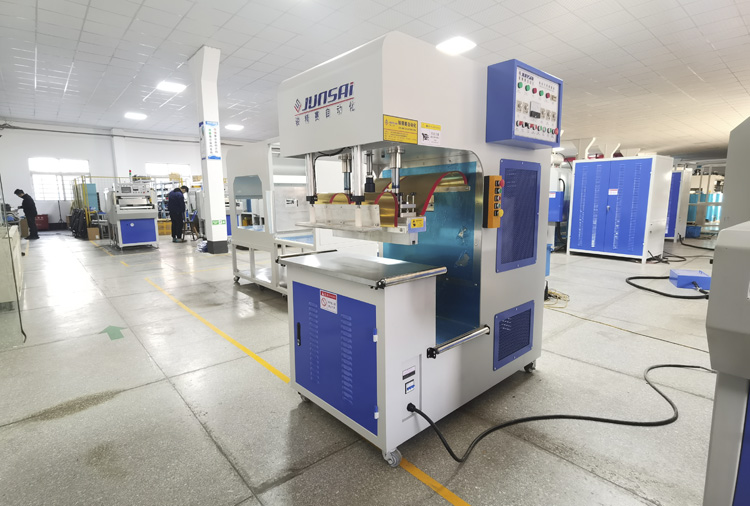
A consistent RF welding process requires the machine, electrode, material, and process settings to work together. The main stages are material preparation, positioning, electromagnetic heating, pressure-assisted fusion, cooling, and inspection.
The process starts with flexible thermoplastic sheets, films, or suitable coated materials. PVC is widely used for inflatable pools, air mattresses, water beds, and many recreational inflatables because suitable formulations offer flexibility and can be processed using RF welding.
Certain polyurethane materials, including selected TPU formulations, may also be RF weldable. Compatibility should be confirmed with the actual material grade and construction rather than assumed from the polymer name alone.
Material preparation includes cutting panels to the required dimensions, checking thickness and surface condition, and ensuring that the joining areas are clean and properly aligned.
The overlapping material layers are placed on the machine's working table or fixture. A shaped RF electrode defines the weld pattern.
The electrode may be designed for a straight seam, curved perimeter, circular section, internal air chamber, or customized product feature. Its shape and dimensions must match the product's construction.
Correct positioning helps prevent uneven seams, incomplete joints, and unwanted marks on the finished product.
When the RF generator activates, the electromagnetic field causes suitable polar molecules within the material to respond to the alternating field. This produces internal heat in the intended welding area.
The softened material becomes capable of fusing under pressure. Unlike conventional hot-plate welding, RF welding does not rely primarily on transferring heat from a hot tool through the material surface.
The machine applies controlled pressure through the electrode. The softened material layers fuse together at the joint, creating the seam that forms the inflatable product's perimeter or internal structure.
Energy input, pressure, and welding time must be matched to the material and seam design. Too little energy can produce a weak joint, while excessive energy may cause material damage, thinning, or unwanted deformation.
After RF energy is switched off, the material is allowed to cool under the required conditions. The welded joint then retains its shape and strength.
Finished products should be inspected for seam continuity, appearance, dimensions, and signs of material damage. Inflatable products may also require air-retention, pressure, or other application-specific tests.
A seam that looks smooth is not automatically airtight. Product testing is needed to confirm performance under the intended conditions.
Inflatable swimming pools are a common application for flexible PVC welding. Depending on the design, they may contain a large water-holding body, reinforced upper rings, inflatable walls, or multiple connected chambers.
RF welding can join compatible PVC film layers to create the walls and perimeter sections of inflatable pools. The electrode defines the seam geometry, allowing manufacturers to match the welding pattern to the pool design.
Consistent seam width and fusion help the structure retain water and maintain its intended shape. The process should be established using representative material thicknesses and production conditions.
Some inflatable pools use air-filled rings or chambers to support their walls. RF welding can form the seams of compatible PVC constructions and join shaped sections used to create these chambers.
The welding pattern should account for the chamber's geometry and expected loading. Air-retention testing can help identify leaks around the perimeter, corners, and transitions between sections.
Pool products may include reinforcing patches, valve areas, handles, or other accessories. RF welding can attach compatible thermoplastic components when the material combination and design support the process.
Different components may require separate electrode designs and process settings. A suitable joining method must be selected for each interface rather than assuming that every accessory can be directly RF welded.
Pool size, material thickness, seam length, and production volume influence machine selection. Larger products may require a larger working area, specialized fixtures, or high-power RF welding equipment.
Manufacturers should also consider how the product will be folded, packaged, stored, and used. These conditions can affect the performance requirements of the welded seams.
Inflatable boats require carefully designed seams because the finished structure may be exposed to water, changing temperatures, handling loads, abrasion, and repeated inflation or deflation.
RF welding can be suitable for certain inflatable boat components made from compatible PVC films or constructions. However, many commercial inflatable boats use reinforced PVC-coated fabrics or other heavy-duty materials that may be better suited to hot-air or hot-wedge welding. The joining process should be selected according to the exact material and boat design.
Inflatable boat tubes contain air and help provide buoyancy. Their construction may include multiple panels, end sections, internal divisions, and connection areas.
Where the material is compatible with RF welding, the process can produce shaped seams for selected tube components. The electrode and fixture design should account for the intended seam geometry and the material's reinforcement structure.
For large reinforced-fabric assemblies, manufacturers should evaluate whether RF welding is technically suitable or whether another welding process is more appropriate.
Inflatable boats may contain reinforced areas around transoms, handles, attachment points, and other locations subject to localized loads. These features often involve multiple material layers or components with different physical properties.
RF welding may be suitable for selected compatible thermoplastic layers, patches, and components. However, the load-bearing design and joining method must be assessed as a complete assembly. Some structures require mechanical fastening, adhesives, or alternative welding methods in addition to or instead of RF welding.
Boat seams must meet the product's design requirements for air retention and structural performance. Depending on the construction, quality verification may include visual inspection, seam-strength testing, pressure retention, and other product-specific checks.
Testing should reflect the intended use, expected pressure, environmental exposure, and applicable requirements. Machine settings alone cannot establish the safety or service life of a finished boat.
Air mattresses are another common application for RF welding, particularly when the product uses compatible PVC films or related weldable thermoplastic layers.
Manufacturers use welded seams to create the outer body, internal air chambers, raised sections, and selected structural features. The design and tooling determine how air is distributed and how the mattress maintains its shape.
The outer perimeter contains the air within the mattress. RF welding can join overlapping PVC layers along straight or shaped edges to create a continuous seam.
Material alignment, electrode pressure, and controlled energy input help maintain consistent seam quality. Uneven pressure or insufficient fusion can result in leaks that may become noticeable only after the mattress has been inflated.
Some air mattresses contain internal welded channels, baffles, or partitions that control their shape and support. Custom electrodes can create these features in compatible constructions.
The weld layout should account for how the mattress expands during inflation and how the internal structure responds to body weight. Testing should evaluate both air retention and the mattress's intended load-bearing performance.
Air mattresses require valves or other inflation interfaces. RF welding may be used to attach compatible thermoplastic valve components or create suitable surrounding seams, depending on the design.
Not every valve or rigid fitting can be directly RF welded. Manufacturers should confirm material compatibility and evaluate the connection for leakage, mechanical strength, and repeated use.
Some air mattresses use flocked surfaces, laminated films, or multi-layer constructions. These structures may require a specific welding approach because the surface layer, backing material, and joining interface can behave differently under RF energy.
The weld area must be designed to achieve adequate fusion without damaging decorative or functional layers. Production trials using the actual material stack-up help determine whether RF welding is suitable.
Beyond pools, boats, and air mattresses, RF welding is used in a range of inflatable products made from compatible materials.
Inflatable toys, floating rings, loungers, and recreational water products often use flexible PVC films. RF welding can produce perimeter seams and customized shapes that support air retention.
Product design, material thickness, and intended use determine the required seam dimensions and inspection procedures.
Water beds and selected inflatable cushions use flexible thermoplastic layers to contain water or air. RF welding can create seams and internal partitions in compatible materials.
Because the contents and operating conditions differ, manufacturers should choose test methods that match the product's actual function.
Inflatable chairs, sofas, and support structures may contain multiple chambers, shaped panels, and reinforced sections. RF welding can be used for suitable PVC constructions, including selected seams and internal features.
Larger products may require custom fixtures and electrodes to maintain alignment and pressure across the welding area.
Certain industrial bladders, flexible reservoirs, and air-containing components can be manufactured using RF welding when their materials are compatible with the process.
These products may have more demanding requirements for pressure retention, chemical exposure, repeated flexing, or dimensional stability. Material selection and testing should be based on the intended application.
Material compatibility is one of the first factors to evaluate when selecting RF welding for inflatable manufacturing.
Flexible polyvinyl chloride (PVC) is widely used for inflatable products because many PVC formulations respond well to RF energy. Suitable PVC films can be joined to form seams that retain air or water.
PVC formulations vary in plasticizer content, thickness, reinforcement, and surface treatment. These differences can affect weldability and finished seam performance, so manufacturers should verify the actual material specifications.
Thermoplastic polyurethane (TPU) is used in selected premium inflatables and technical products because of its flexibility and other application-dependent properties. Certain TPU grades can be RF welded, but process suitability depends on the formulation and product construction.
Manufacturers should run welding trials before specifying RF welding for TPU products. Hot-air, hot-wedge, or other joining technologies may be more appropriate for some TPU films and coated fabrics.
Some inflatable boats and large inflatables use reinforced fabrics with a thermoplastic coating. The fabric reinforcement, coating type, thickness, and laminate construction influence the joining process.
RF welding may be suitable for some constructions, but reinforced fabrics often require evaluation of alternative methods, including hot-air or hot-wedge welding. The selected process must create a joint that meets the product's performance requirements.
RF welding generally works best with materials that can generate heat in response to the electromagnetic field. Non-polar plastics such as polyethylene (PE) and polypropylene (PP) are not normally suitable for direct conventional RF welding.
Specialized material systems may allow other joining approaches, but compatibility should never be assumed. Testing the actual materials and interface is the most reliable way to establish process suitability.
RF welding offers several manufacturing benefits when the material and product design are compatible.
Once the process is established, RF welding equipment can apply defined energy, pressure, and timing settings across production cycles. This helps manufacturers maintain consistent seam dimensions and appearance.
Repeatability also depends on stable material quality, electrode condition, machine maintenance, and correct product positioning.
Custom electrodes can form straight seams, curved outlines, circular joints, and selected internal patterns. This makes RF welding useful for inflatable products with specialized geometries.
Tooling must be designed around the material, required seam width, and intended product structure.
RF welding fuses compatible thermoplastic layers directly, eliminating the need for adhesive at that particular joint. This can reduce certain assembly steps and avoid adhesive-related variables in the welded area.
Other areas of the finished product may still require adhesives, mechanical fasteners, or additional joining processes.
RF welding can achieve short cycle times for compatible materials and well-designed tooling. In repeat production, dedicated electrodes and fixtures can support consistent processing and predictable manufacturing workflows.
Actual cycle time depends on weld area, material thickness, machine capability, cooling requirements, and product handling.
RF welding machines can be configured for manual, semi-automatic, or automated production. Depending on the application, automation can help improve positioning, handling, and process consistency.
The right configuration depends on production volume, product variation, changeover frequency, and factory layout.
Selecting an RF welding machine requires evaluating the product, material, seam geometry, and production target together.
The dimensions of the pool, boat component, mattress, or inflatable structure determine the working area and electrode size required. Large products may need a larger platen or specialized machine configuration.
Manufacturers should distinguish between overall product dimensions and the actual area welded in each cycle. The total seam length and the size of the electrode can affect power requirements and cycle planning.
The required power depends on material properties, thickness, weld area, electrode design, and production requirements. Large-area welding applications may require higher-power equipment, but power alone does not determine weld quality.
A suitable machine should provide enough output for the intended welding task while allowing the process to be controlled within an appropriate operating range.
The electrode defines the weld pattern and influences how energy and pressure are applied. Complex products may require custom tooling to form internal chambers, curved edges, reinforcement areas, or multiple weld features.
Fixtures should support accurate material positioning and consistent pressure. Tooling design should also allow practical loading, unloading, inspection, and maintenance.
Manual machines may be suitable for smaller batches, prototypes, or products with frequent design changes. Semi-automatic equipment can improve consistency in material handling, while automated configurations may be appropriate for repeat, higher-volume manufacturing.
The decision should consider expected output, labor requirements, changeover time, and the cost of tooling.
Before finalizing a machine specification, manufacturers should identify the required seam strength, air-retention performance, dimensional tolerances, and any relevant environmental or durability tests.
Representative production materials and product samples should be used during machine trials. The final equipment configuration should be based on demonstrated process capability rather than a general product category alone.
Quality control should verify that the welded seams perform as intended, not just that they look acceptable.
Inspect the seam for uneven width, wrinkles, holes, burn marks, incomplete fusion, and visible material damage. Confirm that the seam follows the specified position and dimensions.
Acceptance criteria should be defined for each product and material construction.
Peel or tensile testing can help measure the strength of welded joints. The test method and acceptance limits should reflect the material, seam design, and intended application.
A strong seam in a test specimen does not necessarily prove that the complete product will retain air under all operating conditions.
Inflatable pools, boats, mattresses, and bladders may require inflation testing to check for leaks or unexpected deformation. Depending on the product, manufacturers may use pressure retention, pressure decay, immersion, or other suitable methods.
Test pressure, duration, and acceptance criteria should be established for the specific product. Avoid applying an arbitrary test pressure that exceeds the product's intended design limits.
Leaks can occur at valves, ports, reinforced sections, and other component interfaces even when the main perimeter seam is sound.
These areas should be included in the quality plan and evaluated using suitable inspection and leak-testing procedures.
Documented process settings, electrode maintenance, material checks, and operator training help reduce variation. Changes to materials, tooling, or machine settings should be reviewed to determine whether additional trials or verification are needed.
RF welding is not the only joining technology used for inflatable products. Hot-air and hot-wedge welding are common alternatives, particularly for some coated fabrics and large flexible structures.
| Feature | RF welding | Hot-air welding | Hot-wedge welding |
|---|---|---|---|
| Heating method | Electromagnetic energy generates heat in compatible materials | Heated air softens the joining surfaces | A heated wedge transfers heat to the joining surfaces |
| Material suitability | Commonly used with compatible PVC and certain other polar thermoplastics | Used for many compatible thermoplastic films and coated fabrics | Used for suitable thermoplastic films and coated fabrics |
| Typical applications | PVC inflatable pools, air mattresses, shaped seams, selected inflatable components | Selected boat fabrics, large inflatables, coated textiles, and continuous seams | Long seams in suitable films, membranes, and coated fabrics |
| Tooling | Often uses a shaped electrode for each weld pattern | Uses hot-air delivery and suitable pressure tooling | Uses a wedge and pressure arrangement suited to the seam |
| Production considerations | Effective for suitable products with repeatable, shaped welds | Can suit continuous seams and certain large-format products | Can suit long, consistent seams in compatible materials |
The best method depends on the material construction, product geometry, required seam performance, production volume, and available equipment. RF welding can be a good choice for compatible PVC products that need shaped seams, while hot-air or hot-wedge welding may be more suitable for certain reinforced fabrics and large continuous seams.
Possible causes include insufficient energy, unsuitable pressure, poor material alignment, or incompatible materials. Check the material specifications, electrode condition, and process settings before making controlled adjustments.
Excessive energy, uneven pressure, poor electrode alignment, or unsuitable tooling can damage the material. Review the welding cycle and tooling setup, then confirm the results through repeatable tests.
Misalignment, electrode wear, material movement, or inconsistent pressure can cause irregular welds. Improve fixture design, inspect the electrode, and verify that the material is positioned correctly for each cycle.
Leaks may result from incomplete fusion, holes, damaged material, or poor valve connections. Inspect the entire product, including corners, intersections, and accessory interfaces. Use a suitable leak-detection method to identify the source.
Variations in material formulation, thickness, surface condition, and machine setup can change welding performance. Incoming material checks, documented settings, preventive maintenance, and process monitoring can help improve consistency.
RF welding is used to join compatible thermoplastic materials for inflatable swimming pools, air mattresses, water beds, recreational inflatables, and selected boat components. The process can create shaped seams and internal chambers designed to retain air or water.
Yes. RF welding is commonly used for compatible PVC film constructions in inflatable pools. It can create perimeter seams, air-filled rings, and selected reinforced areas. The machine, electrode, and welding parameters must match the pool's material and design.
RF welding can be suitable for selected inflatable boat components made from compatible thermoplastic materials. However, many boats use reinforced PVC-coated fabrics or other constructions that may be better suited to hot-air or hot-wedge welding. The material structure and intended use should guide process selection.
Yes. RF welding can join compatible PVC layers to create air mattress perimeter seams, internal chambers, and selected structural features. The finished mattress should be tested for air retention, seam quality, and performance under its intended loading conditions.
Flexible PVC is a common RF-weldable material. Certain TPU and other thermoplastic formulations may also be suitable. Compatibility varies by formulation, thickness, reinforcement, and surface construction, so material trials are recommended.
The advantages include repeatable seam formation, customized weld patterns, short cycles for suitable applications, and direct fusion without adhesive at the welded interface. Actual results depend on the material, electrode design, process settings, and machine configuration.
Manufacturers should use compatible materials, maintain accurate alignment, optimize energy and pressure settings, inspect the tooling, and test finished products for leakage. Valve connections, corners, and seam intersections should also be included in the inspection plan.
The required power depends on the material, thickness, weld area, electrode geometry, and cycle requirements. Large products may require higher-power machines, but the correct specification should be established through engineering evaluation and representative material trials.
RF welding uses an electromagnetic field to generate heat within compatible materials. Conventional heat sealing generally uses heated surfaces to transfer heat into the material. Both methods can produce sealed joints, but their suitability depends on material compatibility, seam design, and production requirements.
Manufacturers should assess material type, product dimensions, seam length, electrode design, power requirements, production volume, and testing criteria. Machine trials using actual production materials can help confirm whether the proposed configuration meets the required seam performance.
RF welding is an established manufacturing option for inflatable products made from compatible thermoplastic materials, particularly flexible PVC. It can be used to produce inflatable pools, air mattresses, water beds, recreational inflatables, and selected boat components with shaped, repeatable seams.
Successful production depends on selecting suitable materials, matching the machine and electrode to the product, controlling the welding process, and verifying the finished seams through appropriate testing. For reinforced boat fabrics or other specialized constructions, hot-air or hot-wedge welding may be a better fit.
Looking for an RF welding machine for PVC pools, air mattresses, or other inflatable products? Share your material specifications, product dimensions, seam design, and expected production volume with the HFWelders Radio Frequency Welding Machine Division to discuss suitable equipment and customized tooling.