For cooperation and more details, feel free to email us or call directly for consultation.

Home > News & Blog > Knowledge > What Determines RF Welding Machine Price? A Buyer’s Guide
The price of an RF welding machine depends on more than its power rating. Machine structure, automation level, electrode tooling, control systems, material compatibility, safety features, and after-sales support all affect the final investment. A basic machine for small production runs may cost far less than a customized system designed for continuous manufacturing, complex weld shapes, or medical applications.
For manufacturers comparing radio frequency welding equipment, the key is to identify the configuration that meets actual production requirements without paying for features they do not need. A lower purchase price may be attractive, but it should be evaluated alongside production capacity, weld consistency, maintenance expenses, and the cost of rejected products.
This buyer’s guide explains the main factors that determine RF welding machine price, how to compare supplier quotations, and how to estimate the long-term cost of ownership before purchasing welding equipment.
An RF welding machine is industrial equipment that joins compatible thermoplastic materials by applying high-frequency electromagnetic energy and pressure. The process is commonly called radio frequency welding, RF welding, or high frequency welding. It is also known as dielectric welding.
During the process, an RF generator supplies high-frequency electrical energy to the welding system. The electromagnetic field causes dielectric losses within a suitable material, which generate heat inside the material. Pressure brings the material surfaces together so they can form a bond.
Unlike conventional heat sealing, which transfers heat from a heated surface, RF welding generates heat within compatible materials through their response to the electromagnetic field. The result can be a strong, consistent seam when the material, tooling, and process settings are properly matched.
RF welding machines are used for products such as:
Material compatibility must be confirmed before choosing this process. PVC and certain other polar thermoplastics are commonly suitable for RF welding, while materials such as polyethylene and polypropylene generally require alternative joining methods or a specially developed process.
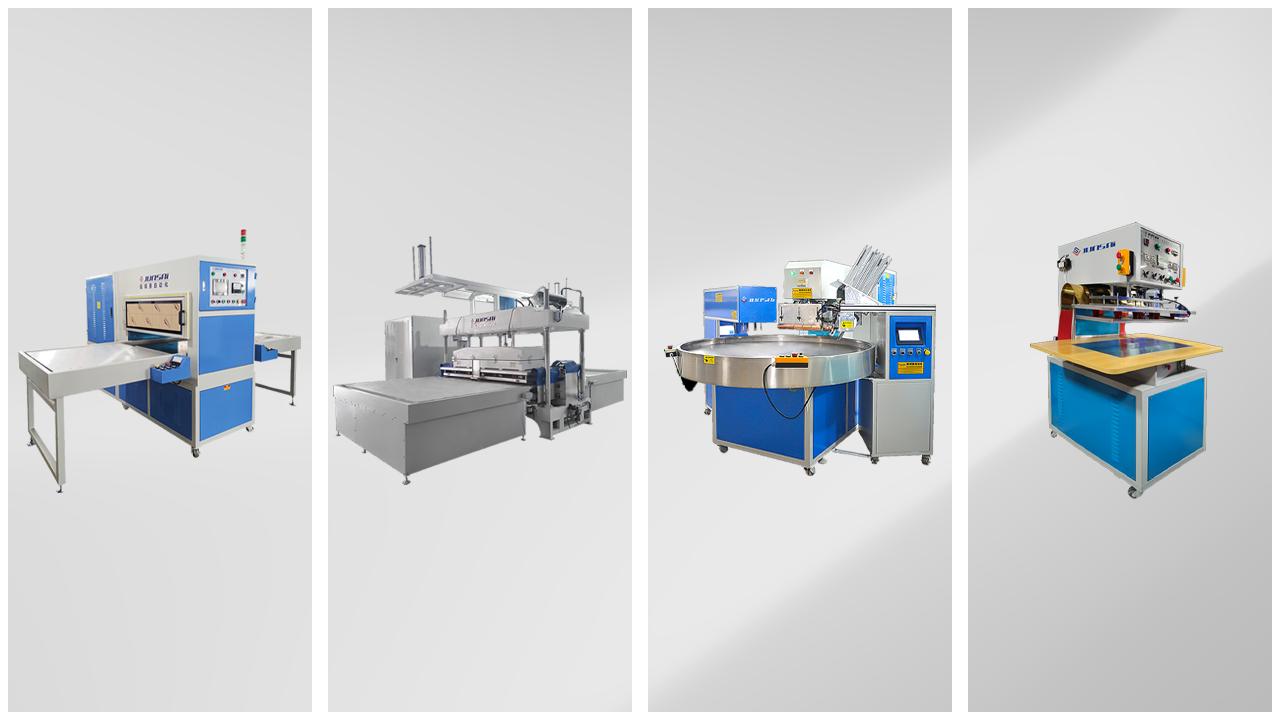
The price of an RF welding machine is mainly determined by its RF power capacity, press structure, automation level, electrode and fixture requirements, control system, safety features, and application-specific customization.
Basic manual machines generally require a smaller initial investment than semi-automatic or fully automatic systems. Machines designed for large weld areas, high production volumes, specialized products, or demanding quality requirements may cost substantially more.
When comparing quotations, buyers should evaluate the complete supply package, including:
The most economical option is not necessarily the machine with the lowest purchase price. It is the equipment that produces acceptable parts at a competitive cost while meeting the required output, quality, and service-life expectations.
The RF generator is one of the main components affecting machine price. It supplies the high-frequency energy required to weld compatible materials, and its capacity must match the application.
A machine intended for small components with narrow weld seams may need less power than a system designed for large panels, long seams, or products with substantial electrode areas.
Higher-capacity equipment may require a more substantial RF generator, additional electrical components, improved cooling, and a machine structure designed to handle the associated production demands. These requirements can increase the purchase price.
However, buying the highest available power rating is not a reliable way to improve production performance. Excess power does not automatically mean faster cycles or better welds.
The required power depends on several variables:
For example, a manufacturer producing small PVC accessories may have very different power requirements from a manufacturer welding large inflatable structures. Both use RF welding, but their tooling, weld areas, and production targets may differ substantially.
Before selecting a power rating, ask the supplier to review your material specifications, product drawings, and representative samples. A practical welding trial is more useful than choosing a machine based on kilowatts alone.
The machine's operating structure has a direct effect on its price. RF welding machines range from manually operated presses to integrated automatic production systems.
Manual machines usually have a simpler configuration. Operators position the material, align it with the electrode, initiate the welding cycle, and remove the finished part.
They can suit small production batches, sample development, custom products, and factories that manufacture several product types in limited quantities.
Their lower initial cost may make them attractive to businesses entering RF welding or expanding gradually. However, manual loading and positioning can increase labor time per part, especially when output targets are high.
Semi-automatic machines combine operator handling with controlled machine movements and welding cycles. Depending on the design, they may include pneumatic or hydraulic presses, sliding tables, programmable controls, or assisted positioning.
These features can reduce repetitive operator tasks and improve process repeatability. The price depends on the machine structure, control system, table design, and additional safety functions.
For manufacturers producing recurring batches of medical bags, flexible containers, or inflatable products, semi-automatic equipment may offer a useful balance between investment and output.
Automatic RF welding machines may include material feeding, automatic positioning, indexing tables, multiple welding stations, unloading, trimming, or integration with downstream production equipment.
Their price depends on how much of the production process must be automated. A machine with automatic indexing is not equivalent in cost or complexity to a complete production cell with robotic handling and inspection.
Automatic systems are often suitable for stable, high-volume production. They can reduce manual handling and improve production flow, but they also require more engineering, commissioning, and maintenance planning.
When comparing machine quotations, confirm exactly which functions are included. The term "automatic" can describe very different equipment configurations.
Electrodes and fixtures are major cost considerations because they determine how the machine interacts with the product.
The electrode defines the shape of the weld. Depending on the application, it may form a straight seam, a curved joint, a shaped sealing line, an embossed pattern, or a specific outline. Fixtures hold the material in position and help maintain alignment throughout the cycle.
A simple, flat electrode may be relatively straightforward to manufacture. A complex electrode with multiple sealing paths, narrow features, curved profiles, or several welding positions may require more design and machining work.
Tooling cost can also increase when a product requires:
For example, a manufacturer producing pressure cuffs may need tooling that follows the cuff's shape and forms the required seams around its air chambers. A manufacturer producing simple flat plastic components may need a much less complicated setup.
The machine price should therefore be assessed together with the tooling package. A low machine quotation that excludes custom electrodes may not represent the lowest total project cost.
Ask the supplier whether the quotation includes tooling design, manufacturing, installation, adjustment, sample testing, and future replacement costs.
The physical size and structure of an RF welding machine influence its cost. Larger products often require a larger working area, suitable press force, adequate electrode clearance, and a stable machine frame.
The mechanical structure must support consistent electrode alignment and pressure distribution. If the press is not sufficiently rigid or the tooling is poorly aligned, the machine may produce uneven welds even when the RF generator has sufficient power.
Important design considerations include:
A machine designed for small bags or labels will not necessarily accommodate large industrial components. Increasing the working area may also affect the frame, press, and handling system, raising the overall cost.
When requesting a quotation, provide the maximum product dimensions rather than only the dimensions of the weld line. The supplier needs to consider the full workpiece, its positioning, and the space required for tooling.
The control system determines how operators set, adjust, and monitor the welding cycle.
Basic RF welding equipment may offer straightforward controls for cycle timing and machine operation. More advanced systems may include PLC controls, touchscreen interfaces, stored recipes, process monitoring, alarms, and production records.
These functions can increase equipment cost, but they may reduce setup errors and help standardize work across operators and production shifts.
Programmable welding parameters: Allow operators to store and recall settings for different products.
Recipe management: Helps organize settings when a factory manufactures several product types.
Process monitoring: May provide information about selected machine conditions or welding parameters.
Alarm and fault diagnostics: Can help maintenance staff identify operating problems.
Production data recording: May support traceability and process review when properly configured.
For products with strict quality requirements, stored settings and documented operating procedures can help maintain consistency. However, a control system alone does not guarantee a reliable weld. Material variation, tooling condition, and process validation remain important.
Buyers should select control features according to their real production and quality needs instead of paying for functions that will not be used.
Material compatibility affects the machine configuration, tooling, and process-development work required for a project.
RF welding is widely associated with PVC and is also used with certain other materials that respond appropriately to a high-frequency electromagnetic field. The exact material formulation matters. Thickness, coatings, additives, reinforcements, and multilayer construction can all influence weldability.
Different applications may require different equipment arrangements even when they use similar materials.
The medical industry uses RF welding for selected flexible thermoplastic products, including medical bags, compatible fluid containers, pressure cuffs, and components used in certain medical devices.
These products may require consistent seams, defined dimensions, and leak-resistant construction. Depending on the intended use, the manufacturer may also need process validation, traceability, documented inspection procedures, and compliance with applicable quality and regulatory requirements.
The resulting machine price can reflect specialized tooling, controlled process settings, inspection requirements, and additional documentation or validation support.
Not every medical product is suitable for RF welding, and a machine purchase does not establish that the finished product meets medical requirements.
Inflatable products, flexible enclosures, and coated-fabric components may require large or shaped welding electrodes. Some products need multiple weld lines or dedicated fixtures to hold the material accurately.
In these applications, product size, seam geometry, and production quantity can affect the choice between a basic press, a sliding-table machine, a rotary-table system, or a customized production line.
The best equipment configuration depends on the product design and manufacturing process, not simply on the industry name.
RF welding equipment uses high-frequency electrical energy and mechanical pressing systems. Appropriate safety provisions must be considered during machine selection.
Depending on the design and destination market, safety features may include protective enclosures, interlocks, emergency stops, suitable grounding, spark protection, and safeguards around moving parts.
The required configuration depends on the machine design, workplace conditions, applicable standards, and local regulations. Buyers should confirm which safeguards and compliance documentation are included in the quotation.
A machine supplied without the required safety functions may require additional engineering and installation work before it can be used in the intended facility.
When comparing suppliers, ask for a clear list of safety features, relevant certificates or declarations, operating instructions, and maintenance requirements. Do not assume that two machines with similar power ratings have equivalent safety provisions.
Two RF welding machines with similar specifications can have different prices because their components, engineering, manufacturing quality, warranty terms, and service arrangements differ.
A lower-priced machine may be appropriate for a straightforward application, provided it meets the necessary performance and safety requirements. For continuous production, however, the availability of technical support and replacement components can affect long-term operating costs.
Review the following points when evaluating a supplier:
A supplier that can test your actual material and demonstrate a suitable welding process may provide more useful technical evidence than a supplier offering only a low price.
Compare the scope of service rather than assuming that every quotation includes the same level of support.
The machine price may not include every expense required to start production.
Depending on the supplier and project, additional costs may include shipping, insurance, import duties, taxes, installation, commissioning, operator training, electrical preparation, and factory modifications.
Customized automatic systems may also require more time for installation, integration, and production testing than standalone manual machines.
Before placing an order, confirm:
A detailed quotation makes it easier to compare suppliers and avoid unexpected expenses after the machine arrives.
The initial purchase price is only one part of the total cost of owning an RF welding machine.
Ongoing expenses may include electricity, routine maintenance, replacement components, electrode repairs, training, downtime, and material losses. The importance of each cost depends on the machine configuration and production environment.
For example, a machine with a low purchase price may require more frequent intervention or generate more rejected parts if the process is poorly controlled. Conversely, a more expensive system may not provide a financial benefit if its additional capacity is rarely used.
When estimating long-term cost, consider:
The objective is to understand the cost of producing acceptable products, not simply the amount paid for the machine.
There is no universal RF welding machine price because equipment configurations vary widely. Public supplier listings show that some basic machines are offered in the low-thousands of US dollars, while larger or specialized machines can reach the tens of thousands. Customized automatic production systems may require project-specific quotations and can cost substantially more.
These figures are broad market indications, not a standardized price list. They may refer to different power ratings, machine structures, tooling packages, delivery terms, and levels of automation. Some advertised prices exclude installation, custom electrodes, taxes, or other project expenses.
The following table provides a practical way to think about budget categories without treating them as fixed price bands.
| Equipment category | Typical configuration | Main cost considerations |
|---|---|---|
| Basic manual machine | Simple press and standard controls | Power rating, working area, basic tooling |
| Specialized manual machine | Application-specific press or tooling | Product dimensions, electrode design, safety features |
| Semi-automatic machine | Controlled press, sliding table, or assisted handling | Table structure, controls, tooling, output targets |
| Automatic machine | Indexed stations or integrated handling | Automation scope, sensors, control system, production layout |
| Customized production line | Multiple integrated processes or stations | Engineering, integration, tooling, testing, commissioning |
A reliable quotation should be based on the actual application. Request pricing after confirming the material, product dimensions, weld geometry, target output, tooling scope, and required quality checks.
When several suppliers offer different prices, compare the technical scope before comparing the totals.
A quotation with a lower price may exclude components or services included in another supplier's proposal. Without a common specification, it is difficult to determine whether the machines are genuinely comparable.
Use this checklist when reviewing offers.
Confirm the RF generator rating, machine structure, working area, press capacity, control system, and available safety functions.
Check how many electrodes and fixtures are included, whether they match your product drawings, and whether tooling trials or adjustments are covered.
Ask how the supplier calculated the proposed cycle time and whether the estimate includes loading, positioning, welding, cooling, unloading, and inspection.
Define the acceptance criteria before testing. Depending on the product, these may include seam appearance, strength, dimensional accuracy, leak resistance, or other application-specific requirements.
Confirm delivery time, installation scope, warranty coverage, training, spare parts, and technical support arrangements.
Check payment conditions, shipping terms, taxes, optional accessories, and any excluded expenses.
Where possible, arrange a sample welding trial and ask the supplier to document the tested material, tooling, machine settings, cycle time, and resulting product quality. This creates a more useful basis for comparison than a quotation alone.
A practical way to evaluate an RF welding machine is to estimate its total cost per acceptable finished part.
A simplified formula is:
Cost per acceptable part = Total production cost ÷ Number of acceptable parts produced
Total production cost should include the relevant equipment cost allocation, labor, energy, maintenance, tooling, and quality-related expenses for the period being assessed.
For an investment comparison, buyers can also estimate the equipment cost allocated to each part:
Equipment cost per part = Net equipment investment ÷ Expected lifetime output
This is a simplified estimate. A complete financial model should account for the expected service life, utilization, financing, maintenance, downtime, and the time value of money where appropriate.
For example, a higher-priced automatic machine may have a lower equipment cost per part if it produces substantially more acceptable parts over its service life. But this result depends on actual demand and utilization. If production volume is too low, the additional capacity may not justify the investment.
Use realistic production data rather than the machine's maximum theoretical speed. Include setup time, operator handling, changeovers, downtime, and rejected parts in the calculation.
A higher-power RF generator does not guarantee better weld quality or a shorter cycle. The material, weld area, electrode design, and process settings must all be considered.
The machine may require application-specific electrodes and fixtures that are not included in the base quotation. Confirm tooling scope before comparing prices.
A fully automatic system may be unnecessary for low-volume or frequently changing products. Underused automation can increase the cost per part.
Maintenance, downtime, training, spare parts, and material losses can influence long-term operating expenses.
A machine that works well with one material grade may not perform identically with another formulation or construction. Test representative production materials before finalizing specifications.
Ask how the quoted cycle time was measured and whether it includes all production steps. Confirm output using a representative trial whenever possible.
A visually acceptable seam may not meet the required strength or leak-resistance criteria. Define measurable acceptance standards before purchasing the equipment.
The largest cost factors are generally the RF generator and power capacity, machine structure, automation level, electrode tooling, control system, and application-specific requirements. Installation, safety provisions, and after-sales support can also affect the final investment.
Power rating is only one part of the specification. Machines may differ in press structure, working area, control features, component selection, tooling, safety systems, manufacturing quality, warranty, and service scope. A meaningful comparison requires equivalent technical specifications and included accessories.
No. The required power depends on the material, weld area, thickness, electrode design, and desired production cycle. Excess power may not improve output and can make process control more difficult if the equipment is poorly matched to the application.
Manual machines generally have a lower initial investment because they require less automation and integration. Automatic RF welding machines may cost more because they can include indexing systems, material handling, sensors, advanced controls, and multiple production stations. The best option depends on production volume and the required workflow.
The included items vary by supplier. A quotation may cover the main machine, RF generator, standard controls, and basic accessories, while custom electrodes, fixtures, installation, shipping, training, and optional automation may be charged separately. Ask for an itemized quotation.
Electrode prices depend on their dimensions, profile, material, machining complexity, tolerances, and quantity. Simple tooling may be relatively inexpensive, while complex shaped electrodes or multi-position tooling can require more engineering and manufacturing work. Request a separate tooling quotation based on your product drawings.
Yes. RF welding is used for compatible thermoplastic products in the medical industry, including selected medical bags, pressure cuffs, and flexible components for medical devices. Material suitability, product design, process validation, and applicable quality requirements must be confirmed for each application.
RF welding can create airtight seals in compatible materials when the material, electrode, pressure, energy input, and process settings are appropriate. If the product requires leak resistance, the manufacturer should establish and perform a suitable leak-testing procedure.
The RF generator supplies the high-frequency electrical energy used to generate heat within compatible materials. Its capacity and control characteristics influence the available process range, but final performance also depends on the electrode, material, pressure, welding time, and cooling conditions.
In industrial plastic joining, radio frequency welding and high frequency welding commonly refer to the same dielectric welding process. The machine uses a high-frequency electromagnetic field to generate heat within suitable materials, which are then bonded under pressure. Terminology may vary by supplier or market.
Prepare the material type and thickness, product dimensions, weld-line drawings, target production volume, required cycle time, quality criteria, preferred automation level, and destination country. Product samples and photographs can help the supplier understand the application, but drawings and material specifications are more useful for final machine selection.
Start by selecting a machine that matches the real production workload. Confirm material compatibility, optimize electrode design, reduce unnecessary changeovers, establish repeatable welding parameters, and follow preventive maintenance procedures. Compare the cost per acceptable part instead of focusing only on the initial purchase price.
Confirm that the equipment can weld your actual material and product geometry, that the generator and press meet the process requirements, and that the tooling and safety features are appropriate. Review the quotation scope, warranty, service arrangements, and acceptance criteria. A sample welding trial is recommended before placing an order.
RF welding machine price depends on the complete equipment configuration, not just the generator's power rating. Machine structure, automation, electrode tooling, control systems, material requirements, safety features, and service support all influence the final investment.
For manufacturers in the medical industry and other sectors producing compatible flexible thermoplastics, the equipment must meet both production targets and product-quality requirements. Applications such as medical bags, pressure cuffs, and products requiring an airtight seal may also need dedicated tooling, documented process controls, and application-specific testing.
Before purchasing, define your production requirements, test representative materials, and compare itemized supplier quotations. Include installation, tooling, maintenance, labor, and expected output in your financial assessment.
The best RF welding machine is the one that meets your technical requirements and produces acceptable parts at a sustainable cost over its working life. Discussing your product drawings, material specifications, and target output with an experienced welding equipment manufacturer is a practical starting point for selecting the right configuration.