For cooperation and more details, feel free to email us or call directly for consultation.

Home > News & Blog > Knowledge > Manual vs. Semi-Automatic vs. Automatic RF Welding Machines
Choosing between manual, semi-automatic, and automatic RF welding machines affects production speed, weld consistency, labor requirements, and long-term operating costs. The right option depends on product design, material characteristics, production volume, and the level of process control your factory needs.
Radio frequency (RF) welding, also known as high frequency welding or dielectric welding, uses high-frequency electromagnetic energy to heat compatible thermoplastic materials from within. Under pressure, the heated material forms a strong bond without relying on conventional external heating alone. This welding method is widely used for inflatable products, medical bags, flexible plastic components, and other products that require a durable, airtight seal.
However, not every manufacturer needs a fully automated production line. Manual RF welding machines offer flexibility for small batches and custom products, semi-automatic equipment balances operator involvement with repeatable production, and automatic RF welding machines support higher-volume manufacturing with reduced manual handling.
This guide compares the three machine types, explains how they work, and outlines how to select an RF welding machine that matches your production requirements.
An RF welding machine is industrial equipment that joins compatible thermoplastic materials by applying high-frequency electromagnetic energy and pressure. The process is also known as radio frequency welding, high frequency welding, or dielectric welding.
During the welding process, an RF generator supplies high-frequency electrical energy to an electrode or welding tool. The resulting electromagnetic field causes molecular movement in suitable dielectric materials, generating heat within the material. Pressure helps the softened surfaces bond together, creating a welded joint after the material cools sufficiently.
Unlike conventional heat sealing, which primarily transfers heat from a heated surface to the material, RF welding generates heat within compatible materials through dielectric losses. The exact heating behavior depends on the material's dielectric properties, thickness, formulation, and process settings.
Common applications include:
Not every plastic can be welded using RF technology. PVC and certain other polar thermoplastics are commonly suitable, while polyethylene and polypropylene generally require different joining methods or specially developed processes. Material testing is recommended before selecting a machine.
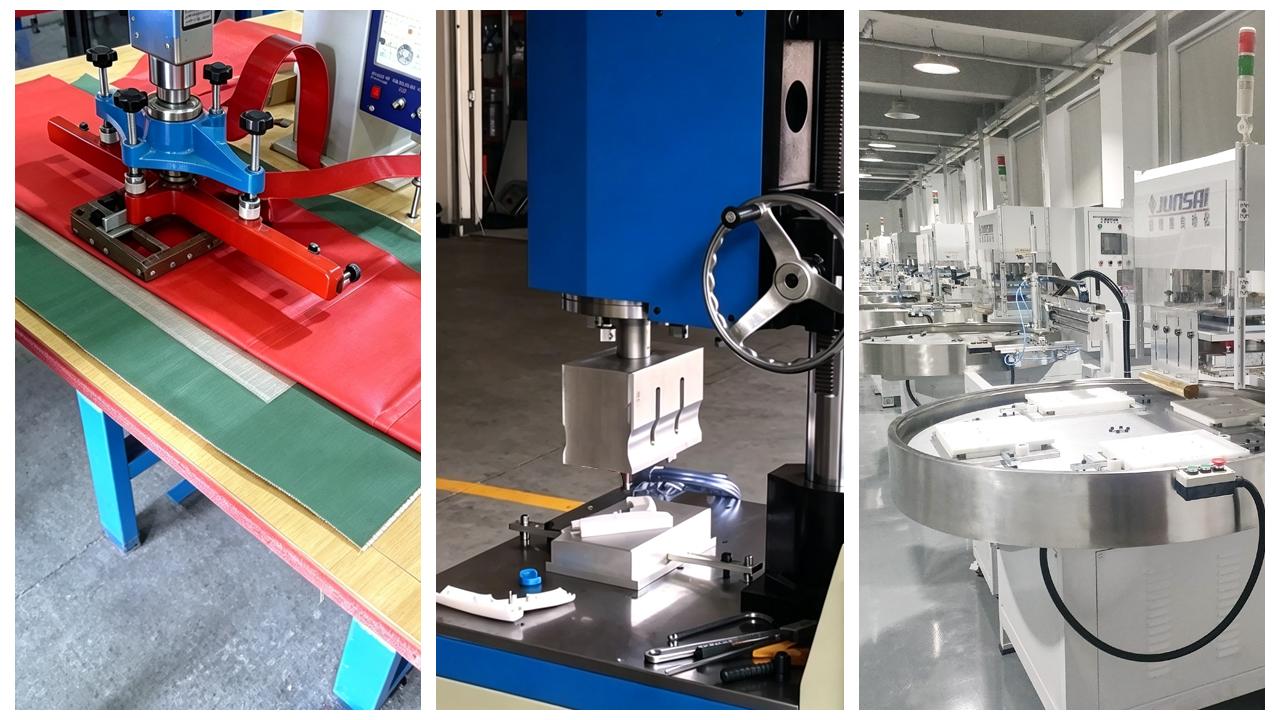
A manual RF welding machine is generally suitable for small production runs, customized products, prototyping, and frequent changes between jobs. A semi-automatic RF welding machine is a practical choice for manufacturers seeking a balance between production efficiency and investment. An automatic RF welding machine is better suited to high-volume production with stable product designs, repeatable processes, and consistent demand.
The best choice is not necessarily the machine with the highest automation level. Manufacturers should compare actual cycle time, labor cost per finished part, changeover time, welding quality, tooling requirements, and expected output before making a decision.
The main difference between manual, semi-automatic, and automatic RF welding machines is how much of the production cycle is controlled by the operator and how much is performed by the machine.
A manual RF welding machine relies heavily on an operator to position materials, align the welding area, initiate the welding cycle, and remove the finished product. Depending on the machine design, the operator may control the electrode movement manually or use a powered press with manually loaded parts.
How it works
The operator places the material between the electrode and the lower fixture, checks its position, and starts the welding cycle. The machine applies the programmed or adjusted welding parameters, including RF power, welding time, and pressure. After the cycle finishes, the operator removes the part and prepares the next one.
Advantages
Limitations
Typical applications
Manual RF welding machines are often used for sample production, repair or specialty operations where appropriate, small batches of inflatable products, and custom plastic components that require frequent setup changes.
For example, a manufacturer producing several designs of inflatable cushions may prefer a manual RF welder because the work involves different sizes, electrode shapes, and production quantities. A dedicated automatic line may not be economical if each design requires a different setup and demand changes frequently.
A semi-automatic RF welding machine combines operator handling with automated or controlled machine functions. The operator usually loads and positions the materials, while the equipment manages defined parts of the welding cycle, such as electrode movement, pressure application, RF output, and cycle timing.
The specific automation level varies by model. Some machines use pneumatic or hydraulic presses and programmable controls, while others include indexing tables, assisted material positioning, or additional safety interlocks.
How it works
The operator places the materials in the fixture and initiates the cycle. The machine then performs the configured welding sequence. Once the cycle ends, the operator removes the welded part and prepares the next workpiece. The machine may provide repeatable settings for welding time, pressure, and other process parameters.
Advantages
Limitations
Typical applications
Semi-automatic RF welding machines are suitable for manufacturers producing medical bags, flexible containers, inflatable components, and other products in moderate quantities. They can also be a good option for factories that need more consistent production but cannot justify a fully automated line.
For example, a medical bag manufacturer may use a semi-automatic machine to weld seams on a recurring product range. Operators load the bag material into a dedicated fixture, while the machine follows a controlled welding sequence. This approach can improve repeatability without requiring automatic material feeding and unloading.
An automatic RF welding machine performs multiple production steps with limited operator intervention. Depending on its configuration, it may include automatic feeding, positioning, indexing, welding, cooling, cutting, unloading, or product transfer.
Automation can be built around a rotary table, conveyor system, robotic handling unit, or dedicated production line. Not every automatic RF welding machine includes every function, so the actual configuration should be checked against the required production workflow.
How it works
Materials enter the machine through the configured feeding or loading system. Sensors, fixtures, indexing mechanisms, or programmed controls position the workpiece for welding. The RF generator supplies energy during the welding cycle, and the machine applies the required pressure and timing. Additional stations may cool, trim, cut, inspect, or transfer the finished product.
A properly designed automatic system coordinates these steps to reduce unnecessary handling and maintain a repeatable production sequence.
Advantages
Limitations
Typical applications
Automatic RF welding machines are often suitable for large production runs of medical bags, inflatable products, flexible containers, and other components with stable dimensions and repeatable welding patterns.
For example, a manufacturer producing a high volume of similar inflatable products may use an automatic system with indexed fixtures and programmed welding stations. Depending on the product design, additional stations can perform trimming or transfer the welded parts to the next production stage.
Automation is most effective when the product design, material supply, welding process, and quality requirements have already been validated.
| Comparison factor | Manual RF welding | Semi-automatic RF welding | Automatic RF welding |
|---|---|---|---|
| Operator involvement | High | Moderate | Low during the automated cycle |
| Initial investment | Generally lower | Moderate | Generally higher |
| Production volume | Low or variable | Medium or recurring | High and repeatable |
| Cycle consistency | Depends heavily on operator and controls | More standardized | High potential with validated settings |
| Material loading | Usually manual | Usually manual or assisted | May be automatic |
| Product changeover | Often flexible | Depends on fixtures and settings | Can require dedicated tooling and programming |
| Labor requirements | Higher per unit in many cases | Moderate | Lower direct handling labor in suitable applications |
| Process monitoring | Basic to advanced, depending on model | Programmable controls may be available | More opportunities for integrated monitoring |
| Maintenance complexity | Often relatively simple | Moderate | May involve more integrated systems |
| Best suited for | Samples, custom jobs, small batches | Repeated production with moderate volumes | Large, stable production runs |
The table describes common configurations rather than fixed rules. A manual machine with well-designed tooling and controls may deliver excellent results, while an automatic machine with poor process settings can still produce defective welds. Machine configuration and process validation matter as much as the automation category.
Production efficiency should be measured by the number of acceptable finished products produced over a defined period, not simply by the machine's advertised welding cycle.
Manual machines may have longer overall cycle times because operators handle loading, positioning, unloading, and inspection. Semi-automatic machines reduce some of the variation in the welding sequence, while automatic systems can coordinate multiple steps.
However, the welding time itself may be similar across machine types when the material, electrode geometry, weld area, and process parameters are comparable. Automation often improves total production throughput by reducing non-welding time.
A useful way to estimate output is:
Good parts per hour = 3,600 × yield rate ÷ cycle time in seconds
This simplified formula assumes one finished part per cycle. For multi-cavity tooling or machines that weld several parts at once, adjust the calculation for the number of parts produced per cycle.
For example, if a machine completes one cycle every 30 seconds and produces one part per cycle, its theoretical output is 120 parts per hour. At a 95% acceptable-part rate, the estimated output is 114 good parts per hour before accounting for downtime, breaks, and other production losses.
Actual output should be measured during a representative production trial.
Manual RF welding typically requires more operator attention per part. Semi-automatic equipment can reduce the time spent controlling each welding cycle, while automatic systems may reduce repetitive handling across the production line.
When comparing equipment, calculate labor cost per acceptable part rather than comparing labor headcount alone. Include loading, inspection, material preparation, changeovers, rework, and maintenance support where relevant.
All three machine types can produce high-quality welds when the materials, tooling, and parameters are suitable. The difference lies in how consistently the process is repeated.
Semi-automatic and automatic systems can standardize cycle timing and machine movement. Automatic positioning and controlled fixtures may also reduce alignment variation. Nevertheless, operators still need to load materials correctly where manual loading remains part of the workflow.
Consistent weld quality requires suitable RF power, electrode design, pressure, dwell time, material thickness, and cooling conditions. Too much energy can cause burning, arcing, sticking, or material damage, while insufficient energy may lead to weak or incomplete welds.
The medical industry uses RF welding for selected flexible thermoplastic products that require reliable seams, dimensional consistency, and, in some applications, fluid-tight or airtight performance.
Examples include compatible medical bags, fluid containers, flexible pouches, and selected components used in medical devices. The appropriate welding process depends on the material, product construction, intended use, and applicable regulatory requirements.
Manual equipment may be suitable for development samples, small batches, or specialized products with frequent design changes. It allows operators to work with different fixtures and part geometries without investing in a fully automated line.
For products with strict sealing or traceability requirements, the process must still be validated. Manual operation alone does not establish that a weld meets medical quality standards.
Semi-automatic equipment can help manufacturers standardize welding parameters and reduce variation in repetitive operations. Fixtures can improve alignment, while controlled machine cycles can help operators follow documented procedures.
This configuration may suit recurring production of medical bags and other compatible flexible components where product volumes justify more controlled processing but full automation is unnecessary.
Automatic RF welding can support high-volume manufacturing when the product design and process are stable. Material feeding, positioning, welding, transfer, and inspection can be integrated into a documented production workflow.
For medical products, manufacturers should consider process validation, equipment qualification, material traceability, inspection requirements, and applicable quality-system standards. An automated process can improve repeatability, but it does not by itself guarantee compliance or make a product suitable for medical use.
Inflatable products often require long seams, shaped welds, and reliable joints that withstand internal air pressure. Applications may include inflatable boats, air mattresses, advertising inflatables, inflatable cushions, and other products made from RF-weldable materials.
The best machine depends on the product's dimensions, weld layout, material thickness, and production quantity.
Manual RF welding is useful for large or irregular products, prototypes, and small batches that need frequent repositioning.
Semi-automatic RF welding suits recurring products that benefit from fixed tooling and controlled welding cycles while still requiring manual material placement.
Automatic RF welding can improve throughput for repeatable products with consistent dimensions and stable production demand. Depending on the design, rotary tables or dedicated fixtures can help organize loading, welding, cooling, and unloading.
For inflatable products, a strong-looking seam is not enough to prove performance. Manufacturers should establish suitable leak testing, seam-strength testing, and other product-specific acceptance criteria.
Choosing the correct machine type is only one part of achieving consistent welding results. The following factors influence the performance of an RF welding process.
RF welding works best with materials that respond appropriately to a high-frequency electromagnetic field. PVC is widely used, and certain other polar thermoplastics may also be suitable. Material grade, plasticizers, coatings, additives, and multilayer construction can affect the result.
Thin plastic sheets may be suitable for RF welding if their composition and thickness are compatible with the process. The term “thin plastic” alone does not establish weldability.
The RF generator supplies the high-frequency electrical energy used during welding. Its power capacity, frequency, control characteristics, and compatibility with the electrode and load influence the usable process window.
A higher-rated RF generator does not automatically produce better welds. Power selection should match the material, weld area, tooling, and required cycle time.
The electrode determines the weld shape and influences how energy is distributed across the joint. Poorly designed tooling may create uneven heating, inconsistent seams, or localized overheating.
Fixtures also help keep materials aligned, especially when products have complex shapes or narrow sealing areas.
Welding time and pressure must suit the material and joint geometry. Too little energy or pressure can cause incomplete bonding, while excessive energy may damage the material or create weak areas.
Manufacturers should develop and validate settings for each product rather than copying parameters from a different material or machine.
The joint may need to remain under pressure during cooling so it can stabilize before removal. Depending on the application, cooling time, handling, and post-weld inspection can influence final dimensions and seam integrity.
Automatic cooling or transfer functions may reduce handling time, but the correct sequence depends on the product and process requirements.
Before selecting equipment, review the following factors.
Estimate current demand, expected growth, and the number of acceptable parts required per shift. Low or unpredictable demand may favor manual equipment. Recurring medium-volume production may justify semi-automatic equipment, while high-volume, repeatable production may support investment in automation.
Confirm the exact material grade, thickness, coatings, and layer structure. Test the material using representative samples before finalizing machine specifications.
If the material is not suitable for dielectric welding, another welding method or joining technology may be more appropriate.
Simple parts with repeatable weld lines are generally easier to fixture and automate. Large, irregular, or frequently changing products may require more operator flexibility.
Ask the supplier whether the proposed electrode, fixture, and machine layout can accommodate the product dimensions and weld geometry.
The purchase price is only one part of the investment. Include tooling, installation, operator training, maintenance, consumables, energy use, changeovers, scrap, and downtime.
A higher-priced automatic system may reduce cost per acceptable part at sufficient volume. At low utilization, its additional capacity may not offset the investment.
Determine whether the product requires visual inspection, seam-strength testing, leak testing, dimensional checks, or traceability records.
For products requiring an airtight seal, the machine should be selected alongside a suitable inspection and testing plan. Do not assume that a particular automation level guarantees leak-free results.
If your factory produces many product variations, assess how long it takes to replace electrodes, change fixtures, update settings, and verify the first acceptable part.
A flexible manual or semi-automatic machine may be more productive overall when frequent changeovers would leave a dedicated automatic line underutilized.
Ask about preventive maintenance, spare parts, RF generator servicing, troubleshooting, operator training, and technical support. For automatic lines, also review the support available for sensors, controls, pneumatic or hydraulic systems, and material-handling components.
Where possible, test representative materials and finished-product designs on the proposed equipment. Measure actual cycle time, acceptable-part rate, setup time, weld consistency, and operator workload.
A production trial provides a more reliable basis for comparison than machine specifications alone.
Choosing automation based only on maximum speed. A high-speed machine may not improve overall output if loading, changeovers, inspection, or material supply becomes the bottleneck.
Assuming every plastic can be RF welded. Material compatibility must be confirmed. Some plastics require alternative joining methods.
Selecting an RF generator by power rating alone. Power capacity must match the welding area, material properties, tooling, and process window.
Ignoring fixture and electrode costs. Specialized products may require custom tooling, which can affect both the initial investment and future changeovers.
Overlooking quality verification. A visually acceptable seam may still fail leak or strength testing. Establish measurable acceptance criteria.
Automating an unstable process. If materials, product dimensions, and welding parameters have not been standardized, automation can reproduce defects at a higher rate. Validate the process before expanding production.
Manual RF welding machines require more operator involvement in loading, positioning, and unloading. Automatic RF welding machines can perform several of these tasks through programmed controls and material-handling systems. Automatic equipment generally suits higher-volume, repeatable production, while manual machines offer greater flexibility for small batches and custom jobs.
A semi-automatic RF welding machine can be a good investment when production demand is recurring, operators spend substantial time controlling each welding cycle, and full automation is not yet economical. It can standardize machine movement and cycle timing while retaining manual loading and unloading.
RF welding machines commonly weld PVC and certain other compatible polar thermoplastics. Material composition, thickness, coatings, additives, and construction influence weldability. Polyethylene and polypropylene generally are not directly suited to conventional RF welding and may require alternative processes or specialized solutions.
Yes. RF welding is commonly known as high frequency welding or dielectric welding. It uses high-frequency electromagnetic energy to generate heat within compatible materials, allowing them to bond under pressure.
Radio frequency welding uses an alternating electromagnetic field to produce dielectric losses within a suitable material. The resulting molecular-scale energy dissipation generates heat internally. Pressure brings the material surfaces together so they can form a bond under the correct process conditions.
Yes, RF welding is used for compatible thermoplastic medical bags and other flexible medical components. Suitability depends on material compatibility, product design, sealing requirements, and applicable quality and regulatory requirements. Manufacturers should validate the process and verify the finished product against defined acceptance criteria.
Yes, RF welding can create airtight seams in compatible materials when the material, electrode, welding parameters, and process controls are suitable. Leak testing or another appropriate verification method should be used when airtight performance is required.
The RF generator supplies high-frequency electrical energy to the welding system. Its power capacity and operating characteristics affect the available process range. The generator must be matched to the material, weld area, electrode design, and production requirements.
No. Automation can improve positioning and process repeatability, but weld quality also depends on material compatibility, electrode design, pressure, energy input, cooling, and maintenance. A well-configured manual or semi-automatic machine can produce high-quality welds when the process is properly controlled.
For a machine producing one part per cycle, divide 3,600 by the total cycle time in seconds to estimate theoretical parts per hour. Multiply this result by the acceptable-part rate to estimate good parts per hour. For multiple parts per cycle, multiply by the number of parts produced per cycle. Account separately for downtime, changeovers, and other production losses.
The answer depends on the plastic type, sheet thickness, joint design, and required weld quality. Compatible thin thermoplastic sheets can be welded using manual, semi-automatic, or automatic RF welding equipment. Material testing and process development should determine the appropriate machine configuration and settings.
Not in every application. RF welding is useful for compatible materials and applications requiring shaped, repeatable seams. Hot-air welding, hot-wedge welding, ultrasonic welding, heat sealing, and other welding methods may be more appropriate depending on material properties, product geometry, production volume, and sealing requirements.
The price depends on machine power, working area, tooling, safety features, control system, automation level, and optional feeding or handling equipment. Manual machines generally require a smaller initial investment than comparable automated systems, but actual costs vary. Request a quotation based on the product, material, target output, and required functions.
Ask whether the machine can weld your exact material, whether the supplier can run a sample test, what output is achievable under real production conditions, what tooling is required, and how weld quality will be verified. Also confirm safety features, maintenance requirements, spare-parts availability, training, warranty, and technical support.
Manual, semi-automatic, and automatic RF welding machines serve different production needs. Manual machines offer flexibility for small batches and customized work. Semi-automatic equipment provides a practical balance between operator involvement and process repeatability. Automatic RF welding machines can improve throughput and reduce handling for stable, high-volume production.
The right choice depends on material compatibility, product geometry, expected output, changeover frequency, quality requirements, and total operating cost. Before investing, test representative materials, measure actual production performance, and confirm that the machine can meet your product's welding and inspection requirements.
For manufacturers producing medical bags, inflatable products, flexible plastic components, or other RF-weldable products, a machine selection process based on real samples and measurable results is more reliable than choosing equipment by automation level alone.
Contact an experienced RF welding machine manufacturer to discuss your material, product dimensions, weld design, and target output. A sample welding trial can help establish a suitable machine configuration and process before you commit to production equipment.