For cooperation and more details, feel free to email us or call directly for consultation.

Home > News & Blog > Knowledge > What Is the Difference Between RF Welding and High Frequency Welding?
RF welding and high frequency welding are two names for the same industrial joining process in most manufacturing contexts. Both use high-frequency electromagnetic energy to generate heat inside suitable thermoplastic materials, allowing the material surfaces to bond under pressure without relying on a conventional external heat source.
The main difference is terminology rather than the underlying process. RF welding stands for radio frequency welding, while high frequency welding describes the high-frequency electrical energy used to produce the weld. In industrial applications, both terms commonly refer to dielectric welding, particularly when joining PVC and other polar thermoplastic materials.
Understanding how RF welding works, which materials it can join, and how it compares with other welding methods helps manufacturers select suitable equipment for inflatable products, medical bags, industrial components, and flexible plastic assemblies.
RF welding and high frequency welding generally describe the same process. Both use a high-frequency electromagnetic field to generate heat within compatible thermoplastic materials. The resulting heat softens the material at the joint, and pressure is applied to create a strong bond. The weld remains under pressure while the material cools.
The terms are often interchangeable in equipment specifications, manufacturing discussions, and product descriptions. However, manufacturers should verify the machine's operating frequency, output power, electrode design, and material compatibility rather than assuming that every machine marketed under either name has identical capabilities.
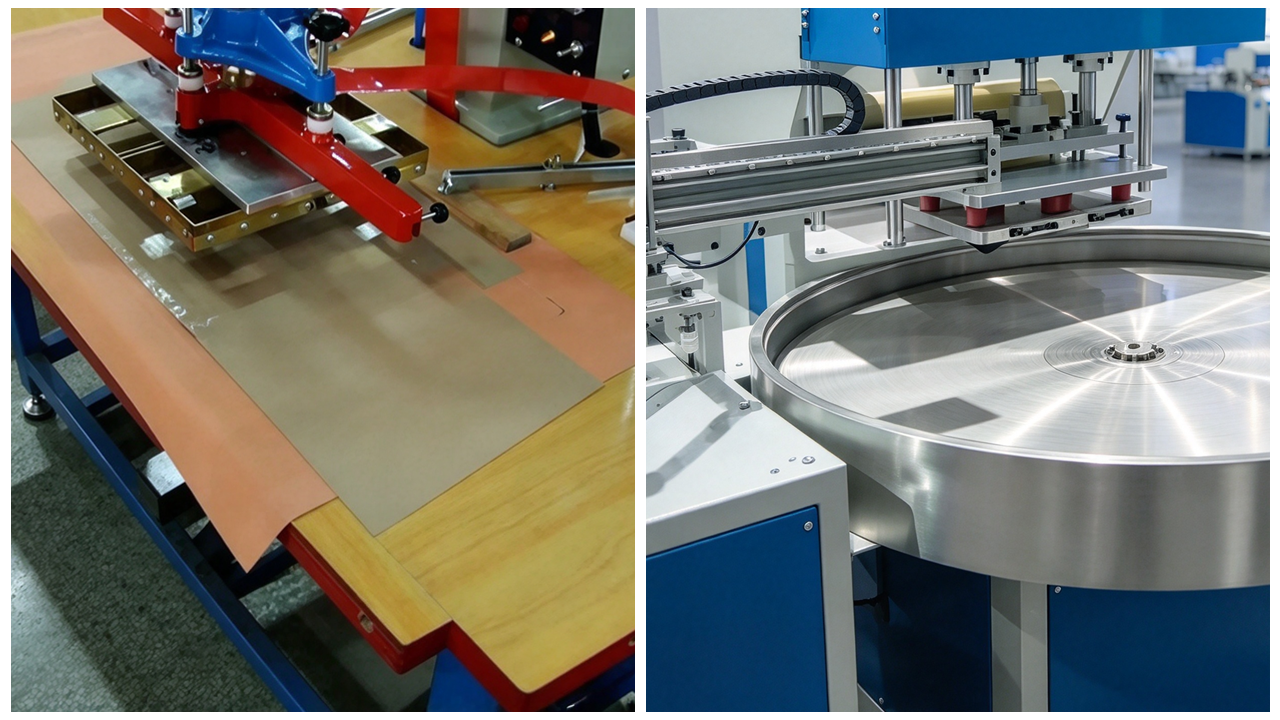
Radio frequency (RF) welding is a thermal joining technique that uses a high-frequency alternating electric field to heat compatible dielectric materials internally. The process is also known as high frequency welding or dielectric welding.
When a suitable material is exposed to the electromagnetic field, its polar molecules respond to the changing field. This molecular movement and associated dielectric losses generate heat within the material. Once the joint reaches the required temperature, pressure brings the softened surfaces together. After the material cools, the resulting weld forms a continuous bond.
Unlike conventional hot air welding, RF welding does not depend primarily on hot air or another external heat source to soften the joining surfaces. Instead, RF energy generates heat within the material itself.
The terms RF welding and high frequency welding are generally interchangeable in industrial manufacturing.
In practical applications, a manufacturer advertising an RF welding machine may offer equipment similar in function to a machine described as a high frequency welding machine.
The exact operating frequency can vary by equipment design and application. Buyers should check the technical specifications instead of relying on the product name alone.
Both RF welding and high frequency welding use electromagnetic energy to generate heat within compatible materials.
When the machine applies a high-frequency electric field, polar molecules in the material respond to the changing field. Their response, together with dielectric losses, produces heat. The temperature rises primarily in the material exposed to the field, particularly around the intended weld area.
This process differs from conventional heat sealing, where heated elements transfer heat to the material from the outside. It also differs from hot air welding, which uses heated gas to warm the joining surfaces.
Because RF welding generates heat internally, it can produce localized welds without requiring the entire component to reach the same temperature.
Both processes are most commonly associated with polar thermoplastic materials.
PVC is widely used because its dielectric properties make it suitable for RF welding. Certain grades of polyurethane (PU), thermoplastic polyurethane (TPU), and other compatible polymers may also be weldable, depending on their formulation and dielectric response.
Not every thermoplastic material can be welded successfully using RF energy. Polyethylene (PE) and polypropylene (PP), for example, generally have low dielectric losses and are not well suited to conventional RF welding without specialized material formulations or alternative joining methods.
Material compatibility depends on more than the polymer name. Thickness, additives, plasticizers, moisture, surface condition, and the material's dielectric properties can all affect welding performance.
Before selecting an RF welder, manufacturers should test the actual material grade and thickness under representative production conditions.
An RF welding machine and a high frequency welding machine generally contain similar functional components:
The machine applies RF energy while the material is held in the welding area. After the joint reaches the required condition, the RF output stops and pressure is maintained while the material cools.
Although the names may be interchangeable, equipment designs can differ in frequency, power output, electrode geometry, automation, and production capacity. These factors should guide equipment selection.
RF welding can create strong, continuous weld seams when the material, electrode design, process parameters, and machine configuration are properly matched.
For applications requiring leak resistance, the welding process must create a consistent bond across the entire joint. Inadequate energy may produce weak seams, while excessive energy can cause material degradation, discoloration, thinning, or damage around the weld.
Pressure also affects the result. The machine must apply sufficient and consistent pressure to bring the softened surfaces into contact without excessively squeezing or damaging the material.
After the RF output stops, the material cools under pressure. This cooling stage helps stabilize the joint and preserve its shape.
For products that contain air or liquid, manufacturers should evaluate the completed weld seams using appropriate leak, burst, peel, tensile, or other application-specific tests.
RF welding technology joins compatible thermoplastic materials through a controlled sequence of electromagnetic heating, pressure application, and cooling.
The operator places the thermoplastic sheets or components between the welding electrodes. The material must be correctly aligned so that the intended joint receives uniform heating.
For repeatable production, fixtures and automated positioning systems may be used to maintain consistent placement.
The welding machine generates a high-frequency electric field across the material.
Polar molecules respond to the alternating field, and dielectric losses generate heat within the material. This is how RF welding heat is produced without relying primarily on an external heat source.
The amount of heat generated depends on the material's dielectric properties, field strength, operating frequency, thickness, and welding time.
As the material reaches the required welding condition, the machine applies pressure through the electrodes or welding dies.
This pressure brings the softened surfaces into close contact, allowing the materials to fuse into a continuous joint. The combination of RF energy and controlled pressure helps create a consistent weld profile.
Once the welding cycle reaches its target, the machine stops supplying RF energy.
Pressure is maintained while the material cools and the joint stabilizes. This step helps the weld retain its shape and reduces the risk of deformation when the electrodes release the component.
The finished part is checked against the application's quality requirements. Depending on the product, inspection may include visual examination, dimensional checks, peel-strength testing, leak testing, or destructive sampling.
Production parameters should be validated for the specific material, product design, and required service conditions.
No. RF welding and hot air welding are different welding techniques, even though both can join certain thermoplastic materials.
RF welding uses a high-frequency electromagnetic field to generate heat inside suitable dielectric materials. Hot air welding uses heated air to soften the material surfaces before pressure or another joining action creates the bond.
The choice depends on the material, component geometry, seam design, production volume, and required joint performance.
RF welding is well suited to compatible polar materials, especially PVC. It is frequently used for inflatable products, flexible containers, medical bags, and other components that need consistent welded seams.
The process can create defined weld patterns with custom electrodes and may be automated for repeatable production.
Hot air welding directs heated air at the surfaces to be joined. The material is softened by heat transferred from the hot air, after which the surfaces are pressed together.
It is commonly used for compatible thermoplastic films, coated fabrics, membranes, and sheet materials. Depending on the material and application, hot air welding may be preferable when RF welding is unsuitable.
| Feature | RF Welding | Hot Air Welding |
|---|---|---|
| Heat source | High-frequency electromagnetic energy | Heated air |
| Heating mechanism | Dielectric losses generate internal heat | Heat transfers from hot air to the surfaces |
| Material requirements | Best suited to compatible dielectric materials, especially polar polymers | Depends on the material's response to external heating |
| Tooling | Typically uses electrodes or shaped welding dies | Typically uses a hot air nozzle and pressure mechanism |
| Weld geometry | Well suited to defined patterns and shaped welds | Well suited to seams and joints accessible to the heated air stream |
| Typical applications | PVC inflatable products, medical bags, flexible components | Compatible films, coated fabrics, membranes, and sheet materials |
Neither method is universally better. Manufacturers should select the process that matches the material's properties and the finished product's performance requirements.
RF welding is used across industries where compatible thermoplastic materials must form strong, repeatable joints.
Inflatable products are one of the best-known applications of RF welding. Examples include inflatable boats, air mattresses, inflatable advertising structures, water toys, and certain inflatable safety products.
RF welding can create continuous seams that help prevent air leakage. The electrode design determines the seam geometry, while controlled heating and pressure support consistent joint quality.
For products exposed to repeated inflation, folding, abrasion, or changing temperatures, manufacturers should validate seam strength and air retention under realistic operating conditions.
RF welding can be used to manufacture compatible PVC medical bags, fluid containers, and selected flexible medical components.
The process allows manufacturers to produce repeatable seams and defined joint patterns. Medical applications may also require validated production processes, material traceability, cleanliness controls, and compliance with relevant regulatory requirements.
The suitability of RF welding depends on the material formulation and the product's intended use.
Compatible coated fabrics and thermoplastic sheets may be used in industrial covers, protective enclosures, flexible tanks, and other fabricated products.
RF welding can help form shaped seams and localized joints. Product design, material thickness, and exposure to chemicals or weather should be considered when determining the appropriate welding method.
Certain automotive and industrial components made from compatible dielectric materials can be joined using RF welding.
Examples may include flexible covers, protective components, and selected assemblies that benefit from repeatable seam geometry. The process must be evaluated against the component's mechanical, thermal, and environmental requirements.
Selecting the right RF welder requires more than comparing rated power or machine size. Buyers should assess material compatibility, weld dimensions, production requirements, and the expected quality of the finished joint.
Confirm that the actual thermoplastic material can be welded using RF energy. Obtain material specifications where available and test representative samples before purchasing equipment.
Material thickness and layer structure affect heat generation and the required welding cycle.
The dimensions and shape of the weld determine the electrode design and the working area needed.
Large inflatable products may require a different machine configuration from small medical components or narrow industrial seams.
The generator must provide suitable output for the application, while the pressing mechanism must deliver controlled and repeatable pressure.
Welding time, RF output, electrode geometry, and hold time should be adjustable to support process development and production consistency.
A manual RF welding machine may be suitable for smaller production runs or customized products. High-volume manufacturing may benefit from automated positioning, programmable cycles, multi-station equipment, or specialized production lines.
Buyers should also consider changeover time, maintenance requirements, operator training, and the availability of replacement electrodes.
RF welding equipment should incorporate appropriate electromagnetic shielding, interlocks, grounding, and other safeguards based on its design and applicable standards.
Manufacturers should also establish inspection procedures and verify the finished product against defined acceptance criteria. Leak-sensitive products may require pressure-decay testing, immersion testing, or other validated methods.
Even when the correct equipment is used, poor process settings or inconsistent materials can result in defective joints.
Weak seams may result from insufficient RF energy, inadequate pressure, short welding time, unsuitable materials, or poor electrode contact.
The solution is to verify material compatibility and adjust the process using controlled trials rather than increasing power without evaluating other variables.
Excessive RF energy, excessive welding time, uneven electrode contact, or inappropriate tooling can damage the material.
Reducing energy input, reviewing the electrode design, and checking pressure distribution may help correct the problem.
Variation in material thickness, positioning, pressure, electrode condition, or generator output can cause inconsistent results.
Standardized material specifications, routine equipment maintenance, controlled machine settings, and regular quality checks help reduce variation.
Leaks can occur when a seam contains gaps, weakly bonded sections, or damaged material.
Manufacturers should inspect the entire weld path and use application-appropriate leak testing. Simply increasing welding energy may not solve the problem if the underlying cause is poor alignment, unsuitable material, or inconsistent pressure.
For most industrial applications, both terms are acceptable.
Use RF welding when the target audience commonly searches for radio frequency welding machines, RF welders, or RF welding equipment.
Use high frequency welding when the market, industry, or customer terminology favors that expression. It is also useful to include both terms in technical product descriptions so that buyers can recognize the relationship between them.
A clear product description might state:
"High frequency RF welding machines use radio frequency electromagnetic energy to join compatible thermoplastic materials, producing consistent weld seams for inflatable products, medical bags, and industrial applications."
This wording explains the process without suggesting that RF welding and high frequency welding are fundamentally different technologies.
Yes. In most industrial manufacturing contexts, RF welding and high frequency welding describe the same process. Both use high-frequency electromagnetic energy to generate heat within compatible dielectric materials and form a bond under pressure.
The process is called dielectric welding because heat is generated through dielectric losses when a suitable material is exposed to an alternating electric field. Polar molecules respond to the changing field, contributing to internal heat generation.
No conventional external heat source is required to generate the welding heat. RF energy produces heat within compatible materials. The machine still uses electrodes, a generator, and a pressing mechanism to complete the welding cycle.
PVC is one of the most commonly RF-welded materials. Certain grades of TPU, polyurethane, and other compatible polymers may also be suitable. Material formulation and dielectric properties must be evaluated before production.
Yes. RF welding can produce leak-resistant seams in properly designed and manufactured products. Performance depends on material compatibility, seam geometry, welding parameters, and quality control. Inflatable products and fluid containers should undergo appropriate leak testing.
RF welding generates heat within compatible dielectric materials using a high-frequency electromagnetic field. Hot air welding uses heated air to soften the joining surfaces. RF welding is commonly used for PVC inflatable products and other compatible components, while hot air welding is suitable for a different range of thermoplastic films, fabrics, and membranes.
The terms often refer to the same type of equipment, but individual machines are not automatically interchangeable. Operating frequency, power output, electrode dimensions, pressure capacity, automation, and material compatibility must be checked before selecting a replacement or alternative machine.
Pressure brings softened material surfaces into contact and helps form the joint. Maintaining pressure while the material cools helps stabilize the weld. Insufficient or uneven pressure can result in weak or inconsistent seams, while excessive pressure may damage or distort the material.
No. RF welding works best with materials that respond sufficiently to a high-frequency electric field. PVC is a common choice, while materials such as PE and PP generally have low dielectric losses and are less suitable for conventional RF welding.
Buyers should assess material compatibility, material thickness, weld dimensions, generator output, pressure control, production volume, automation needs, safety features, and after-sales support. Testing representative materials and finished components before production helps establish suitable process parameters.
RF welding and high frequency welding generally refer to the same industrial joining technology. Both use high-frequency electromagnetic energy to generate heat within compatible thermoplastic materials, followed by pressure application and controlled cooling to form the joint.
The practical differences between machines lie in their specifications, tooling, automation, and application suitability rather than in the names alone. For manufacturers working with inflatable products, medical bags, flexible containers, and other compatible thermoplastic components, evaluating material properties and validating weld quality are the best ways to select an appropriate RF welding solution.