For cooperation and more details, feel free to email us or call directly for consultation.

Home > News & Blog > Knowledge > RF Welding vs. Hot Air Welding vs. Hot Wedge Welding
Choosing the right welding method affects seam strength, production speed, material compatibility, and the long-term performance of industrial products. For manufacturers working with thermoplastic films, coated fabrics, flexible membranes, and inflatable structures, three common options are radio frequency (RF) welding, hot air welding, and hot wedge welding.
Although all three methods use heat and pressure to join compatible thermoplastic materials, they generate and transfer heat differently. RF welding uses high-frequency electromagnetic energy to generate heat inside suitable materials, while hot air welding uses a stream of heated air and hot wedge welding uses a heated metal wedge to soften the joining surfaces. The softened materials are then pressed together to form welded seams.
Each method suits different production requirements. RF welding is often selected for shaped seals, repeatable joints, and products requiring reliable leak-proof performance. Hot air welding offers flexibility for continuous seams, custom fabrication, and on-site work. Hot wedge welding is well suited to long, straight seams in large-scale membrane and coated-fabric production.
Understanding these differences helps manufacturers select suitable equipment, reduce weld defects, and balance production efficiency with finished-product quality.
RF welding, also called radio frequency welding or high frequency welding, is a dielectric heating process. The material is placed between electrodes, and an alternating electric field generates heat internally in compatible polymers. Pressure is applied to fuse the softened surfaces, and the joint cools under pressure.
Hot air welding is a thermal joining process in which a nozzle directs heated air into the overlap between two thermoplastic surfaces. The heat softens the material, and pressure rollers bring the surfaces together as the machine moves along the seam.
Hot wedge welding uses a heated metal wedge positioned between the overlapping layers. As the material passes the wedge, the joining surfaces soften. Pressure rollers then consolidate the layers into a continuous seam.
The main distinction is the way heat reaches the material. RF welding generates heat within the material through dielectric losses. Hot air transfers heat through a moving stream of heated air, while hot wedge welding transfers heat through direct contact with a heated metal tool.
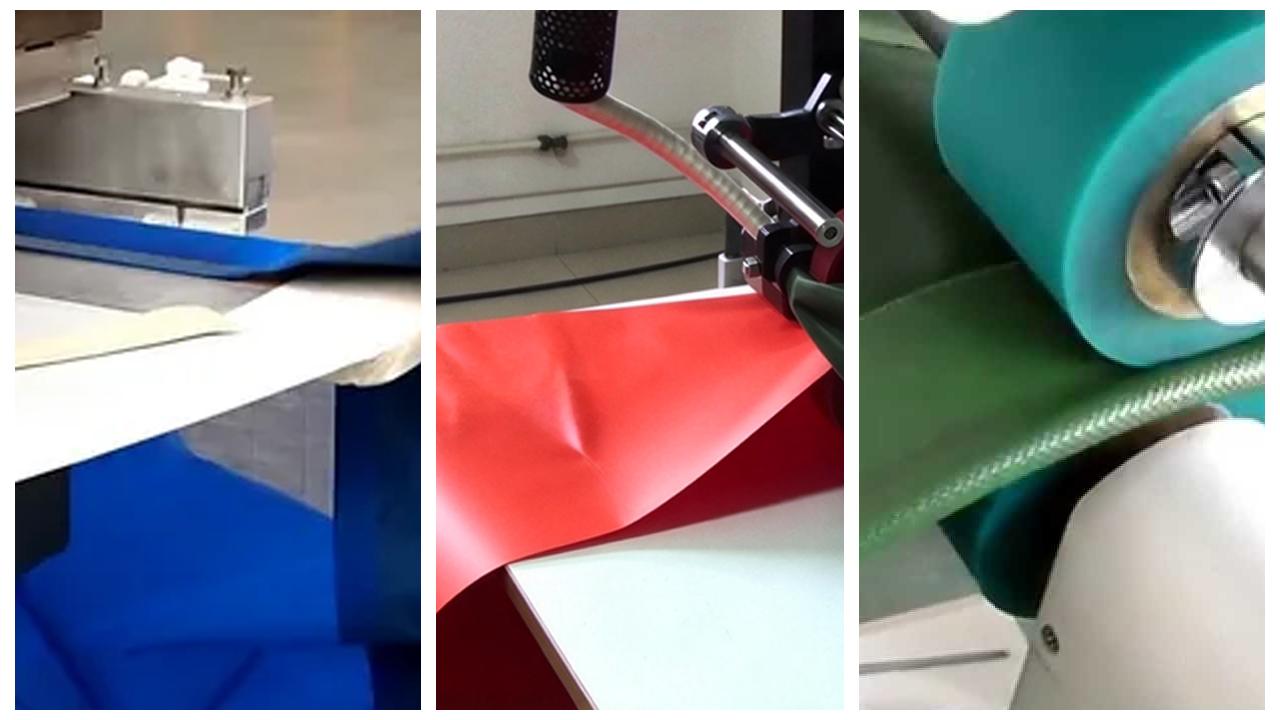
RF welding, hot air welding, and hot wedge welding all join thermoplastic materials through heat and pressure, but they use different heating mechanisms.
The best method depends on material compatibility, seam geometry, required leak resistance, production volume, equipment access, and quality specifications. No single welding process is the best choice for every application.
RF welding uses high-frequency electromagnetic energy to heat compatible dielectric thermoplastics. Industrial equipment commonly operates at 27.12 MHz, although the exact frequency and configuration depend on the machine and applicable regulations.
First, the material layers are positioned between the welding electrodes. The machine applies an alternating electric field, causing polar molecules within the material to respond to the field. Dielectric losses convert part of the electrical energy into heat.
The internal heat softens the joining region. Pressure brings the softened surfaces together, allowing the polymer chains to form a fused interface. After the RF energy stops, the joint remains under pressure while cooling and solidifying.
Because the heat is generated internally, RF welding can produce precise, repeatable welds in compatible materials without relying primarily on an external hot-air stream or heated wedge.
RF welding requires suitable material properties. PVC is widely used, while some TPU and other compatible thermoplastics may also be weldable. Standard polyethylene and polypropylene generally respond poorly to conventional RF welding because of their low dielectric losses.
The equipment also requires appropriate electrodes, electrical shielding, grounding, and safety controls. Tooling must match the product geometry, and large or complex products may require specialized machines or multiple welding operations.
RF welding is used for inflatable boats, air chambers, medical bladders, blood pressure cuffs, flexible containers, PVC stationery, and selected industrial fabric products.
It is often a good option when the design requires a defined seam pattern, repeatable dimensions, or dependable sealing performance.
Hot air welding uses heated air to soften thermoplastic surfaces before pressure is applied. The air is directed through a nozzle into the overlap between two layers, and rollers or another pressing mechanism consolidate the softened surfaces into a welded seam.
The operator or automated system aligns the materials and sets the air temperature, airflow, travel speed, and pressure. As the machine moves, heated air reaches the joining area and softens the material surfaces.
The pressure rollers then press the layers together. The joint cools behind the heating zone, forming a continuous seam.
Unlike RF welding, hot air welding does not require the material to generate heat through an alternating electric field. Its success depends on controlled heat transfer from the air stream, adequate surface softening, consistent movement, and sufficient pressure.
Weld quality depends on nozzle positioning, air temperature, airflow, travel speed, pressure, and operator or machine control. If the material receives insufficient heat, the joint may not fuse completely. Excessive heat can cause shrinkage, distortion, discoloration, or damage to the coating.
Hot air welding may require more operator skill when the process is manual. For high-volume production, automated systems and consistent material handling can reduce variation.
Typical applications include banners, awnings, tarpaulins, tents, flexible ducts, coated-fabric covers, inflatable structures, and selected waterproof products.
Hot air welding is often preferred when products have long seams, changing dimensions, or fabrication requirements that benefit from portable equipment.
Hot wedge welding uses a heated metal wedge to transfer heat directly to the overlapping surfaces of thermoplastic materials. Pressure rollers positioned after the wedge consolidate the softened layers into a continuous seam.
The machine aligns the material layers and positions the heated wedge at the overlap. As the material advances, the wedge softens the surfaces that need to be joined.
The layers then pass through pressure rollers, which press the softened surfaces together. As the welded seam cools, the materials solidify into a continuous bond.
The wedge temperature, travel speed, pressure, and contact position must be matched to the material construction. A stable setup helps maintain uniform fusion along long seams.
The heated wedge must maintain suitable contact with the material, and changes in thickness or surface condition can affect heat transfer. Incorrect temperature, pressure, or speed may cause incomplete fusion or material damage.
Wedge geometry also needs to match the seam and material. The wedge is a wear component that may require maintenance or replacement, depending on equipment design and operating conditions.
Hot wedge welding is widely used for suitable geomembranes, industrial tarpaulins, truck covers, architectural membranes, flexible containment products, and large coated-fabric assemblies.
It is particularly attractive when production involves long, relatively straight seams across large material sections.
| Comparison factor | RF welding | Hot air welding | Hot wedge welding |
|---|---|---|---|
| Heat source | High-frequency electromagnetic energy | Heated air stream | Heated metal wedge |
| Heat generation or transfer | Internal dielectric heating | Heat transferred by hot air | Heat transferred by direct contact |
| Material compatibility | Best for RF-compatible polar thermoplastics | Depends on whether the material can be softened and fused by hot air | Depends on compatibility with contact heating and the wedge process |
| Seam geometry | Shaped, defined, and repeatable seams | Long continuous and curved seams, depending on equipment | Long continuous seams, particularly straight overlaps |
| Typical production setup | Press with electrodes | Nozzle and pressure rollers | Heated wedge and pressure rollers |
| Tooling needs | Shaped electrodes are usually required | No RF electrode; nozzle and guides are used | Wedge and guides suited to the seam |
| Large-scale fabrication | Possible with suitable press size or automated systems | Well suited to many large-format products | Well suited to long seams in large sheets and membranes |
| Portability | Generally lower for industrial press systems | Portable and mobile options are available | Portable and automated options are available |
| Leak-proof seams | Suitable when material and process are validated | Possible with correct settings and quality control | Possible with correct settings and quality control |
| Main process variables | RF power, welding time, pressure, electrode design, cooling | Air temperature, airflow, speed, pressure, nozzle position | Wedge temperature, speed, pressure, wedge position |
| Typical products | PVC inflatable products, bladders, shaped seals | Banners, awnings, covers, flexible coated fabrics | Geomembranes, truck covers, architectural membranes |
These are general tendencies rather than absolute performance rankings. Equipment design, material construction, seam dimensions, operator skill, and production conditions can change the outcome.
The best method depends on the material, seam design, and required leak resistance. All three technologies can produce leak-proof welded seams when the materials are compatible and the process is properly controlled.
RF welding is worth evaluating for products that require defined sealing areas, shaped seams, and repeatable production. It is commonly used for suitable PVC products, inflatable chambers, and selected medical components.
The electrode can create a controlled seam pattern, which is useful when the product contains multiple sealed sections or needs a specific contour.
Hot air welding is a practical option for long seams, custom fabrication, and large coated-fabric products. It is particularly useful when portability, flexible seam paths, or reduced reliance on dedicated RF electrodes matters.
Leak resistance depends on achieving consistent heat penetration, correct overlap, and adequate pressure throughout the seam.
Hot wedge welding is often suitable for long, straight seams in large thermoplastic sheets or coated fabrics. The heated wedge and pressure rollers can maintain a continuous joining process across wide products.
For geomembranes and similar applications, specialized dual-track systems can create two parallel welds with an unbonded channel between them, allowing the seam to be pressure-tested where the design and applicable procedures support that method.
Do not judge a seam solely by its appearance. Depending on the product, quality checks may include visual inspection, peel or tensile testing, air-leak testing, water-leak testing, or a specified pressure test.
The test method and acceptance criteria should reflect the product's actual service conditions. A seam intended to retain air under repeated inflation may require different validation from a long geomembrane seam exposed to soil pressure and environmental conditions.
Large-scale production requires consideration of more than the maximum welding speed. Manufacturers should assess seam length, loading and unloading time, changeovers, material handling, quality inspection, equipment downtime, and rework rates.
RF welding can be productive for repeatable parts and defined weld patterns, particularly when the process is automated and the material is RF-compatible. Custom electrode tooling can be worthwhile for stable, repeated production.
Hot air welding can support large-format production when long seams, varied product dimensions, and flexible fabrication are required. Automated hot air systems can improve consistency and throughput compared with manual work.
Hot wedge welding is well suited to continuous long seams in large sheets and membranes. It can be efficient when the product design contains extended overlaps and the material can be processed reliably with a heated wedge.
The most suitable method is the one that meets seam performance requirements at an acceptable total production cost. Machine purchase price alone does not account for tooling, operator training, maintenance, energy use, inspection, or rejected products.
Material compatibility should be checked before comparing equipment specifications.
RF welding depends on dielectric properties that allow the material to generate heat under a high-frequency electric field. PVC is a common choice, and some TPU formulations can be suitable. Other materials must be assessed individually.
Hot air and hot wedge welding rely on heat transfer from the air stream or metal wedge. They can be used with many thermoplastic films and coated fabrics, provided the joining surfaces soften and fuse within a workable process window.
Coating chemistry, fabric backing, reinforcement, thickness, additives, surface contamination, and the condition of the overlap can all affect the result. Two products labeled as the same polymer may behave differently during welding.
Before committing to a process, conduct trials with the actual material construction and evaluate seam strength, appearance, leak resistance, repeatability, and production speed.
Use the following checklist when evaluating equipment:
For manufacturers comparing industrial welding equipment, application testing is more reliable than choosing a method based on general claims about strength or speed.
Incomplete fusion occurs when the material surfaces do not soften sufficiently or are not brought together under suitable pressure. Review material compatibility, heat input, travel speed, pressure, and surface preparation.
Excessive heat can cause distortion, discoloration, shrinkage, or damage to the coating. Adjust the relevant energy or temperature settings and confirm that the material remains within its acceptable processing range.
Variation can result from uneven material thickness, misalignment, unstable machine speed, inconsistent pressure, or worn tooling. Regular inspection and controlled setup procedures help reduce variation.
Leakage may result from gaps, contaminated surfaces, incomplete fusion, wrinkles, or inconsistent seam width. Identify the failure location and use a suitable leak or pressure test rather than relying on visual inspection alone.
Material tension, uneven heat input, incorrect pressure, or unstable handling can create wrinkles and distortion. Review the complete material-feed and welding setup, not just the temperature setting.
RF welding uses high-frequency electromagnetic energy to generate heat inside compatible dielectric materials. Hot air welding uses a stream of heated air to soften the joining surfaces before pressure is applied. RF welding is often suited to shaped, repeatable seals, while hot air welding is useful for long seams and flexible fabrication.
Hot air welding transfers heat through a nozzle that directs heated air into the material overlap. Hot wedge welding uses a heated metal wedge that contacts the joining surfaces directly. Both typically use pressure rollers to consolidate the seam, but the heat-transfer mechanism differs.
There is no universally best method. RF welding, hot air welding, and hot wedge welding can all produce leak-proof seams when the material, equipment, and process parameters are suitable. The choice should be based on the product design and verified through appropriate leak testing.
Hot air and hot wedge welding are commonly used for long seams in large-format products. Hot wedge welding is especially suitable for extended straight overlaps, while hot air welding offers flexibility across different seam paths. RF welding can be highly productive for repeatable components and shaped seals when suitable materials and tooling are used.
Yes. PVC is widely used in RF welding because its dielectric properties generally support internal heat generation under a high-frequency electric field. The specific PVC formulation, thickness, coating, and product construction should still be tested.
Yes. Both methods can create waterproof seams in compatible thermoplastic materials when heat, speed, pressure, and material overlap are properly controlled. Finished products should be tested under conditions appropriate to their intended use.
Hot air welding often requires less dedicated tooling for changing seam patterns because it does not rely on a custom RF electrode or a product-specific heated wedge. However, guides, nozzles, fixtures, and other tooling may still be needed. Total tooling cost depends on the product and machine configuration.
Use compatible materials, maintain clean joining surfaces, control heat input and travel speed, apply consistent pressure, and inspect the finished seam. Establish process settings through production-representative trials and verify performance with suitable peel, tensile, leak, or pressure tests.
Hot wedge welding is commonly used for compatible thermoplastic geomembranes and similar sheet materials, especially when long continuous seams are required. The membrane formulation, thickness, site conditions, welding parameters, and project specifications determine whether it is appropriate.
Start with the material and seam requirements. Compare the required seam geometry, leak resistance, production volume, portability, automation, tooling cost, maintenance, and quality-control procedures. Test the actual material on the proposed equipment before making a final selection.
RF welding, hot air welding, and hot wedge welding all create fused joints in compatible thermoplastic materials, but each method addresses different manufacturing needs.
RF welding uses high-frequency electromagnetic energy to generate internal heat and is often suited to shaped, repeatable seals in RF-compatible materials. Hot air welding transfers heat through a controlled stream of heated air and offers flexibility for continuous seams, large products, and on-site fabrication. Hot wedge welding transfers heat through a heated metal wedge and is well suited to long seams in large sheets and membranes.
The right choice depends on material compatibility, seam geometry, leak-proof performance, production scale, and total operating cost. Manufacturers should validate the process using actual production materials and measurable seam-quality requirements before selecting equipment.