For cooperation and more details, feel free to email us or call directly for consultation.

Home > News & Blog > Blog > RF Heat Sealing Machines
RF heat sealing machines use radio frequency energy to join compatible thermoplastic materials and create sealed joints with controlled strength, shape, and consistency. Also known as high frequency welding machines, this equipment is widely used for manufacturing products that require durable seams, including flexible packaging, inflatable products, medical bags, coated fabrics, and selected automotive components.
Shanghai Junjingsai Automation Machinery Co., Ltd. has specialized in radio frequency welding equipment since 2002. HFWelders provides RF welding solutions for different material structures, sealing patterns, product dimensions, and production requirements. Machine configurations can be adapted to the application, from manually operated equipment to automated systems with dedicated tooling.
For manufacturers comparing RF heat sealing machines, the choice depends on material compatibility, seal geometry, required output, and the performance specifications of the finished product.
RF heat sealing machines are industrial machines that use radio frequency electromagnetic energy to generate heat within compatible polar thermoplastic materials, allowing material layers to bond under pressure. The process is commonly called RF sealing, radio frequency welding, or high frequency welding.
Unlike conventional heat sealing, which transfers heat from a heated tool to the material surface, RF welding uses an alternating electromagnetic field to generate heat inside suitable materials through dielectric heating. Pressure brings the material layers together, and controlled cooling helps stabilize the resulting joint.
RF heat sealing is commonly associated with compatible PVC materials and selected other polar thermoplastics. It is not suitable for every plastic, coated fabric, or multilayer structure. Material composition, thickness, surface treatments, and product construction must be evaluated before selecting a machine.
The objective is to produce a seal that meets the application's requirements for strength, leakage resistance, appearance, and durability. These properties must be verified through appropriate testing rather than assumed from the welding process alone.
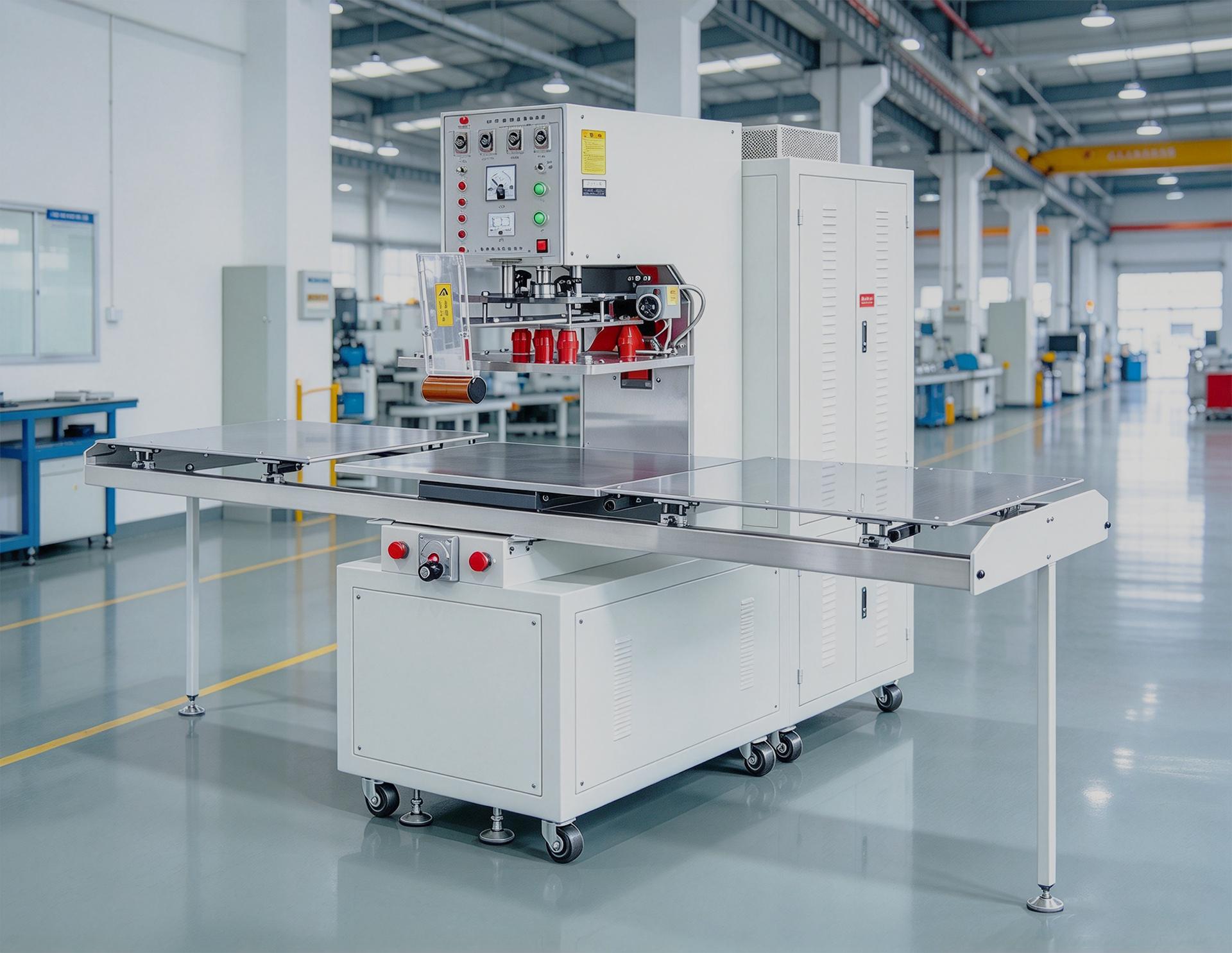
RF sealing combines electromagnetic energy, pressure, electrode design, and controlled process timing. The exact settings depend on the material and the geometry of the intended seal.
The material layers are placed between the welding electrodes according to the required seal pattern. Fixtures or positioning systems help maintain alignment and overlap, reducing variation between production cycles.
The RF generator supplies high-frequency electrical energy to establish an electromagnetic field between the electrodes. In compatible polar materials, the alternating field causes molecular movement and dielectric losses, generating heat within the material.
As the material reaches the required welding condition, the electrodes apply pressure to bond the layers across the intended sealing area. The electrode shape determines the location and geometry of the seal.
The joint is allowed to cool under suitable conditions before the electrodes release the finished part. Adequate cooling helps the bond stabilize and reduces the risk of deformation or inconsistent sealing.
The finished joint is checked against the product's acceptance criteria. Depending on the application, inspection may include visual examination, seal-strength testing, leak testing, or other performance checks.
RF sealing and conventional heat sealing both join material layers, but they use different methods to generate heat.
| Comparison | RF heat sealing | Conventional heat sealing |
|---|---|---|
| Heat generation | Dielectric heating within compatible materials | Heat transferred from a heated surface |
| Material compatibility | Suitable for selected polar thermoplastics | Depends on the material's thermal sealing properties |
| Typical equipment | RF generator, electrodes, press, and controls | Heated bars, jaws, or other heated tooling |
| Seal geometry | Can use custom electrodes for shaped and patterned seams | Often suited to straight or patterned seals using heated tooling |
| Process considerations | Requires compatible dielectric properties and controlled RF energy | Requires control of temperature, pressure, and dwell time |
| Application suitability | Selected inflatable products, flexible components, and thermoplastic assemblies | Packaging films, pouches, liners, and other heat-sealable materials |
Neither method is suitable for every product. Manufacturers should compare material compatibility, joint performance, cycle time, tooling cost, and production requirements before choosing a sealing process.
RF heat sealing machines are used in industries that need repeatable joints in compatible flexible or formed thermoplastic materials.
RF sealing can be used for selected thermoplastic packaging structures and flexible containers when the materials are compatible with dielectric heating. Applications may include specialized pouches, flexible enclosures, and products requiring shaped or continuous seams.
Material construction should be reviewed carefully because multilayer packaging may contain films, coatings, adhesives, or barrier layers that affect RF weldability.
Inflatable products often need sealed seams to retain air or water. RF welding machines can join compatible materials used in air mattresses, inflatable pools, inflatable boats, and other leisure products.
Seal design, material thickness, chamber layout, and intended operating pressure should guide machine and tooling selection. Leak testing and seam-strength testing help determine whether the finished product meets its performance requirements.
Selected medical bags and flexible medical components can be manufactured using RF sealing when their materials are compatible with the process. The application may require repeatable seam geometry and controlled process parameters.
Material suitability, cleanliness, validation, and applicable regulatory requirements must be assessed for the finished medical product. Using RF sealing does not by itself establish that a product meets medical safety or regulatory requirements.
RF welding can join compatible thermoplastic layers used in selected automotive interior parts, covers, trim components, and flexible assemblies. Custom electrodes can create defined seam patterns that match the product design.
The machine should be configured around material compatibility, component dimensions, appearance requirements, and expected production volume.
Certain coated fabrics and thermoplastic sheets can be RF welded to create sealed edges and shaped joints. Suitability depends on the base material, coating formulation, reinforcement, and layer structure.
Where the material is not RF-weldable, hot-air welding, hot-wedge welding, or another joining method may be more appropriate.
Understanding the machine's main components helps manufacturers assess equipment specifications and identify the features required for their application.
The RF generator produces the high-frequency electrical energy used to create the electromagnetic field. Its output capacity and control range must match the material, electrode area, and intended sealing process.
Electrodes transfer the RF field to the material and define the seal pattern. Custom electrode designs may be needed for curved seams, shaped components, repeated patterns, or specific seal widths.
The pressing system applies the force needed to bring material layers together during welding. Depending on the machine design, it may use pneumatic, hydraulic, mechanical, or other drive arrangements.
The control system manages relevant process settings and machine sequences. Depending on the equipment, these may include RF energy, welding time, pressure-related settings, cooling time, and safety interlocks.
The fixture and worktable support the product and help position it accurately beneath the electrodes. The working area should accommodate the component dimensions and allow practical loading and unloading.
Selecting suitable welding machines requires an assessment of the material, seal design, and manufacturing process.
Start with the exact material grade, thickness, coating, and layer structure. Many PVC formulations are suitable for RF welding, while other plastics may not respond adequately to dielectric heating.
For unfamiliar materials, request sample trials before finalizing equipment specifications.
Determine whether the product requires an airtight seal, a watertight joint, a particular peel or tensile strength, a specific appearance, or a defined seal width. These requirements influence electrode design and process development.
Terms such as “proof seals” should be defined by the actual product requirement—for example, leak-resistant, airtight, or watertight seals—and supported by suitable test results.
The working area must accommodate the product and its seal pattern. Large components may need custom fixtures, a larger press, or multiple welding stages.
Electrode geometry should provide the required seal while allowing reliable material positioning and practical operation.
Production volumes influence the required cycle time, tooling strategy, automation level, and number of stations. Manufacturers should consider loading, welding, cooling, unloading, and inspection when calculating overall output.
Assess the machine's control functions, guarding, electrical protection, operator access, and maintenance requirements. The installation should follow the equipment manufacturer's instructions and applicable workplace safety requirements.
A machine should be evaluated using representative materials and product samples. Test results can help establish a suitable process window and determine whether the resulting seals meet the intended performance criteria.
Seal defects may result from unsuitable materials, incorrect settings, electrode wear, inconsistent positioning, or inadequate process control.
| Defect | Possible causes | Recommended checks |
|---|---|---|
| Weak or incomplete seal | Insufficient energy, unsuitable material, poor contact, or incorrect pressure | Verify material compatibility, electrode condition, and process settings |
| Burn marks or material damage | Excessive energy input or an unsuitable process window | Review RF settings, welding time, and tooling condition |
| Irregular seal width | Misalignment, uneven pressure, or electrode wear | Inspect fixtures, electrode surfaces, and press alignment |
| Leakage through the seam | Incomplete bonding, gaps, wrinkles, or inconsistent material overlap | Inspect the seam and perform an appropriate leak test |
| Inconsistent results between cycles | Material variation, positioning changes, or unstable settings | Standardize material handling and monitor process repeatability |
The corrective action should be based on the observed defect and test results. Changing energy or pressure without identifying the cause may create additional defects.
Shanghai Junjingsai Automation Machinery Co., Ltd. has specialized in RF welding equipment since 2002. HFWelders develops equipment solutions for manufacturers joining compatible thermoplastic materials across different industrial applications.
Machine selection can be based on the actual product rather than a generic specification. Relevant design considerations include:
To evaluate a suitable RF heat sealing machine, manufacturers can provide material samples, product drawings, target seal dimensions, expected output, and the required performance criteria. These details help determine process suitability and guide equipment configuration.
An RF heat sealing machine uses radio frequency electromagnetic energy to generate heat within compatible polar thermoplastic materials. Pressure brings the layers together to form a bonded seal, which is allowed to cool under suitable conditions.
RF sealing and high frequency welding are commonly used terms for dielectric welding processes that use high-frequency electromagnetic energy to heat compatible materials internally. The terms are often used interchangeably, although machine specifications and application requirements can differ.
The RF generator supplies the electrical energy that creates the electromagnetic field in the welding area. Its capacity and controls must be matched to the material, electrode design, and required sealing process.
Many PVC formulations and selected other polar thermoplastics can be RF welded. Compatibility depends on material composition, thickness, coatings, and layer structure. Not all plastics or coated fabrics are suitable, so sample testing is recommended.
RF sealing generates heat within compatible materials using an electromagnetic field. Conventional heat sealing transfers heat from a heated tool to the material. The best method depends on the material, seal geometry, performance requirements, and production conditions.
Yes, RF sealing can produce airtight or watertight joints in suitable materials when the process and seal design are properly developed. The finished product must be tested under appropriate conditions to verify leakage performance.
“Proof seals” is not a single universal technical specification. It may refer to seals designed to meet a defined leakage, pressure, or containment requirement. Manufacturers should specify the intended performance and use an appropriate test method to verify it.
Material compatibility, RF energy, welding time, pressure, electrode geometry, material positioning, and cooling conditions all influence seal quality. Consistent material handling and equipment maintenance also help reduce variation.
Yes. Machine configurations can be adapted to product dimensions, working area, electrode geometry, fixture design, output targets, and automation needs. Material trials and sample evaluation help confirm the appropriate configuration.
Manufacturers should define the material, thickness, seal dimensions, performance requirements, product size, production volume, and desired automation level. Testing representative samples helps establish whether RF welding is suitable and what equipment specifications are needed.