For cooperation and more details, feel free to email us or call directly for consultation.

Home > News & Blog > Blog > Sliding Table RF Welding Machine
A sliding table RF welding machine is designed for joining compatible thermoplastic materials with controlled pressure and high-frequency electromagnetic energy. It is widely used in manufacturing applications that require consistent seams, repeatable positioning, and efficient handling of components, including medical bags, inflatable products, and flexible PVC assemblies.
HFWelders provides radio frequency (RF) welding machines and customized welding solutions for industrial production. By combining an RF generator, purpose-designed electrodes, a sliding worktable, and adjustable process controls, a sliding table RF welding machine helps manufacturers establish a repeatable welding process suited to their products and production requirements.
A sliding table RF welding machine is an industrial welding system that uses a movable worktable to position materials beneath the welding electrode. The table slides between the loading and welding positions, allowing operators to prepare components, align the material, and complete the welding operation in an organized workflow.
This welding technology is also known as high frequency welding or radio frequency RF welding. Instead of relying only on external heat, the process applies high-frequency electromagnetic energy to compatible polar thermoplastic material. Dielectric losses generate heat within the material, softening the joining surfaces so they can fuse under pressure.
The sliding table design provides accessible material loading and unloading, which can be useful when components require careful alignment, larger fixtures, or repeated positioning. Depending on the machine configuration, it can operate as a manually loaded workstation or be integrated into automated systems.
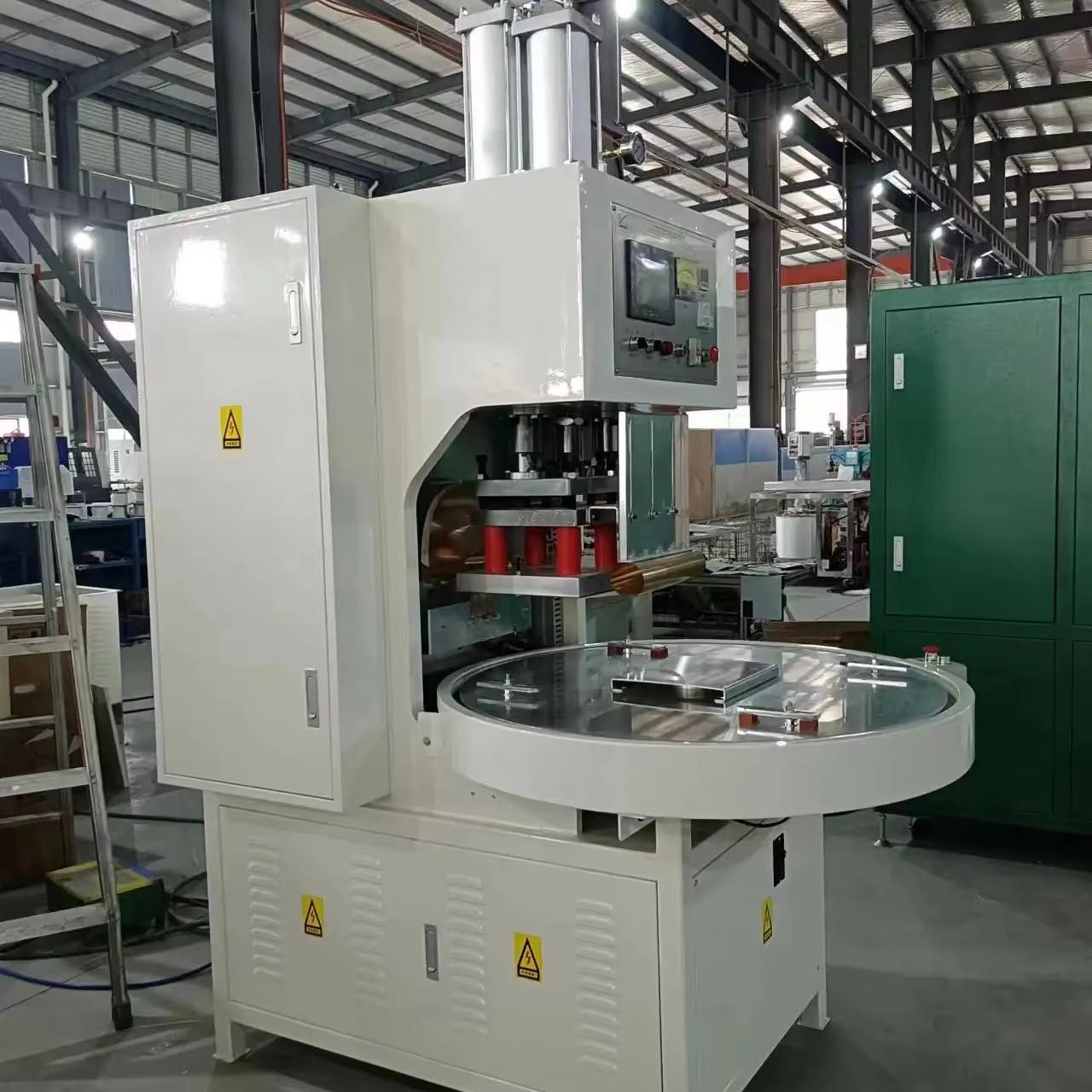
The RF welding work process combines electromagnetic heating, electrode pressure, and controlled timing to produce a welded seam. The specific settings depend on the material, thickness, electrode geometry, and required seal performance.
The operator or an automated handling system places the components on the sliding table. Materials are aligned with the welding fixture and electrode so that the intended welding area receives uniform pressure.
Accurate positioning is especially relevant when producing medical bags, shaped PVC components, and products with defined sealing paths.
The table moves the workpiece into the welding position. Depending on the machine design, the table may use manual movement, pneumatic assistance, or a powered mechanism. Safety interlocks and operating controls should be configured to suit the machine and the intended workflow.
Once the workpiece is correctly positioned, the RF generator supplies high-frequency electrical energy to the electrode system. The resulting electromagnetic field acts on compatible thermoplastic material and generates heat within the welding area.
This internal heat generation distinguishes RF welding from conventional heat sealing processes that depend primarily on transferring external heat from a heated tool.
The electrode applies pressure while the RF energy softens the material at the joining interface. When the process parameters are properly matched to the material and product design, the softened surfaces fuse to form an RF seal.
The material is held under appropriate pressure for the required portion of the welding cycle. After the RF energy stops and the joint has sufficiently stabilized, the table returns to the loading position and the finished component can be removed.
The complete welding cycle includes loading, positioning, table movement, RF heating, pressure holding, cooling or stabilization, and unloading. Actual cycle time varies with product geometry, material properties, weld area, and handling requirements.
The RF generator produces the high-frequency electrical energy used during welding. Its output range and control characteristics should match the material, electrode design, and target welding area.
Stable energy delivery and suitable process controls help operators establish repeatable welding parameters.
The sliding table supports the workpiece and moves it between loading and welding positions. Its travel range, load capacity, fixture mounting, and positioning accuracy should suit the size and geometry of the product.
For applications involving large sheets or multiple sealing areas, the worktable and fixture should provide sufficient support without obstructing the operator's access.
The electrode defines the shape and location of the weld. Tooling must be designed around the intended seam, material thickness, component geometry, and pressure distribution.
Correct electrode alignment helps reduce uneven sealing, incomplete fusion, material damage, and inconsistent seam appearance.
The pressing mechanism applies force to the welding area during RF energy application. Pressure must be suitable for the material and tooling; excessive or insufficient pressure can affect weld consistency.
Controls manage the welding parameters and machine sequence. Depending on the model, features may include adjustable RF output, weld time, pressure controls, table-position monitoring, emergency stops, and safety interlocks.
Machine configuration should reflect the required operating method, production volume, and applicable workplace safety requirements.
Sliding table RF welding machines are suitable for products made from RF-weldable thermoplastic materials. The exact application depends on material formulation, product design, tooling, and performance specifications.
RF welding can be used to join compatible materials in medical bags, fluid containers, flexible pouches, and selected medical-device components. The sliding table helps position flat or shaped components for accurate seam formation.
Medical applications may require validated welding parameters, documented process controls, traceability, leak testing, and other product-specific quality measures. Using an RF welding machine alone does not establish compliance with medical-device requirements.
Manufacturers use RF welding to join compatible flexible materials in inflatable products such as air chambers, cushions, pool accessories, and selected recreational inflatables.
A sliding table can support precise placement of panels and reinforcement patches before welding. Electrode design and pressure distribution should be evaluated against the intended seam geometry and leak-resistance requirements.
RF welding is commonly applied to suitable PVC materials used in flexible bags, folders, covers, and shaped plastic components. The sliding table allows operators to position multiple components consistently and handle fixtures that require repeatable alignment.
The equipment can also be configured for selected industrial covers, flexible enclosures, protective components, and custom thermoplastic assemblies. Manufacturers should confirm that the material is compatible with RF welding before investing in production tooling.
The sliding worktable gives operators direct access to the work area while the component is outside the welding position. This arrangement can simplify material placement and fixture handling, particularly for parts that need accurate manual alignment.
A properly designed fixture and sliding mechanism help maintain consistent positioning between successive parts. Repeatability supports more uniform seams when material placement, electrode condition, and welding parameters are controlled.
Sliding table RF welding equipment can accommodate different fixtures and product geometries, subject to machine capacity and tooling design. Manufacturers producing several related products may be able to use interchangeable tooling where the machine configuration permits it.
Although many sliding table machines are manually loaded, selected configurations can incorporate powered table movement, automatic loading and unloading, sensors, or other automated systems.
For higher-volume production, the machine may serve as part of a larger welding line. The appropriate automation level depends on handling time, product consistency, required output, available floor space, and integration costs.
Because RF welding generates heat within compatible material rather than relying solely on external heat, it can create localized welded seams without heating the entire component to the same degree. The results depend on material characteristics, electrode geometry, energy settings, and process control.
When the material, tooling, pressure, and RF parameters are properly matched, the process can produce durable welded seams. Weld strength and sealing performance should be verified through application-specific testing rather than assumed from machine specifications alone.
Different welding technologies suit different material types, seam designs, and production environments. The right choice depends on the application rather than a single universal performance measure.
Conventional heat sealing generally uses externally heated bars or plates to transfer heat to the joining surfaces. RF welding uses high-frequency electromagnetic energy to generate heat within compatible materials.
RF welding may be suitable for certain thick or shaped PVC components where internal heat generation and formed electrodes offer process advantages. Conventional heat sealing may be more appropriate for materials and packaging formats designed for direct-contact heating.
Hot wedge welding uses a heated wedge to transfer external heat to the joining surfaces, often while rollers apply pressure. It is commonly used for suitable continuous seams in films and coated fabrics.
RF welding is generally considered for compatible polar thermoplastics and electrode-defined weld areas. Hot wedge and RF processes differ in material compatibility, equipment layout, seam geometry, and production method.
Ultrasonic welding uses high-frequency mechanical vibration to generate heat at the joint. RF welding uses an electromagnetic field and is commonly associated with compatible polar materials such as PVC.
The preferred method depends on the material, component thickness, joint design, equipment access, and production requirements.
The welding cycle must be developed around the specific material and product. Increasing RF output or extending weld time does not automatically improve seal quality; excessive energy can damage material or create inconsistent results.
Different thermoplastic formulations respond differently to RF energy. Material additives, coatings, moisture, thickness, and layer construction may affect heating behavior. Compatibility testing should precede final parameter selection.
The shape, length, and width of the welding area influence energy distribution and pressure requirements. Electrode geometry must match the intended seam while avoiding uneven contact or localized overheating.
RF power and weld time must be balanced with the material and tool design. A suitable process window should produce the required joint without burning, excessive thinning, incomplete fusion, or deformation.
The pressing mechanism must maintain suitable contact throughout the welding stage. Pressure holding and cooling or stabilization time can influence how well the joint retains its shape after energy application.
Misalignment, inconsistent material placement, or movement during welding can produce irregular seams. Stable fixtures, consistent table travel, and appropriate maintenance support repeatable operation.
Operators should follow documented setup procedures and monitor process variables. Where required, manufacturers should establish acceptance criteria and validate weld performance through tests such as peel, tensile, burst, or leak testing, depending on the product.
Selecting RF welding equipment requires more than comparing generator power or machine dimensions. A suitable configuration should match the product, process, and production environment.
Identify the exact thermoplastic material, material thickness, number of layers, and component dimensions. Provide material samples when possible so that RF compatibility and welding feasibility can be assessed.
Supply drawings or samples showing the required seam shape, total welding length, sealing width, and location of each weld. These details help determine electrode size, fixture layout, and the required working area.
Estimate the required hourly or daily output and identify the expected welding cycle. Consider loading, unloading, inspection, and material handling, not only the RF heating time.
Decide whether the process requires manual loading, powered table movement, automatic handling, or integration with a larger welding line. A fully automated arrangement may improve throughput for suitable products, but it also requires appropriate part presentation, controls, safety measures, and integration planning.
Define the required weld strength, leak resistance, visual appearance, and other acceptance criteria. For medical bags and similar regulated products, identify applicable validation, documentation, and traceability requirements before equipment design is finalized.
A practical equipment assessment should include material trials, tooling considerations, parameter development, and evaluation against the actual product requirements. This helps establish whether the proposed machine and process can achieve the intended result.
HFWelders is associated with Shanghai Junjingsai Automation Machinery Co., Ltd., a manufacturer with a history in RF welding and plastic welding equipment dating back to 2002.
Machine selection and configuration should be based on the material, product structure, required seal performance, and manufacturing workflow. For applications such as medical bags, inflatable products, and other compatible thermoplastic components, discussing product samples and technical drawings with the equipment supplier helps clarify tooling requirements, machine layout, and potential automation options.
When evaluating a sliding table RF welding machine, manufacturers should ask for application-specific testing and a clear explanation of the proposed welding process, operating parameters, safety features, and maintenance requirements.
Looking for RF welding equipment for medical bags, inflatable products, PVC components, or other compatible thermoplastic products?
Contact HFWelders with your material specifications, product drawings, welding area, required output, and quality requirements. These details help determine a suitable RF generator, electrode configuration, sliding table design, and level of automation for your production needs.
A sliding table RF welding machine uses a movable worktable to position components under an RF electrode. High-frequency electromagnetic energy generates heat within compatible thermoplastic material, and pressure joins the softened surfaces to form a welded seam.
RF welding machines are commonly used with PVC and can work with selected other polar thermoplastic materials. Compatibility depends on the material formulation, additives, thickness, and product construction. Material trials are recommended before production.
Yes, it can be used to weld compatible materials for medical bags and selected flexible medical components. The finished product may require application-specific process validation, leak testing, traceability, and compliance assessments according to its intended use.
RF welding uses high-frequency electromagnetic energy to generate heat within compatible material. Conventional heat sealing typically transfers heat from an externally heated bar or plate to the material surface. Each process has different material and product-design requirements.
The RF generator supplies the high-frequency electrical energy that creates the electromagnetic field used during welding. Its output and control characteristics must suit the material, electrode, welding area, and required seal performance.
The welding cycle depends on material type and thickness, weld area, RF power, weld time, pressure, holding or cooling time, and the time required to load and unload components. The complete cycle should be measured during application testing.
Some configurations can integrate powered table movement, automated loading and unloading, sensors, and production controls. A fully automated solution requires compatible part handling, suitable fixtures, safety interlocks, and integration with the wider production process.
It can produce leak-resistant seams in suitable materials when the tooling and welding parameters are properly developed. Actual leak resistance must be verified using appropriate testing based on the product's design and operating conditions.
RF welding generates heat within compatible polar thermoplastics through an electromagnetic field. Hot wedge welding uses external heat from a heated wedge and is commonly used for suitable continuous seams. Material compatibility and seam design determine the appropriate process.
Provide the material type and thickness, product samples or drawings, required welding area, target output, desired seal strength, testing criteria, automation needs, and available factory utilities. This information helps the manufacturer assess machine capacity, electrode design, and process feasibility.