For cooperation and more details, feel free to email us or call directly for consultation.

Home > News & Blog > Blog > Rotary Table RF Welding Machine
A rotary table RF welding machine is an industrial welding machine designed to join compatible thermoplastic materials using high-frequency electromagnetic energy. Its rotating worktable allows operators to load and unload components at accessible stations while the machine performs the welding process at a designated position. This configuration can support repeatable production, organized material handling, and efficient workflows for products that require consistent welded seams.
Also known as a rotary table radio frequency (RF) welding machine or rotary table high-frequency welding machine, this equipment is used for selected inflatable products, flexible PVC components, plastic accessories, and other products made from compatible materials. Machine configuration, electrode design, table layout, and automation level can be adapted to the product geometry and production requirements.
Shanghai Junjingsai Automation Machinery Co., Ltd., operating through HFWelders, develops RF welding equipment for industrial applications. When evaluating a rotary table system, manufacturers should consider material compatibility, welding area, weld time, operator workflow, required output, and the quality standards of the finished product.
A rotary table RF welding machine is a high-frequency welding system that combines a rotating worktable with an RF generator, welding electrodes, a pressing mechanism, and process controls. The table moves components between loading, welding, and unloading positions, depending on the machine design.
During welding, high frequency electromagnetic energy creates an electric field across compatible dielectric thermoplastic materials. Dielectric losses generate heat within the material, allowing the contacting surfaces to soften and bond under pressure. After the required weld time and stabilization period, the finished component can be removed.
Unlike conventional welding equipment that relies entirely on heat transferred from an external source, radio frequency RF welding generates heat within suitable materials. This process is often called dielectric welding or high-frequency welding.
RF welding is not suitable for every plastic or flexible material. It is commonly used for PVC and selected other polar thermoplastics, while the weldability of other formulations depends on their dielectric properties and construction. Material trials are recommended before selecting the machine.
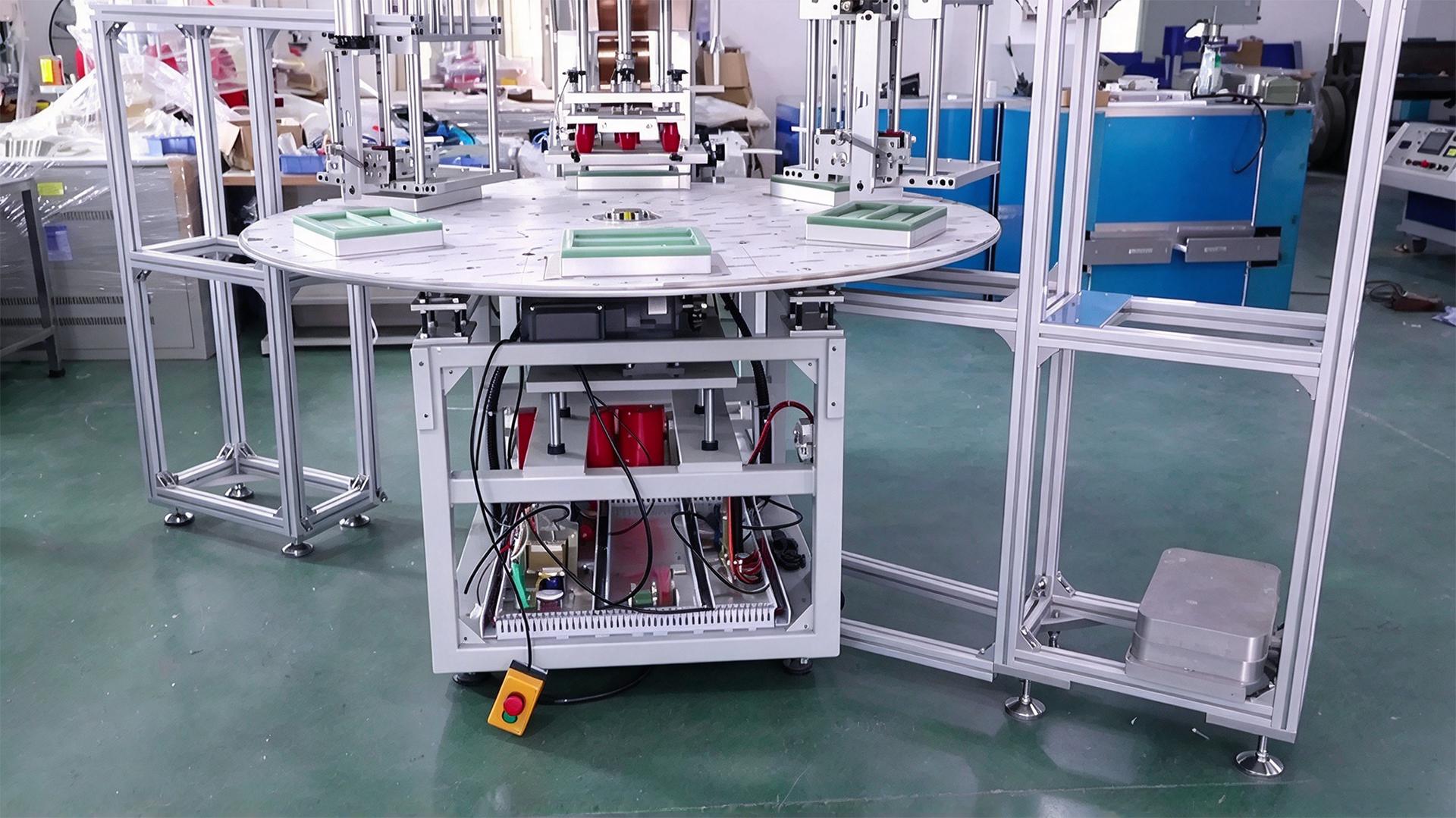
The welding process combines material positioning, RF energy, mechanical pressure, and controlled timing. The rotating table helps organize these operations into a repeatable production sequence.
The operator or an automated loading system places the components into a fixture on the rotary table. The fixture aligns the material within the intended welding area and helps maintain the correct seam position.
Accurate positioning is especially relevant for products with shaped seams, multiple welded sections, or defined edge dimensions. The fixture should support the component without obstructing the electrode movement or finished-product removal.
The table rotates to move the loaded component to the welding station. Depending on the machine configuration, separate stations may be used for loading, welding, cooling or handling, and unloading.
This arrangement allows some handling activities to take place while another component is being welded. However, the actual productivity benefit depends on the number of stations, table indexing time, operator workflow, and whether the loading and unloading operations can be completed within the machine cycle.
At the welding station, the press closes and positions the electrodes around the material. The RF generator supplies high-frequency electromagnetic energy, creating an electric field across the welding area.
In compatible polar thermoplastics, molecular polarization and dielectric losses produce heat generation inside the material. This heat softens the contacting surfaces without requiring the entire component to be heated externally.
The welding parameters must be matched to the material, thickness, electrode geometry, and required seam performance. Excessive energy or unsuitable settings can cause surface damage, overheating, or inconsistent bonding.
As the material reaches the required welding condition, pressure brings the contacting surfaces together. The material forms a bonded joint within the defined welding area.
The weld time, RF power, pressure, electrode shape, and material properties influence the resulting seam. These parameters should be established through testing rather than selected solely from general machine specifications.
After RF energy is switched off, the joint may need to stabilize under pressure before the electrodes release the component. Appropriate cooling and release timing help the seam retain its shape and strength.
The finished part is then removed manually or transferred by an automated handling system. Depending on the product, it may undergo visual inspection, dimensional checks, peel testing, or leakage testing.
Understanding how RF welding works helps manufacturers determine whether the process is suitable for a particular product.
Radio frequency RF welding uses high-frequency electromagnetic energy to establish an alternating electric field across compatible dielectric materials. The field interacts with the material's electrical properties, producing dielectric losses that generate heat within the material.
This is different from using radio waves simply to transmit information or heat an object from a distance. In an RF welding machine, the generator, electrodes, workpiece, and electrical circuit are designed to establish the field needed for the welding process.
Polar thermoplastics contain molecular structures that respond to an applied electric field. Under suitable high-frequency conditions, molecular polarization and dielectric losses contribute to heat generation.
PVC is a common RF-weldable material, while other polar thermoplastics may also be suitable depending on their formulation. Not every material described as a thermoplastic can be welded using high frequency.
Material thickness, plasticizers, fillers, coatings, moisture, and multilayer construction may influence welding performance. Representative samples should be tested to confirm compatibility and establish suitable process settings.
RF welding generates heat within compatible material through dielectric losses. By comparison, hot-bar or hot-wedge equipment uses externally heated surfaces to transfer heat to the material.
A hot wedge is often used in continuous welding applications, including certain films, coated fabrics, and flexible structures. RF welding uses a different heating mechanism and is suitable for a different range of materials and product designs.
The preferred process depends on material compatibility, seam geometry, production volume, and the required finished-product performance.
A rotary table RF welding system combines several mechanical, electrical, and control components.
The RF generator supplies the high-frequency electrical energy used to create the welding field. Its configuration and output capacity should suit the material, welding area, electrode arrangement, and intended duty cycle.
The electrodes establish the field across the welding area and define the shape of the welded seam. Custom electrode tooling may be required for curved seams, shaped components, multiple bonding sections, or product-specific geometries.
Tooling design affects energy distribution, pressure contact, seam dimensions, and the repeatability of the welding process.
The rotary table carries fixtures and moves components between designated work positions. The indexing mechanism controls table movement and station alignment.
The number and arrangement of stations depend on the product, handling requirements, and desired production workflow.
The press brings the electrodes and material together under controlled mechanical conditions. The design must provide suitable force, alignment, and repeatability for the intended application.
The control system coordinates table movement, pressing, RF output, weld time, and relevant safety functions. Depending on the configuration, it may also monitor process parameters and communicate with other automated machines.
RF welding machines should be designed with suitable guarding, interlocks, emergency-stop functions, and RF shielding appropriate to their configuration. Operators should follow the manufacturer's installation, operation, and maintenance instructions.
Rotary table RF welding machines are suitable for selected products that use compatible thermoplastic materials and benefit from repeatable station-based production.
Selected inflatable products, including air chambers, inflatable cushions, pool components, and other flexible structures, may use RF welding to create seams that retain air or water when the material is suitable.
The electrode design must follow the required seam geometry, and finished products should undergo application-specific leak and pressure testing. Material construction, reinforcement layers, and product size influence the machine configuration.
The machine can be considered for compatible PVC components requiring shaped or repeatable welded joints. Fixtures help maintain positioning while the rotary table transfers components between workstations.
Some flexible plastic accessories, protective covers, sleeves, and specialty components can be processed using rotary table RF welding. The suitability of each application depends on the material formulation, thickness, product shape, and required bond performance.
For products requiring the same seam or bonding pattern across many units, a rotary table may provide a structured workflow for loading, welding, and unloading. Dedicated tooling can support consistent positioning and repeatable joint geometry.
A rotary table separates work into designated stations. Operators can prepare the next component while another part is undergoing welding, provided the machine layout and safety controls permit these activities.
Dedicated fixtures and indexed table movement help maintain the position of components relative to the electrodes. This can reduce variation caused by repeated manual repositioning.
Rotary table systems can be configured with manual, semi-automatic, or automated loading and unloading. The appropriate level depends on product complexity, production volume, handling requirements, and available factory space.
Different electrode and fixture designs can accommodate specific products or seam layouts. When multiple product types are planned, manufacturers should assess tooling changeover time and validate each configuration.
Because loading, welding, and unloading may take place at separate stations, the table can reduce some idle handling time. The real benefit depends on the complete machine cycle, including table indexing, welding, cooling, and operator or robot movements.
The best welding method depends on the material and production requirements. Rotary table RF welding should not be selected solely because a product is made from plastic.
RF welding uses a high-frequency electric field to generate heat inside compatible dielectric materials. Hot wedge welding uses an externally heated wedge positioned between material layers, often combined with pressure rollers or another joining mechanism.
RF welding is commonly considered for suitable PVC components and products requiring shaped or localized seams. Hot wedge welding may be better suited to certain continuous seams in flexible films or coated fabrics.
Hot-bar heat sealing transfers heat from heated tooling to compatible material layers. RF welding generates heat internally through dielectric losses.
The choice depends on material composition, seam geometry, heating requirements, cycle time, and finished-product specifications.
Ultrasonic welding uses mechanical vibrations to generate heat at a joint, while RF welding uses an electromagnetic field to heat compatible dielectric materials. Material properties, part geometry, and production requirements determine which method is appropriate.
Weld time is only one part of the complete machine cycle. A suitable setting must create the required bond without damaging the material.
Key factors include:
Manufacturers should establish parameters through controlled trials, then verify the results using tests appropriate to the finished product.
Before choosing a machine, define the product requirements and assess whether RF welding is suitable.
Identify the exact polymer, formulation, thickness, coating, and number of layers. Do not assume that all thermoplastic materials can be joined by RF welding.
Provide product drawings and indicate the dimensions, shape, and location of each required seam. These details help determine the working area, electrode design, fixture arrangement, and press configuration.
Estimate the required output, shift schedule, product changeover frequency, and acceptable cycle time. The number of rotary table stations and the level of automation should be evaluated against the full production sequence.
Consider how components are loaded, positioned, removed, and inspected. Irregular or large products may need dedicated fixtures or additional handling equipment.
Provide representative material samples and, where possible, complete product components. Test results should confirm seam integrity, appearance, strength, and any application-specific leakage or pressure requirements.
Confirm the machine's safety provisions, maintenance access, electrode replacement procedure, and requirements for RF shielding and electrical servicing. Operators should receive suitable training before production begins.
Shanghai Junjingsai Automation Machinery Co., Ltd. has developed industrial welding machinery since 2002. Through HFWelders, the company provides RF welding equipment and customized solutions for applications involving compatible thermoplastic materials.
For a rotary table RF welding project, equipment planning should begin with product samples, material specifications, seam drawings, required output, and automation preferences. These details help determine whether a rotary table configuration is appropriate and what tooling or handling arrangements may be needed.
A practical evaluation should consider welding feasibility, seam quality, cycle time, product changeovers, and integration with the wider production process before the machine specification is finalized.
Looking for a rotary table RF welding machine for your production line? Share your product drawings, material samples, welding area, required seam performance, and target output with HFWelders.
The technical team can review material compatibility, discuss electrode and fixture requirements, and assess a suitable machine configuration. Final equipment selection should be based on verified welding trials and realistic production conditions.
A rotary table RF welding machine uses high-frequency electromagnetic energy to join compatible thermoplastic materials. Its rotating table moves components between loading, welding, and unloading positions, supporting an organized and repeatable production workflow.
RF welding creates a high-frequency electric field across compatible dielectric materials. Dielectric losses generate heat within the material, allowing the contacting surfaces to soften and bond under pressure.
PVC is a common RF-weldable material, and selected other polar thermoplastics may also be suitable. Compatibility depends on the exact formulation, thickness, coatings, and product construction. Testing is recommended before selecting equipment.
Yes, it can be suitable for selected inflatable products made from compatible materials. The machine and electrode design must match the product geometry, and finished products should undergo appropriate leak or pressure testing.
RF welding generates heat within compatible materials through dielectric losses caused by a high-frequency electric field. Hot wedge welding transfers heat from an externally heated wedge to the material. The preferred method depends on material compatibility, seam design, and production requirements.
Weld time depends on material properties, thickness, welding area, RF power, electrode geometry, pressure, and the required bond performance. Cooling and handling also affect the total production cycle.
Yes. Depending on the product and machine design, loading, unloading, positioning, and transfer operations can be automated. The suitable configuration depends on production volume, part geometry, and integration requirements.
It can improve production flow by allowing operations such as loading and unloading to take place at separate stations. Actual output depends on welding time, cooling, indexing, handling, inspection, and the number of stations.
Quality checks may include visual inspection, dimensional verification, peel or tensile testing, and leak or pressure tests where applicable. Acceptance criteria should reflect the product's intended use and be established through process validation.
Provide material specifications, product drawings, sample components, welding area, seam geometry, required output, target cycle time, and automation preferences. This information helps the equipment supplier assess feasibility and recommend a suitable machine configuration.