For cooperation and more details, feel free to email us or call directly for consultation.

Home > News & Blog > Blog > Top 5 Radio Frequency (RF) Welding Machine Manufacturers in China
China has a well-established manufacturing base for radio frequency (RF) welding and high frequency (HF) welding equipment. Five manufacturers highlighted in this overview are:
These companies cover different areas of RF and high frequency welding, including standard RF welding machines, customized plastic welding equipment, tarpaulin welding, PVC packaging, automotive components, medical bags, inflatable products, membrane materials, and automated production lines.
A radio frequency welding machine, also called a high frequency welding machine or HF welding machine, uses high-frequency electromagnetic energy to generate heat internally within suitable thermoplastic materials. Instead of relying only on an external heat source, the electrical field causes molecules in the material to generate heat, allowing two or more layers to be fused under pressure.
RF welding is commonly used for polar thermoplastics such as PVC, PU, and TPU. Depending on the machine design, tooling, material, and application, manufacturers can create precise welds over a defined weld area and produce durable sealed products.
Common industrial frequencies include 13.56 MHz and 27.12 MHz. The 27.12 MHz frequency is widely associated with high frequency (HF) welding and radio frequency (RF) welding equipment.
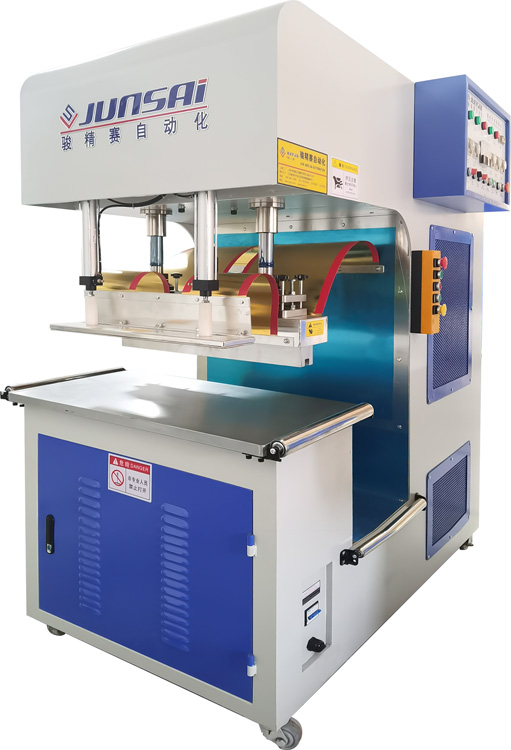
RF welding uses radio waves to generate heat inside a compatible thermoplastic material. The process generally involves several stages:
This method allows manufacturers to weld multiple layers without depending solely on an external heat source. The result can be a clean and consistent weld when the machine, tooling, material, pressure, RF power, and processing parameters are correctly matched.
Shanghai Junjingsai Automation Machinery Co., Ltd. is one of China's leading RF welding machine manufacturers, specializing in the design, manufacturing, and customization of radio frequency welding machines and high frequency welding automation solutions.
Founded in 2002 and formerly known as Shanghai Junjingsai Packaging Machinery Co., Ltd., the company changed its name to Shanghai Junjingsai Automation Machinery Co., Ltd. in 2016. With more than 20 years of experience in plastic welding technology, Junjingsai focuses on RF welders, RF heat sealers, high frequency welding equipment, and customized automated welding systems.
RF welding machines from Junjingsai are designed for materials including PVC, PU, TPU, and other industrial plastic materials. The equipment uses high-frequency electromagnetic energy to generate heat internally, helping produce strong and precise welds.
Junjingsai operates manufacturing facilities in Shanghai, Jiangsu, Chongqing, and Guangdong, with a combined factory area of approximately 29,000㎡:
The manufacturing process includes mechanical fabrication, precision machining, electrical assembly, machine commissioning, welding performance testing, final inspection, packaging, and shipment.
The company operates CNC machining centers, laser cutting machines, metal bending equipment, welding and fabrication equipment, assembly production lines, and machine testing systems. Customers can also visit the factories to review the manufacturing process.
Junjingsai provides a broad range of RF welding and heat sealing equipment, including:
The company develops customized solutions based on product samples, technical drawings, material requirements, production capacity, and automation requirements.
OEM and ODM projects can include customized machine voltage, plug standards, operating languages, safety configurations, automatic feeding systems, and production lines.
Junjingsai RF welding machines are used across multiple industries, providing high frequency welding, heat sealing, forming, and customized automation solutions for thermoplastic products.
Automotive Industry
Applications include:
Junjingsai has accumulated extensive experience in automotive high frequency welding applications and provides equipment solutions for automotive component manufacturers.
Medical Industry
Applications include:
Junjingsai high frequency heat sealing equipment supports medical product manufacturing applications requiring stable sealing quality and production reliability.
Packaging Industry
Applications include:
Junjingsai provides RF welding and heat sealing equipment for packaging manufacturers, including solutions for cardboard blister sealing machines and double blister sealing machines.
Stationery Industry
Applications include:
Junjingsai RF welding machines can process PVC, PP, and other thermoplastic materials used in stationery products, providing efficient sealing and forming solutions for manufacturers.
Household Products
Applications include:
Junjingsai provides customized RF welding and heat sealing equipment for household products requiring consistent sealing, forming, and production efficiency.
Outdoor & Sports Industry
Applications include:
Junjingsai RF welding machines are suitable for manufacturing a wide range of inflatable, waterproof, and flexible outdoor products made from PVC, TPU, PU, and other thermoplastic materials.
The company also develops customized RF welding solutions based on product structure, material characteristics, weld patterns, production volume, and automation requirements.
The company reports exports to more than 35 countries and regions, with markets including Southeast Asia, the Middle East, South America, and Africa.
Junjingsai reports 25 patents and certifications including ISO9001, CE, and 3A Credit Certification. Its quality process covers incoming material inspection, component processing, equipment assembly, electrical testing, welding performance testing, and final inspection before shipment.
International support includes a 1-year warranty, remote technical support, installation guidance, operator training, and spare parts supply. Shipping options include sea freight, air freight, and express delivery, with FOB and EXW trade terms available.
Lian Xing High Frequency Machinery Co., Ltd. specializes in the research, development, and production of high frequency welding machines ranging from 1 kW to 200 kW. The company states that it has more than 30 years of experience in the industry.
According to the supplied company information, Lian Xing uses advanced technology and components from Japan and applies high frequency oscillation technology. Its equipment uses industrial frequency bands including 13.56 MHz and 27.12 MHz ±0.6%.
The company manufactures equipment for applications including tarpaulin welding, PVC cylinder tube forming, soft-crease box production, blister packaging, and plastic welding.
Lian Xing also provides customized plastic welding solutions for special production requirements.
Its equipment has been used in:
The company states that its machines have been sold to more than 10 countries.
Xiamen JINGSHUN High-frequency Equipment Co., Ltd. was founded in 1995 and specializes in the manufacture, development, and distribution of high frequency welding equipment.
JINGSHUN produces more than 80 types of plastic processing equipment. Its product range includes hot embossing equipment, high-frequency plastic welding machines, high frequency fusing machines, cold embossing machines, high-frequency induction heating equipment, heat transfer machines, and ultrasonic welding machines.
This broader equipment portfolio makes JINGSHUN relevant to manufacturers looking for different plastic processing technologies in addition to conventional high frequency welding equipment.
The company also states that it works with agents and provides product and service support for customers.
Dongguan Hansweld Co., Ltd. was founded in 2013 and operates a manufacturing facility in Qingxi Town, Dongguan City.
The company specializes in HF welding machines, PVC cylinder tube packaging machines, PVC folding box machines, blister forming and sealing machines, and plastic welders.
According to the supplied information, Hansweld operates a 2,000-square-meter workshop with an in-house processing center. The company also provides field installation services to help customers put equipment into production.
Hansweld offers standard equipment for:
In addition to standard machines, the company accepts customized orders as well as OEM and ODM projects.
Hansweld reports exporting its equipment to more than 30 countries, including Germany, the UK, Spain, France, India, the UAE, Australia, Mexico, and Brazil.
Liaoning UNIFY High Frequency Equipment Co., Ltd. specializes in the R&D and manufacturing of high frequency welding equipment, high frequency drying equipment, and automatic production lines.
UNIFY is located in the Tieling Economic Development Zone. The supplied company information states that its factory covers approximately 11,000 square meters, with more than 6,000 square meters of plant area.
The company reports more than 30 years of experience and states that it began exporting equipment in its first year. Its equipment has been supplied to customers including Fortune 500 companies, according to the company information provided.
UNIFY has developed equipment such as:
The company also develops customized equipment according to customer requirements, including equipment functions and core component brands.
UNIFY describes several equipment characteristics, including a circuit design developed through long-term production experience, low radiation performance, broad application range, and a multi-stage high-frequency starting system designed to reduce hard-start shock to the tube.
The supplied information also states that UNIFY has obtained EU CE certification and corporate social responsibility system certification.
| Manufacturer | Founded / Experience | Main Equipment or Expertise | Noted Applications |
|---|---|---|---|
| Shanghai Junjingsai | Founded 2002; 20+ years | RF welding machines, HF equipment, automation, customized systems | Automotive, medical, packaging, stationery, household, outdoor & sports |
| Lian Xing | 30+ years | 1–200 kW high frequency welding equipment | Tarpaulin, packaging, automotive, medical, inflatable products |
| Xiamen JINGSHUN | Founded 1995 | High frequency welding and plastic processing equipment | Plastic processing and industrial applications |
| Dongguan Hansweld | Founded 2013 | HF welders, PVC packaging and forming equipment | PVC, tarpaulin, packaging, blister, PU leather |
| Liaoning UNIFY | 30+ years | HF welding, HF drying, automatic production lines | Automotive, membrane materials, transformer insulation |
The manufacturers differ in their product portfolios, manufacturing scale, application focus, customization capabilities, and international market experience. Buyers should therefore compare equipment according to the actual material, product geometry, welding area, production volume, automation requirements, and required RF power rather than relying on company size alone.
RF welding is generally associated with polar thermoplastics that respond to high-frequency electrical fields. Common materials include:
Material compatibility depends on the specific formulation, thickness, additives, construction, and welding requirements. A material test using the actual production material is recommended before selecting final welding equipment and tooling.
27.12 MHz is one of the industrial radio frequency bands used in high frequency welding equipment. It provides a standardized operating frequency for RF welding systems and is used by manufacturers producing industrial RF welding equipment.
Some equipment manufacturers also use 13.56 MHz. The appropriate frequency and machine configuration depend on the equipment design, application, material, and applicable standards.
Confirm that the material has a polar molecular structure suitable for RF welding. PVC, TPU, and PU are common examples.
The required weld area, product dimensions, corners, curves, and sealing pattern affect the electrode and tooling design.
Machine power should match the material thickness, weld area, production cycle, and product construction. Higher power does not automatically mean better welding performance.
For high-volume manufacturing, consider cycle time, automation, automatic feeding, material handling, and production-line integration.
RF welding requires suitable electrodes or welding tooling. Tooling design directly affects the weld shape, pressure distribution, and finished product.
Manufacturers producing large quantities may require rotary tables, sliding tables, track systems, automatic feeding, or complete RF welding automation production lines.
Ask how the manufacturer manages incoming components, assembly, electrical testing, welding performance testing, and final inspection.
International buyers should also consider warranty terms, installation support, operator training, remote technical assistance, spare parts, and logistics options.
RF welding and conventional heat sealing both join thermoplastic materials, but the way heat is generated is different.
RF welding uses high-frequency electrical fields to generate heat internally within suitable materials. Conventional heat sealing generally transfers heat from an external heated element to the material surface.
RF welding can be particularly useful when manufacturers need consistent sealing patterns, multiple-layer welding, complex product shapes, or repeatable industrial production. Conventional heat sealing may be more appropriate for materials or applications that do not respond effectively to RF energy.
The correct process depends on the material, product design, weld specification, production volume, and equipment requirements.
Radio frequency welding equipment is used across a broad range of applications.
Typical applications include sun visors, automotive carpets, ventilation bags, air cushions, interior components, door panels, and decorative components.
RF welding can be used for medical bags, blood bags, infusion bags, urine bags, dialysis packaging, and other suitable medical plastic products.
Applications include PVC packaging, blister packaging, folding boxes, cylinder tube packaging, and other heat-sealed plastic products.
RF welding machines are widely associated with inflatable products, tents, tarpaulins, waterproof products, membrane structures, and related outdoor applications.
Depending on material and product construction, RF welding can also be applied to conveyor components, geomembranes, industrial covers, and customized plastic products.
A practical supplier evaluation should cover several areas:
Manufacturing capability: Review factory size, machining equipment, assembly capacity, testing procedures, and production capacity.
Engineering capability: Ask whether the manufacturer can design electrodes, tooling, machines, and automation around your product.
Material experience: Confirm previous experience with the specific PVC, PU, TPU, or other material being used.
Application experience: Request examples involving products with similar dimensions, weld areas, thicknesses, and production volumes.
Customization: Check whether the manufacturer supports OEM, ODM, customized machine configurations, and non-standard equipment.
Quality documentation: Review applicable certifications, inspection procedures, and test reports.
International service: Confirm warranty, installation guidance, training, spare parts, remote support, and shipping arrangements.
Factory verification: For major equipment purchases, a factory visit or sample welding test can provide useful information about manufacturing and engineering capabilities.
An RF welding machine uses high-frequency electromagnetic energy to generate heat internally within suitable polar thermoplastic materials, allowing material layers to be fused under pressure. RF welding machines are also commonly called radio frequency welding machines or high frequency welding machines.
PVC, TPU, and PU are common RF-weldable materials because their polar molecular structures can respond to high-frequency electrical fields. Material formulation and product construction should be tested before production.
In industrial plastic processing, RF welding and high frequency (HF) welding are often used to describe the same general welding technology. Both use high-frequency electromagnetic energy to generate heat internally in suitable thermoplastic materials.
27.12 MHz is an industrial radio frequency commonly used by RF and high frequency welding equipment. It provides a standardized operating frequency for many industrial RF welding systems.
Yes. The manufacturers covered in this article provide different levels of customization. Depending on the supplier and project, customization may include machine configuration, welding tooling, voltage, plug standards, automation, feeding systems, production lines, and other non-standard requirements.
Compare the manufacturer's experience, equipment range, factory and engineering capabilities, material expertise, customization capacity, quality-control procedures, application experience, certifications, and international service. Testing the actual product material and weld design before final equipment selection can also help confirm suitability.
China's RF welding equipment industry includes manufacturers with different strengths in high frequency welding, plastic processing, automation, packaging, automotive applications, medical products, inflatable products, membrane materials, and customized machinery.
Shanghai Junjingsai, Lian Xing, Xiamen JINGSHUN, Dongguan Hansweld, and Liaoning UNIFY represent five manufacturers with documented experience in these areas. The appropriate supplier depends on the buyer's material, weld area, product structure, production capacity, automation requirements, machine power, tooling requirements, and after-sales expectations.
For industrial buyers, a product sample and technical discussion with the equipment manufacturer are practical starting points for determining whether an RF welding machine can achieve the required weld quality and production efficiency.