For cooperation and more details, feel free to email us or call directly for consultation.

Home > News & Blog > Blog > RF Welding Machine Manufacturer
Shanghai Junjingsai Automation Machinery Co., Ltd. specializes in the design, manufacturing, and customization of radio frequency (RF) welding machines for industrial plastic welding applications. Founded in 2002, the company has developed equipment for joining thermoplastic materials used in inflatable products, medical products, automotive components, packaging, and other industrial applications.
Our RF welding machines use high-frequency electromagnetic energy to generate heat inside compatible materials, creating strong, durable welds without relying on external heat sources. This welding process is also known as high frequency welding, dielectric welding, or radio frequency RF welding, depending on the technical context and application.
From manual equipment to automated production systems, we provide welding solutions designed to meet different product dimensions, material specifications, output requirements, and production environments. Our focus is on consistent weld quality, practical machine configuration, and improved production efficiency.
An RF welding machine is an industrial device that joins compatible thermoplastic materials by applying high-frequency electromagnetic energy and mechanical pressure. The electromagnetic field causes suitable polar molecules within the material to respond to the alternating field, generating heat internally. The material softens, the applied pressure brings the layers together, and the joint forms as the material cools.
Unlike traditional welding methods that depend on an external heat source, RF welding generates heat internally within the material being processed. This makes it suitable for applications requiring controlled sealing, repeatable weld strength, and precise joining of thin plastic sheets or multiple layers of compatible materials.
RF welding is widely used for PVC and certain other dielectric thermoplastics. Material suitability depends on dielectric properties, formulation, thickness, electrode design, and process settings.
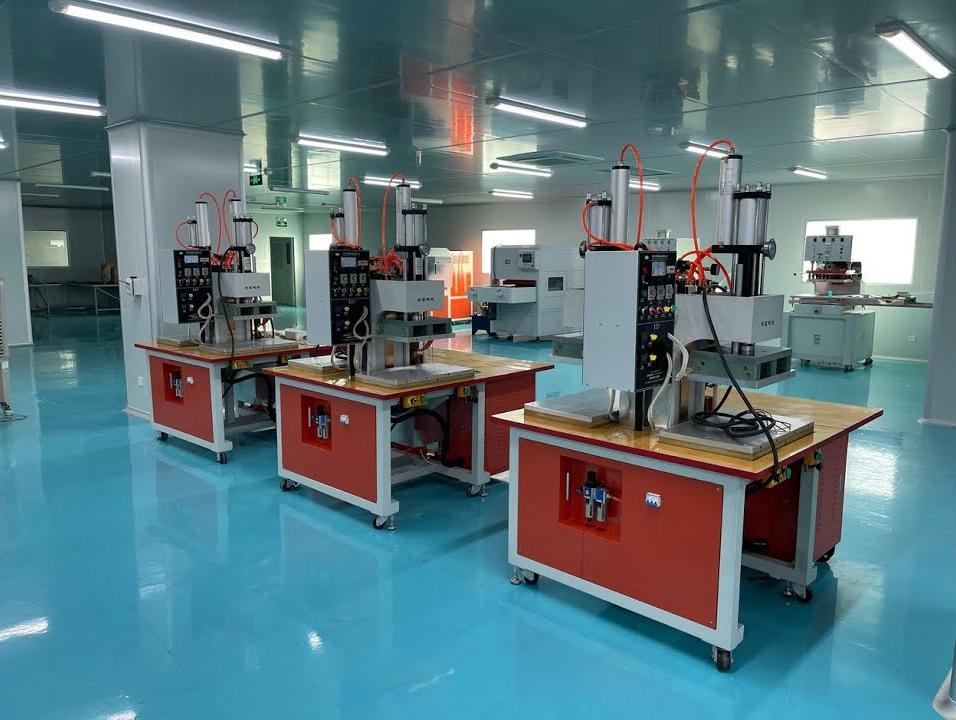
Radio frequency technology enables the welding machine to produce an alternating electromagnetic field between specially designed electrodes. Under appropriate conditions, the material absorbs energy and generates heat throughout the affected welding area.
The welding process generally follows these steps:
The operator or automated feeding system positions the thermoplastic sheets or components between the welding electrodes. Accurate alignment helps maintain consistent seam dimensions and product appearance.
The RF generator supplies high-frequency electrical energy to the electrodes. The resulting electromagnetic field interacts with suitable materials and generates heat internally rather than transferring heat solely from a heated tool surface.
Internal heating softens the material within the welding area. The temperature distribution depends on material composition, thickness, electrode geometry, applied power, and processing time.
The electrodes apply pressure while the material is softened. The adjacent layers bond together to form a welded seam. Correct pressure and energy input help prevent incomplete bonding, excessive thinning, and material damage.
After the RF energy stops, pressure is maintained as required while the joint cools and stabilizes. The finished weld can then be inspected for seam appearance, dimensions, strength, and leak resistance where applicable.
A properly configured welding process helps manufacturers achieve repeatable results across production batches.
RF welding machines offer several advantages for manufacturers working with compatible thermoplastic materials.
RF welding creates strong joints by heating compatible materials internally and bonding them under pressure. When material selection and process settings are appropriate, the resulting seams can provide the strength and integrity required for demanding products.
Automated energy application, controlled welding cycles, and repeatable electrode movement can improve production efficiency. For high-volume manufacturing, suitable machine configurations can reduce manual handling and help maintain consistent cycle times.
RF welding is well suited to many thin thermoplastic sheets, particularly PVC films and coated materials formulated for RF processing. It is commonly used for products requiring continuous seams, airtight construction, or liquid-tight sealing.
Depending on material compatibility and product design, RF welding can join multiple layers of material in a single operation. This capability supports the manufacture of inflatable structures, flexible containers, and multilayer assemblies.
When the RF power, pressure, welding time, electrode geometry, and cooling conditions are properly controlled, the process can deliver consistent seams across repeated production cycles.
Efficient energy application, reduced dependence on continuously heated tooling, and improved material utilization can support sustainable manufacturing practices. Actual environmental benefits depend on machine efficiency, production volume, material selection, scrap rates, and the overall manufacturing process.
Inflatable products are one of the established applications of radio frequency welding. Products such as inflatable boats, swimming pools, air mattresses, inflatable advertising structures, and water sports equipment often require strong seams that withstand repeated loading and internal air pressure.
RF welding machines can join compatible PVC-coated fabrics, PVC films, and other suitable thermoplastic materials to create sealed joints with consistent dimensions.
The machine configuration depends on the product's size, shape, material thickness, seam length, and required production volume. Large inflatable products may require specialized electrodes, extended working areas, or customized machine structures.
For products intended to retain air or water, manufacturers should evaluate weld integrity through suitable pressure, leak, or other application-specific tests.
Beyond inflatable products, RF welding machines serve a range of industries where compatible thermoplastic materials need reliable bonded seams.
RF welding is used for selected medical bags, fluid containers, flexible medical components, and other products made from compatible thermoplastic films. Medical manufacturing may require validated process parameters, documented quality controls, and material compliance appropriate to the intended use.
RF welding can join compatible vinyl and other suitable thermoplastic components used in automotive interiors, including selected upholstery parts, flexible trim, and decorative assemblies.
RF welding machines can seal suitable plastic packaging components, flexible pouches, and specialized containers. The application determines the required seam configuration, tooling design, and inspection method.
Compatible coated fabrics and thermoplastic sheets can be welded into protective covers, flexible enclosures, tarpaulins, and other industrial products.
For specialized products, customized RF welding machines and electrodes can be developed around the material, component geometry, joint design, and required output.
RF welding differs from traditional welding methods in how heat is generated and how materials are joined. Selecting the appropriate process depends on the material, product design, required joint strength, production speed, and cost considerations.
| Welding method | Heat generation | Typical applications | Main consideration |
|---|---|---|---|
| RF welding | High-frequency electromagnetic energy generates heat internally in suitable materials | PVC films, inflatable products, flexible thermoplastic assemblies | Requires compatible dielectric materials and specialized equipment |
| Hot-air welding | Heated air transfers heat to the joining surfaces | Coated fabrics, flexible films, seams and repairs | Heat distribution and operator or process control affect results |
| Hot-bar heat sealing | Heated tooling transfers heat to the material surface | Packaging films and compatible plastic layers | Depends on tool temperature, contact pressure, and dwell time |
| Ultrasonic welding | High-frequency mechanical vibrations generate heat at the joint | Selected rigid and semi-rigid thermoplastic components | Joint geometry and material properties influence performance |
RF welding is not a universal replacement for other joining methods. It is most suitable when the material responds effectively to a high-frequency electromagnetic field and the application benefits from internally generated heat and pressure-assisted bonding.
Selecting the right RF welding machine requires an evaluation of the product, material, welding requirements, and production environment.
Identify the exact thermoplastic material, its formulation, coating, and thickness. PVC is commonly used in RF welding, while other plastics require evaluation of their dielectric properties and compatibility with the process.
The size and geometry of the product determine the required working area, electrode dimensions, machine structure, and operator access. Large inflatable products may require a sliding table, rotary table, or customized work platform.
Determine whether the application requires a structural seam, airtight seal, liquid-tight joint, or decorative weld. The required performance level influences electrode design, process parameters, and inspection procedures.
For small batches or customized products, a manual RF welding machine may be sufficient. Semi-automatic equipment can reduce repetitive handling, while fully automated systems may be appropriate for higher production volumes and repeatable product designs.
Machine power should be selected according to the material, total electrode area, product thickness, and required cycle time. Higher power does not automatically produce better welds; excessive energy can cause burning, material thinning, or other defects.
Electrodes determine the shape and dimensions of the welded seam. Their geometry, alignment, surface condition, and compatibility with the material affect weld consistency and finished product quality.
Evaluate RF shielding, interlocks, grounding, electromagnetic leakage protection, operator safety features, and applicable regulatory requirements. For demanding applications, also consider process monitoring and product-specific weld testing.
Shanghai Junjingsai Automation Machinery Co., Ltd. is a manufacturer specializing in radio frequency welding machines and customized plastic welding solutions. Founded in 2002, the company has experience developing equipment for a range of thermoplastic welding applications.
Our approach focuses on matching the welding machine to the customer's actual production requirements rather than relying on a single standard configuration.
We evaluate material properties, product dimensions, welding seam requirements, and expected output to help determine a suitable machine configuration.
Machine structures, electrode tooling, working tables, and automation options can be adapted to different product designs and manufacturing processes.
Appropriate machine selection, tooling design, and process parameter control help manufacturers pursue repeatable seam quality and stable production cycles.
Our RF welding solutions serve applications involving inflatable products, flexible thermoplastic components, packaging, automotive interiors, and other compatible materials.
From initial application assessment to machine configuration, the goal is to provide equipment suited to the customer's materials, operating conditions, and production targets.
For the most suitable recommendation, provide your product photos or drawings, material type and thickness, required seam dimensions, and expected production capacity.
Looking for a reliable RF welding machine manufacturer for your production line?
Shanghai Junjingsai Automation Machinery Co., Ltd. can help assess your application and identify suitable radio frequency welding equipment for compatible thermoplastic materials.
Contact our team to discuss:
Send us your product specifications to discuss a suitable RF welding machine configuration for your manufacturing needs.
An RF welding machine is industrial equipment that uses high-frequency electromagnetic energy to generate heat internally in suitable thermoplastic materials. The machine applies pressure to bond the softened material, producing a welded joint that can be designed for strength, flexibility, or leak resistance.
Yes. RF welding is commonly known as radio frequency welding or high frequency welding. The terms are often used interchangeably in industrial plastic welding, although specific equipment frequencies and technical configurations can vary.
PVC is one of the most widely used materials for RF welding. Certain PU, TPU, and other thermoplastics may also be suitable depending on their formulation and dielectric properties. Material testing is recommended before selecting a machine or finalizing a production process.
Yes. RF welding machines can join multiple layers of compatible thermoplastic materials when the material properties, electrode design, pressure, and energy input support the application. The maximum practical layer count depends on the specific product and material construction.
RF welding can produce continuous, strong seams in compatible flexible thermoplastic materials. These seams can provide the airtight or liquid-tight performance required by inflatable boats, air mattresses, swimming pools, and similar products when the welding process and quality testing are properly controlled.
RF welding generates heat internally through a high-frequency electromagnetic field, while conventional heat sealing typically transfers heat from an externally heated surface. RF welding is suitable for compatible dielectric materials and can be advantageous for certain thick or multilayer assemblies, whereas conventional heat sealing is often used for packaging films and other applications.
An RF welding machine can improve production efficiency through controlled welding cycles, repeatable pressure application, suitable electrode design, and automated material handling. The actual improvement depends on the product design, machine configuration, cycle time, operator workflow, and production volume.
Evaluate the manufacturer's experience with your product category, material compatibility knowledge, machine customization capabilities, electrode design, safety features, quality-control options, and after-sales technical support. Request an application assessment or sample welding test before making a final decision.
Yes. RF welding machines can be configured with different power levels, working areas, electrode shapes, table arrangements, and automation systems. Customization should be based on the product's dimensions, material, seam geometry, required output, and inspection criteria.
Provide the product name, product photos or drawings, material type, material thickness, welding seam dimensions, required output, and preferred automation level. If the product must retain air or liquid, specify the required leak or pressure performance so the manufacturer can evaluate an appropriate welding solution.