For cooperation and more details, feel free to email us or call directly for consultation.

Home > News & Blog > Blog > Custom RF Welding Machines
Custom RF welding machines provide manufacturers with a tailored solution for joining compatible thermoplastic materials through radio frequency energy and pressure. Designed around specific products, material properties, weld dimensions, and production requirements, these machines help manufacturers produce consistent seams for applications such as inflatable products, PVC bags, medical components, automotive interiors, and industrial covers.
Shanghai Junjingsai Automation Machinery Co., Ltd. specializes in radio frequency welding equipment and customized machinery for industrial plastic joining. With experience dating back to 2002, the company develops RF welding solutions for manufacturers seeking reliable weld quality, repeatable processing, and equipment configured for their products and production volume.
Whether a factory needs a specialized RF welder for a particular product or an automated system for high-volume manufacturing, machine configuration should be based on material compatibility, joint design, required output, and actual production conditions.
Custom RF welding machines are industrial machines designed or configured to join compatible thermoplastic materials using radio frequency energy, also known as high frequency welding energy. The process generates heat within suitable materials through dielectric heating. Pressure is then applied to bring the softened material layers together, creating a permanent bond after cooling.
Unlike conventional heat sealing, which transfers heat from a heated tool to the material surface, radio frequency welding generates heat within the material through an alternating electromagnetic field. This makes the process suitable for selected polar thermoplastics, particularly PVC and certain polyurethane-based materials, depending on their formulation and dielectric properties.
A custom RF welding machine may feature a specific electrode shape, working area, RF generator capacity, pressing mechanism, control system, or automated handling arrangement. These features are selected according to the product design and production requirements rather than relying on a standard machine configuration for every application.
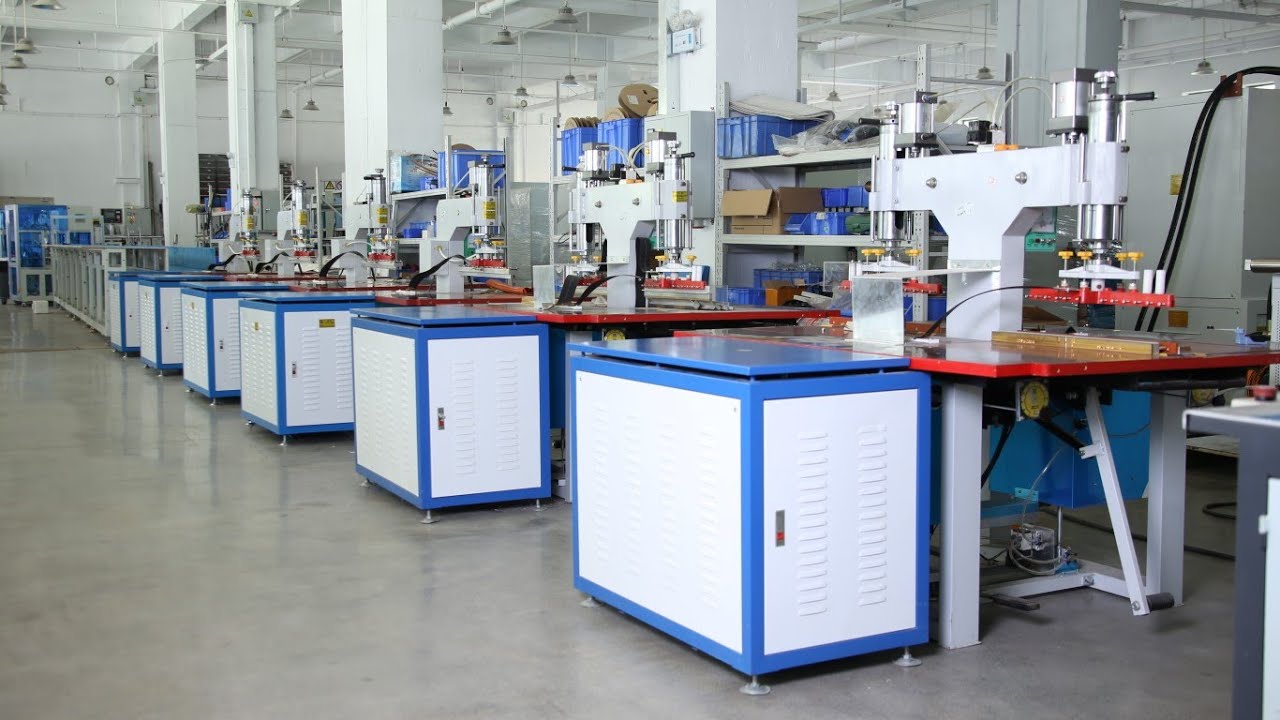
RF welding technology uses an alternating electromagnetic field to heat compatible materials internally. When the material is positioned between the electrodes, the RF generator supplies high-frequency energy to the welding area. Polar molecules respond to the changing electric field, producing dielectric losses that generate heat within the material.
The softened layers are compressed under controlled pressure. Once the RF energy stops and the welded area cools sufficiently, the materials form a permanent bond.
The material layers are placed between the welding electrodes according to the required seam layout. Accurate positioning helps maintain consistent weld dimensions and prevents wrinkles, misalignment, and uneven pressure.
The RF generator delivers controlled frequency energy to the electrodes. The alternating electromagnetic field causes molecular movement in compatible materials, generating heat through dielectric losses.
As the material absorbs RF energy, heat develops within the welding zone. The required energy depends on material formulation, thickness, electrode geometry, and the intended weld strength.
The machine applies pressure to the heated material layers. This brings the softened surfaces into close contact and allows them to form a welded joint.
After the energy application ends, pressure may be maintained while the weld cools. The finished product is then released, inspected, and transferred to the next production stage.
The actual settings for RF power, weld time, pressure, and cooling must be established through material trials. Excessive energy can cause burning, material thinning, or electrode marks, while insufficient energy may result in weak or incomplete seams.
Material compatibility determines whether RF welding is an appropriate joining method. The process is most commonly associated with polar thermoplastics that respond effectively to dielectric heating.
Polyvinyl chloride (PVC) is widely used in radio frequency welding because it generally responds well to dielectric heating. Applications include inflatable boats, air mattresses, swimming pools, tarpaulins, PVC bags, protective covers, and flexible enclosures.
Thermoplastic polyurethane (TPU) can be suitable for RF welding, but performance depends on its formulation, additives, thickness, and dielectric properties. Manufacturers should conduct welding trials before selecting machine specifications for TPU products.
Some polyurethane-based materials and other compatible thermoplastics may be processed using high frequency welding. However, not every plastic is suitable. Materials such as polyethylene and polypropylene generally do not respond to conventional RF welding as readily as PVC because of their dielectric characteristics.
A supplier should evaluate actual material samples instead of assuming that all thermoplastics can form a reliable RF-welded joint.
Custom RF welding machines can be configured to match different product structures, workpiece dimensions, seam layouts, and production targets. The appropriate design depends on the application rather than on machine power alone.
The RF generator supplies the energy required for dielectric heating. Its capacity should correspond to the welding area, material construction, tooling design, and expected production conditions. A properly matched generator helps provide a controllable process without applying unnecessary energy.
Electrode geometry determines the shape and dimensions of the welded area. Custom tooling can be designed for straight seams, curved outlines, shaped components, reinforced edges, and product-specific patterns.
Tooling design should consider seam width, corner geometry, material positioning, pressure distribution, and the risk of arcing or localized overheating.
The working area should accommodate the product and allow safe, repeatable material positioning. Depending on the application, the machine may use a manual, pneumatic, hydraulic, or other engineered pressing arrangement.
The pressing system must provide suitable force and travel for the intended product. Oversized workpieces, complex shapes, or multilayer structures may require a different machine layout from simple flat seams.
A control system can manage RF energy application, weld time, pressure sequence, cooling time, and operating interlocks. Repeatable parameter control helps operators maintain consistent results across production runs.
Depending on the machine design, additional features may include recipe storage, process monitoring, safety interlocks, automated clamping, and production data collection.
Some manufacturers need a standalone RF welder operated by an operator, while others require automated material feeding, positioning, clamping, unloading, or integration with a wider production line.
Automation should be selected according to the production volume, product variability, labor requirements, and acceptable cycle time. A more automated machine is not always the best choice for low-volume work with frequent product changes.
RF welding machines are used across industries where compatible thermoplastic materials need to be joined into a durable seam or shaped assembly.
RF welding is commonly used to manufacture PVC inflatable boats, air beds, swimming pools, water toys, air chambers, and other inflatable structures. The tooling and welding parameters must suit the material construction and the pressure or air-retention requirements of the finished product.
Selected medical bags, fluid containers, flexible components, and other products made from RF-compatible materials may use radio frequency welding. Applications involving medical use require material qualification, process validation, and inspection criteria appropriate to the intended product and applicable regulations.
RF welding can join compatible flexible materials used in selected automotive interior components, trim assemblies, covers, and related products. Custom electrodes help follow the required contour and maintain consistent seam geometry.
PVC bags, document holders, protective covers, flexible enclosures, and similar products may benefit from RF welding when their materials are suitable. The machine can be configured around the required seam pattern, product size, and finishing requirements.
Industrial curtains, protective sheeting, flexible ducts, equipment covers, and outdoor products may use RF welding to create joined seams. The final performance depends on the material, joint design, processing parameters, and required service conditions.
A custom machine is developed around the product's dimensions, seam shape, material structure, and handling requirements. This reduces the need to adapt an unsuitable standard machine to a specialized application.
Controlled RF energy, pressure, timing, and cooling help manufacturers establish a repeatable process. Consistency still depends on suitable material selection, electrode condition, operator procedures, and quality inspection.
A well-matched RF welding system can support short and repeatable processing cycles. Actual output depends on welding time, cooling requirements, loading and unloading, product complexity, and inspection procedures.
For high volume production, customized tooling and automated handling can reduce repetitive manual operations and improve process repeatability. Machine capacity should be evaluated against the required output per shift, product mix, planned operating hours, and expected downtime.
Custom electrode profiles, working tables, and pressing systems allow manufacturers to address different product shapes and seam layouts. These design options are useful when a standard machine cannot meet the required dimensions or processing sequence.
Selecting suitable RF welding equipment requires a review of both the product and the production process. The following factors help establish a practical specification.
Identify the exact material grade, formulation, coating, reinforcement, and layer thickness. If the material's dielectric response is uncertain, request sample testing before finalizing the machine configuration.
Define the maximum workpiece size, seam length, seam width, contour, and number of welds per product. These details help determine the working area, electrode design, and required pressing arrangement.
The target joint performance may involve tensile strength, air retention, liquid tightness, appearance, or resistance to repeated use. These requirements should be converted into measurable acceptance criteria and verified during testing.
Estimate the target number of finished products per hour or shift. Include loading, positioning, welding, cooling, unloading, inspection, and any secondary operations when calculating total cycle time.
A machine's nominal welding speed does not represent the complete production rate. For high-volume production, material handling and downtime may have as much influence on output as the RF welding cycle itself.
Determine whether manual operation, semi-automatic handling, or full automation fits the product mix and factory layout. Frequent product changes may favor flexible tooling and simple setup, while stable high-volume production may justify dedicated fixtures and automated handling.
Review guarding, electrical protection, RF shielding where applicable, interlocks, emergency stops, and the manufacturer's operating and maintenance instructions. The equipment should be installed and operated in accordance with applicable safety requirements.
Both RF welding and heat sealing join thermoplastic materials, but they generate heat differently.
| Comparison factor | RF welding | Conventional heat sealing |
|---|---|---|
| Heat generation | Dielectric heating inside compatible materials | Heat transferred from an externally heated tool |
| Material suitability | Selected polar thermoplastics, commonly PVC | Many heat-sealable films and thermoplastics |
| Tooling | RF electrodes designed for the weld geometry | Heated bars, jaws, or other sealing tools |
| Process control | RF energy, pressure, weld time, and cooling | Tool temperature, dwell time, pressure, and cooling |
| Typical applications | Inflatable products, selected flexible components, PVC products | Packaging films, pouches, liners, and compatible laminates |
| Material limitations | Depends on dielectric properties and formulation | Depends on heat-sealing behavior and material construction |
The correct method depends on material compatibility, seam design, required performance, output targets, and production cost. RF welding should not be selected solely because it is a high-frequency process; the actual material must respond appropriately to the electromagnetic field.
Shanghai Junjingsai Automation Machinery Co., Ltd. has manufactured welding equipment since 2002. Its RF welding machine business focuses on equipment for joining compatible thermoplastic materials in industrial production.
A customized project should begin with the product rather than a standard machine model. Material samples, drawings, product dimensions, seam requirements, and expected production volume provide the basis for evaluating the machine configuration.
Junjingsai can assess application requirements such as:
Providing clear application information at the quotation stage helps determine whether a standard configuration can meet the requirements or whether a custom machine is more appropriate.
If you are evaluating RF welding machines for a new product or production line, prepare the material specifications, product drawings, sample parts, required seam performance, and estimated production volume.
These details allow the equipment supplier to assess material suitability, recommend a tooling concept, and determine the machine configuration for your application. Sample welding and process evaluation should be completed before production settings and output expectations are finalized.
Contact Junjingsai to discuss your product, manufacturing process, and custom RF welding machine requirements.
Custom RF welding machines join compatible thermoplastic materials using radio frequency energy and pressure. They are used for products such as inflatable boats, air mattresses, PVC bags, flexible covers, selected medical components, and automotive interior parts. Machine configuration depends on the material, product geometry, seam requirements, and production volume.
RF welding works by applying an alternating electromagnetic field to compatible dielectric materials. Polar molecules respond to the field, generating heat through dielectric losses. Pressure brings the softened material layers together, and the joint forms a permanent bond as it cools.
PVC is one of the most widely used materials for RF welding. Certain TPU, polyurethane-based materials, and other thermoplastics may also be suitable, depending on their formulation and dielectric properties. Material trials are recommended because not every plastic responds effectively to RF energy.
RF welding and high frequency welding generally describe the same family of dielectric welding processes in industrial plastic joining. Both use high-frequency electromagnetic energy to generate heat within compatible materials. The exact equipment configuration and operating frequency depend on the machine design and application.
An RF generator produces the high-frequency electrical energy used by the welding system. It supplies energy to the electrodes, creating the electromagnetic field that heats compatible materials. Generator capacity must match the material, welding area, electrode design, and required production conditions.
Yes. RF welding machines can be designed with application-specific electrodes, larger working areas, automated clamping, material handling, and control systems. For high-volume production, the design should account for the complete cycle, including positioning, welding, cooling, unloading, and inspection.
Start with the exact material specification, product dimensions, seam layout, target weld strength, and expected output. Then evaluate the working area, RF generator, electrode design, pressing mechanism, controls, safety features, and automation needs. Sample welding trials help verify suitability.
Cycle time depends on material type and thickness, RF power, electrode geometry, weld time, applied pressure, cooling time, and product handling. Automation may reduce loading and unloading time, but process changes must be tested to confirm that the required weld quality is maintained.
RF welding can form a permanent bond between compatible thermoplastic layers when the material, tooling, energy, pressure, and cooling conditions are suitable. Bond performance should be verified against the product's required strength, sealing, durability, or other acceptance criteria.
Provide the material type and thickness, product drawings or samples, required weld dimensions, target seam performance, expected production volume, and preferred automation level. Information about factory utilities, operating conditions, and applicable product standards can also help define the equipment specification.