For cooperation and more details, feel free to email us or call directly for consultation.

Home > News & Blog > Blog > High Frequency Plastic Welding Machine
A high frequency plastic welding machine uses high-frequency electromagnetic energy to join compatible thermoplastic materials by generating heat within the material and applying pressure to form a bonded seam. Also known as an HF welding machine or RF welding machine, this equipment is widely used to manufacture inflatable products, flexible containers, medical bags, automotive components, and other plastic products that require consistent weld quality.
Shanghai Junjingsai Automation Machinery Co., Ltd. specializes in the design, manufacturing, and customization of high frequency welding machines for industrial applications. Founded in 2002, the company develops welding equipment to accommodate different material properties, product dimensions, seam designs, and production requirements.
Compared with conventional heat-sealing methods, high frequency plastic welding can generate heat internally in suitable materials rather than relying solely on an external heat source. This makes the process suitable for many PVC films, coated fabrics, and other compatible polar thermoplastics.
Whether a manufacturer needs a manual welding machine for small production batches or an automated system for repetitive manufacturing, the appropriate machine configuration depends on the material, welding area, required seam strength, weld time, and target cycle times.
A high frequency plastic welding machine is industrial equipment that uses an alternating high-frequency electromagnetic field to generate heat within suitable dielectric thermoplastic materials. Mechanical pressure is applied while the material softens, allowing adjacent surfaces to bond and form a welded joint.
The process is commonly called high frequency welding, HF welding, or radio frequency (RF) welding. These terms generally describe the same family of dielectric welding processes, although operating frequencies and equipment configurations can differ.
High frequency welding is commonly used for PVC and selected other polar thermoplastics whose molecular and dielectric properties allow them to respond effectively to the applied electromagnetic field. Material formulation, thickness, moisture content, and additives can influence welding performance.
A typical HF welding machine consists of an RF generator, electrodes, a pressing mechanism, a control system, and safety components. Depending on the application, the machine may also include a pneumatic or hydraulic system, a sliding worktable, customized tooling, and automated material handling.
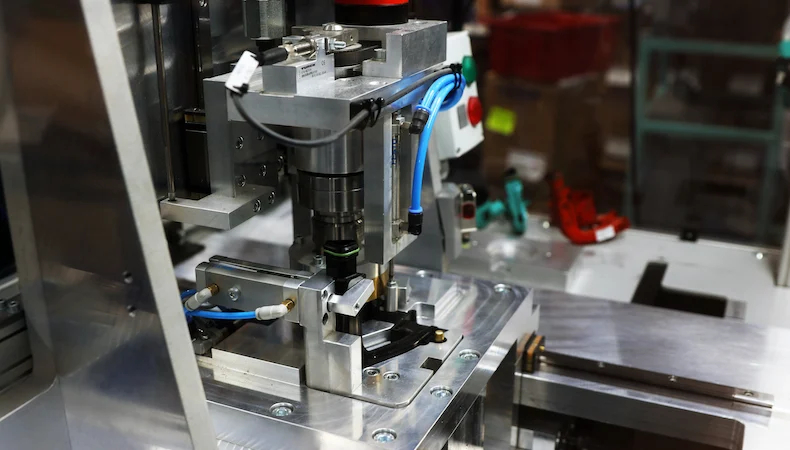
High frequency plastic welding relies on dielectric heating to soften compatible thermoplastic materials and form a bond under pressure. The process can be divided into several stages.
The operator places the plastic sheets or components between the welding electrodes. The material must be aligned correctly to achieve the required seam width, dimensions, and appearance.
For automated production, fixtures or feeding systems can help maintain consistent positioning between cycles.
The welding machine generates a high-frequency electromagnetic field between the electrodes. Suitable polar thermoplastics respond to the alternating field through dielectric losses, converting electromagnetic energy into heat within the material.
Unlike conventional heat sealing, which transfers heat from a heated surface, HF welding generates heat within the material being processed.
As the material absorbs energy, the temperature rises within the welding area. The thermoplastic softens under the combined influence of the electromagnetic field and the applied process conditions.
The amount of energy required depends on material properties, thickness, electrode geometry, welding area, and the selected power and weld time.
The electrodes apply pressure to bring the softened surfaces into close contact. The material forms a bonded seam when the process parameters are appropriate for the application.
Insufficient energy may result in weak bonding, while excessive energy can cause burning, thinning, deformation, or other welding defects.
After the RF energy is switched off, pressure may be maintained while the welded area cools and stabilizes. The electrodes then release the product for inspection or the next production step.
Correct control of energy input, pressure, and cooling helps produce consistent weld quality and predictable cycle times.
High frequency welding machines offer several manufacturing benefits when used with suitable materials and correctly developed process parameters.
HF welding generates heat within compatible thermoplastics through dielectric heating. This reduces reliance on heat transfer from an externally heated tool and supports the formation of defined welded seams.
When material compatibility and process settings are properly controlled, high frequency welding can create durable joints suitable for flexible products, sealed containers, and multilayer assemblies.
The resulting strength depends on the material, seam geometry, energy input, pressure, and cooling conditions.
Modern HF welding machines allow the operator to configure weld time and other process parameters. Consistent settings help standardize production and reduce variation between manufacturing cycles.
Suitable electrode designs, repeatable machine movements, and automated loading can shorten the overall production cycle. The actual cycle time depends on the welding area, material thickness, cooling requirements, operator workflow, and machine configuration.
HF welding can join multiple layers of compatible thermoplastic materials in one operation when the product design and process parameters support it. This capability is useful for inflatable products, flexible containers, and selected industrial assemblies.
Different electrodes, working tables, machine structures, and automation systems can be configured for different product shapes and dimensions. This allows manufacturers to adapt the welding process to specific production requirements.
High frequency plastic welding is used across industries that manufacture products from compatible thermoplastic films, sheets, and coated fabrics.
Inflatable boats, swimming pools, air mattresses, inflatable toys, and advertising structures often require continuous seams that resist air leakage and mechanical stress.
HF welding machines can join compatible PVC films and coated fabrics to create sealed joints. Electrode design and welding parameters are selected according to the product's dimensions and performance requirements.
Selected medical bags, fluid containers, and flexible medical components are manufactured using HF welding when their materials are suitable for dielectric heating.
Applications involving medical products may require documented process validation, controlled manufacturing conditions, and material compliance based on the intended use.
HF welding can be used for selected vinyl-covered components, flexible trim, upholstery parts, and other automotive interior products made from compatible thermoplastics.
The machine and tooling must accommodate the required component geometry, seam location, and appearance specifications.
Certain flexible packaging products, specialized pouches, and thermoplastic containers can be joined using high frequency welding. The appropriate process depends on the packaging material, product design, and required seal performance.
Protective covers, flexible enclosures, tarpaulins, and other industrial products made from suitable coated fabrics can benefit from HF welding.
Customized machine structures and electrode configurations may be required for large products or irregular seam layouts.
Both high frequency welding and conventional heat sealing join thermoplastic materials, but their heating mechanisms differ.
| Comparison factor | High frequency plastic welding | Conventional heat sealing |
|---|---|---|
| Heat generation | Dielectric heating generates heat internally in compatible materials | Heat transfers from an externally heated surface |
| Material suitability | Best suited to compatible dielectric thermoplastics | Suitable for many heat-sealable films and thermoplastics |
| Tooling | Uses electrodes designed for the welding area | Uses heated bars, plates, or other heated tooling |
| Process control | Depends on RF power, weld time, pressure, and cooling | Depends on temperature, dwell time, pressure, and cooling |
| Typical applications | Inflatable products, PVC components, selected flexible containers | Packaging films, pouches, and other heat-sealable materials |
| Production considerations | Requires suitable RF equipment, tooling, and safety systems | Requires temperature control and suitable heated tooling |
Neither method is suitable for every plastic. Material testing and product-specific trials help determine which process offers the required seam quality and production performance.
Weld time is the period during which high-frequency energy is applied to the material. Cycle time refers to the overall time required to complete a production cycle, including positioning, welding, cooling, and releasing the finished product.
These measurements are related but are not interchangeable.
Different polar thermoplastics respond differently to electromagnetic energy. Thicker materials or multilayer constructions may require different energy settings and processing times from thin films.
The appropriate settings must be established for the specific material rather than selected from thickness alone.
Larger welding areas generally require more energy, while electrode geometry influences the distribution of the electromagnetic field and pressure. A well-designed electrode helps maintain a uniform seam and reduces unnecessary variation.
The available power and actual energy delivered to the material affect heating speed. Excessive energy may damage the material, so increasing power does not automatically improve productivity or weld strength.
Pressure helps the softened surfaces make close contact during bonding. Too little or too much pressure can affect seam quality, depending on the material and product design.
Some products require a holding period under pressure after the RF energy stops. Automated feeding, unloading, and worktable movement can also influence total cycle times.
Manufacturers should evaluate weld strength, seam appearance, leak resistance where applicable, and cycle time together. The best production settings balance joint performance with repeatability and output requirements.
Selecting a suitable welding machine begins with the material and finished product rather than the machine's rated power alone.
Identify the exact polymer, coating, material formulation, and thickness. PVC is commonly processed using HF welding, while other plastics should be assessed according to their dielectric properties.
The dimensions of the product and its welded seams determine the required working area, electrode size, and machine structure. Large inflatable products may require an extended worktable or customized equipment.
Specify the required seam strength, width, appearance, flexibility, and leak performance. These requirements influence electrode design, process parameters, and inspection methods.
Estimate the target output and acceptable cycle times. Manual machines may suit low-volume or customized production, while semi-automatic and automatic machines can reduce repetitive handling for larger production runs.
Review the machine's control system, pressure mechanism, RF shielding, interlocks, grounding, and electromagnetic leakage protection. Operators should follow applicable safety requirements and the manufacturer's operating procedures.
Where possible, provide representative materials and sample products for welding trials. Testing helps establish suitable machine specifications and process settings before full-scale production.
Shanghai Junjingsai Automation Machinery Co., Ltd. is a manufacturer of radio frequency welding machines and customized high frequency welding equipment. Founded in 2002, the company develops solutions for industrial plastic welding applications involving compatible thermoplastic materials.
With experience dating back to 2002, Junjingsai focuses on RF welding technology and the equipment requirements of different industrial applications.
Machine power, working area, electrode tooling, worktable design, and automation options can be selected according to product specifications and production targets.
Different materials and products require different welding approaches. Evaluating material compatibility, seam geometry, weld time, and cycle times helps determine a suitable machine configuration.
The company's equipment can be considered for applications involving inflatable products, flexible plastic components, packaging, automotive interiors, and other compatible thermoplastic products.
The objective is to match machine capabilities with the customer's production requirements, including seam quality, operating workflow, output, and product consistency.
For an application assessment, provide product drawings or photos, material specifications, seam dimensions, and expected production volume.
Looking for a high frequency welding machine for your plastic products?
Shanghai Junjingsai Automation Machinery Co., Ltd. can help evaluate your application and identify an appropriate HF welding solution based on material compatibility, product dimensions, welding requirements, and production targets.
When contacting our team, please provide:
These details help establish suitable equipment specifications and determine whether high frequency plastic welding is appropriate for your product.
A high frequency plastic welding machine uses high-frequency electromagnetic energy to generate heat within compatible thermoplastic materials. Pressure is applied to bond the softened material and create a welded seam. The process is commonly used for PVC films, inflatable products, and selected flexible plastic components.
HF welding and RF welding generally refer to the same family of high-frequency dielectric welding processes. The terms are commonly used interchangeably in industrial plastic welding, although the operating frequency and equipment configuration can vary.
PVC is one of the most common materials used in HF welding. Certain PU, TPU, and other thermoplastics may also be suitable depending on their dielectric properties and formulation. Material testing is recommended before selecting equipment or finalizing process parameters.
The machine creates an alternating electromagnetic field between its electrodes. Compatible polar thermoplastics absorb energy through dielectric losses, generating heat internally. The softened material is then pressed together to form a welded joint.
Weld time is the period during which high-frequency energy is applied to the material. It differs from total cycle time, which also includes material positioning, pressure application, cooling, and product release.
Cycle times may be reduced through suitable electrode design, optimized RF power and weld time, efficient material positioning, and automated loading or unloading. Any adjustment must maintain the required seam strength and product quality.
Yes. HF welding machines can join multiple layers of compatible thermoplastic materials when their properties, thickness, electrode design, and process parameters are suitable. The number of layers that can be welded reliably depends on the specific material construction and product requirements.
HF welding generates heat internally through an electromagnetic field, while conventional heat sealing transfers heat from an externally heated tool. HF welding is suitable for compatible dielectric materials, whereas conventional heat sealing works with many heat-sealable films and thermoplastics.
Consider material compatibility, product dimensions, welding area, required seam strength, target cycle times, automation requirements, machine safety, and tooling design. Sample welding trials can help confirm the suitability of the equipment and process settings.
Yes. Machine power, electrode geometry, working area, table configuration, pressing mechanism, and automation can be customized according to the product and production requirements. The final configuration should be based on actual material and application testing.