For cooperation and more details, feel free to email us or call directly for consultation.

Home > News & Blog > Blog > Medical RF Welding Machines
Medical RF welding machines are designed to join compatible thermoplastic materials used in medical bags, fluid containers, flexible medical components, and other healthcare products. Using radio frequency energy and controlled pressure, these machines can create strong, consistent seams without relying solely on heat transferred from an externally heated tool.
Shanghai Junjingsai Automation Machinery Co., Ltd. manufactures RF welding machines for industrial applications, including customized equipment for products requiring specific seam shapes, material configurations, and production output. For medical manufacturing, equipment selection should account for material compatibility, sealing performance, process repeatability, cleaning requirements, and the applicable quality and regulatory requirements.
Whether a manufacturer produces medical bags, flexible fluid-handling products, or multilayer plastic assemblies, the right RF welding equipment depends on the material construction, product design, and validated manufacturing process.
Medical RF welding machines are industrial welding systems that use radio frequency energy, also known as high frequency electromagnetic energy, to join compatible thermoplastic materials used in medical products. The electromagnetic field generates heat within suitable materials through dielectric heating. Pressure brings the softened material layers together, and the joint forms as the material cools.
Welding also known as high frequency welding or radio frequency welding is commonly used for compatible polar thermoplastics, particularly PVC and certain polyurethane-based materials. Depending on formulation and dielectric properties, some TPU materials may also be suitable.
Medical RF welding machines can be configured with application-specific electrodes, pressing mechanisms, working areas, and process controls. These features help manufacturers produce defined weld patterns and repeatable seams for medical bags and other compatible products.
The machine alone does not establish medical product safety or regulatory compliance. Manufacturers must qualify the materials, validate the welding process, and verify the finished product against its intended use and applicable standards.
Radio frequency welding uses an alternating electromagnetic field to generate heat within compatible dielectric materials. The material absorbs energy through dielectric losses, allowing the welding zone to soften before pressure is applied.
The process generally follows five stages.
The plastic sheets or preformed components are placed between the welding electrodes. Accurate positioning helps ensure that the intended seam is formed in the correct location and with consistent dimensions.
For medical bags, the fixture and electrode layout must accommodate the product shape, port locations, material overlap, and required sealing path.
The RF generator supplies high frequency electromagnetic energy to the electrodes. Within suitable materials, polar molecules respond to the alternating field, producing heat through dielectric losses.
The amount of energy required depends on the material formulation, thickness, number of layers, electrode geometry, and target weld characteristics.
The electromagnetic field generates heat inside the compatible material rather than relying entirely on heat transfer from a hot surface. This is the operating principle behind radio frequency technology and one reason it is used for selected flexible medical products.
Material composition still determines whether RF welding is suitable. Not all medical-grade plastics respond effectively to RF energy.
Once the welding zone reaches the required condition, the machine applies pressure to bring the softened surfaces together. The correct combination of energy, pressure, and timing helps create a continuous seam.
For products that hold fluids, the weld design and process must be evaluated for leakage, joint integrity, and performance under intended operating conditions.
After RF energy is switched off, pressure may be maintained while the seam cools. The product is then released for inspection or further assembly.
Depending on the medical application, verification may include visual inspection, leak testing, dimensional checks, seal-strength testing, or other defined acceptance tests.
The applications of RF welding depend on material compatibility, product design, and the performance requirements of the finished device. Medical RF welding machines are commonly considered for selected flexible products made from RF-compatible thermoplastics.
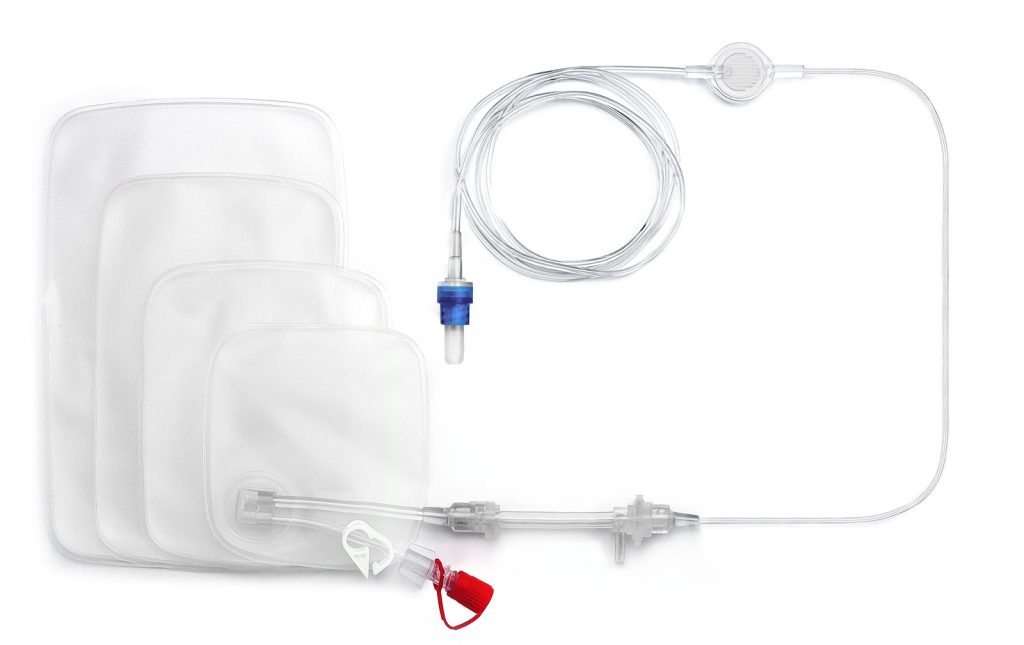
Medical bags are one of the best-known applications of radio frequency welding. Depending on their material construction and intended use, these products may include:
For these applications, the seam may need to withstand handling, storage, transport, and specified fluid pressure. The complete product design, including tubing connections, ports, and material interfaces, should be evaluated rather than assessing the seam in isolation.
Some flexible components used in medical devices can be manufactured using RF welding when their materials respond appropriately to dielectric heating. Examples may include selected flexible chambers, covers, membranes, and fluid-handling assemblies.
The process should be qualified for the actual material and component geometry. Compatibility with sterilization methods, cleaning agents, and intended service conditions must also be assessed where relevant.
Certain medical products contain multiple plastic layers or combinations of film and functional components. RF welding can join compatible layers when their dielectric properties, thicknesses, and construction permit reliable energy transfer and bonding.
Multilayer designs require careful evaluation because different layers may respond differently to the electromagnetic field. A material stack that works with a single layer may require different tooling or process parameters when additional layers are introduced.
Some medical packaging products and flexible pouches may use RF welding if the materials are suitable. The choice of joining method depends on the packaging structure, barrier requirements, sealing specifications, and the intended product application.
Where packaging protects a medical device or sterile product, the manufacturing process and finished package must meet the relevant requirements for the intended use.
The advantage of RF welding is its ability to generate heat within compatible materials and form a seam under controlled pressure. When the process is properly designed and validated, it can support repeatable joining for selected medical products.
Application-specific electrodes can follow defined seam paths and product contours. Consistent tooling, material positioning, and process parameters help manufacturers maintain the intended weld dimensions across production batches.
RF welding creates strong joints when the material and process conditions are suitable. Depending on the application, the resulting seam may be designed to resist leakage, handling stress, or other specified loads.
Actual performance must be demonstrated through appropriate testing rather than assumed from the welding method alone.
Because RF energy generates heat within compatible materials, the process can soften the welding zone without depending solely on an externally heated surface. This can be useful when joining certain flexible films and overlapping plastic sheets.
The process can join multiple layers of compatible materials when the material stack, electrode geometry, and energy distribution are suitable. The number and type of layers must be evaluated through sample trials and process qualification.
A properly configured RF welder can control the welding sequence, energy application, pressing action, and cooling stage. This supports repeatability when combined with qualified materials, maintained tooling, trained operators, and documented production procedures.
Medical RF welding equipment can be configured for manual, semi-automatic, or automated operation. Automation may support repeatable positioning, product handling, and production records, depending on the system design and validation needs.
Medical manufacturing often requires tighter control over product quality, traceability, and process consistency than general-purpose plastic fabrication. Equipment specifications should therefore be based on the actual product and quality system.
The RF generator supplies the high-frequency energy used for dielectric heating. Generator capacity should match the welding area, material construction, electrode design, and required cycle.
The machine should provide suitable control over the energy application and welding sequence. Process settings must be established using representative materials and production conditions.
Electrode geometry defines the weld pattern. Medical bags and fluid containers may require continuous sealing paths, shaped corners, narrow seams, or clearance around ports and connectors.
Tooling should provide suitable pressure distribution while reducing the risk of incomplete welds, material thinning, local overheating, or unwanted marks.
RF welding requires materials with suitable dielectric properties. PVC is commonly used, while some TPU and polyurethane-based materials may be weldable depending on their formulations.
Medical-grade status by itself does not guarantee RF weldability. Material suppliers' specifications and practical welding trials should be reviewed before equipment selection.
Depending on the product and manufacturing process, the machine may include programmable welding parameters, recipe management, cycle monitoring, safety interlocks, and production data interfaces.
The selected controls should support the manufacturer's documented procedures, process qualification, traceability, and investigation of nonconforming products where required.
The equipment layout should suit the production environment and allow appropriate cleaning, inspection, maintenance, and tooling changes. Requirements vary according to the product, manufacturing area, and applicable quality system.
Manufacturers should also consider operator access, electrical safety, RF shielding where applicable, guarding, and integration with existing production equipment.
RF welding and conventional heat sealing can both join suitable plastic materials, but they use different heating methods.
| Comparison factor | RF welding | Conventional heat sealing |
|---|---|---|
| Heat generation | Dielectric heating within compatible materials | Heat transferred from an externally heated tool |
| Material compatibility | Selected polar thermoplastics with suitable dielectric properties | Many heat-sealable films and plastic laminates |
| Tooling | RF electrodes shaped for the weld area | Heated bars, jaws, or sealing tools |
| Process parameters | RF energy, pressure, weld time, and cooling | Tool temperature, pressure, dwell time, and cooling |
| Potential applications | Selected medical bags, flexible components, and compatible multilayer products | Compatible medical pouches, packaging films, and other heat-sealable products |
| Selection factors | Material response, seam geometry, process capability, and product requirements | Material sealing window, package structure, and product requirements |
Neither method is universally better for all medical products. The choice depends on material construction, sealing performance, manufacturing volume, equipment integration, and validation requirements.
A high quality medical product depends on the full manufacturing process, not only the welding machine. The manufacturer should define measurable requirements for the finished seam and establish controls that maintain those requirements during production.
Confirm material identity, formulation, thickness, and relevant supplier specifications. Changes in resin formulation, additives, film construction, or material supplier may affect welding behavior and should be evaluated under the manufacturer's change-control procedures.
Establish suitable parameters for RF energy, pressure, weld time, and cooling time. Qualification should use representative products, tooling, and production conditions.
Where applicable, manufacturers may use installation qualification, operational qualification, and performance qualification as part of their process-validation approach. The exact method should reflect the product and the manufacturer's quality system.
Testing should be selected according to the intended function and risk profile of the product. Depending on the application, this may include:
No single test proves suitability for every medical application. The test plan should reflect the product's intended use and applicable standards.
Manufacturers may need documented material lots, machine settings, tooling identification, inspection results, maintenance records, and product-batch information. Appropriate records help support process control, investigations, and regulatory compliance.
The required documentation depends on the product, market, and applicable quality-management system.
When comparing RF welding equipment suppliers, assess both technical capability and the supplier's ability to understand the product requirements.
Ask whether the supplier can evaluate the actual materials and perform representative welding trials. Experience with general PVC welding does not automatically demonstrate suitability for every medical product or multilayer structure.
Confirm whether the manufacturer can develop the required electrodes, fixtures, pressing arrangement, control sequence, and working area. The equipment should match the product design and intended production workflow.
Share the expected output per hour or shift, product dimensions, number of seams, changeover frequency, operator requirements, and automation goals. These details help determine the practical machine configuration and expected cycle.
Agree on how the sample welds and machine performance will be evaluated. Acceptance criteria may include seam dimensions, strength, leakage performance, repeatability, and production output, as relevant to the application.
Review training, maintenance instructions, spare parts availability, tooling support, and troubleshooting arrangements. These factors affect the ability to maintain consistent production over the equipment's service life.
Shanghai Junjingsai Automation Machinery Co., Ltd. has manufactured welding equipment since 2002 and provides RF welding solutions for industrial plastic joining applications.
For medical manufacturing projects, machine configuration should begin with the actual material and product design. The required seam pattern, material layers, product dimensions, output target, and quality criteria help establish the appropriate RF generator, electrodes, pressing system, and controls.
When discussing a project, manufacturers should prepare:
These details allow the equipment supplier to assess feasibility and identify the trials needed before confirming machine specifications. Final suitability must be demonstrated through product-specific testing and process validation.
Looking for RF welding equipment for medical bags, flexible medical components, or compatible multilayer plastic products? Share your material details, product drawings, required seam performance, and expected production volume with Junjingsai.
A product-specific evaluation can help determine whether radio frequency welding is appropriate, identify the required tooling concept, and establish the testing needed to verify the finished weld.
Medical RF welding machines use radio frequency energy and pressure to join compatible thermoplastic materials used in selected medical bags, fluid containers, flexible components, and related products. Their suitability depends on the material, product design, weld requirements, and validated manufacturing process.
RF welding applies a high-frequency electromagnetic field to compatible material layers. Dielectric losses generate heat within the material, and pressure brings the softened layers together. After cooling, the joint forms a seam that must be tested against the product's sealing and strength requirements.
PVC is commonly used in RF welding. Certain TPU and polyurethane-based materials may also be suitable depending on their formulation and dielectric properties. Material testing is necessary because not all medical-grade plastics can be effectively joined by RF energy.
Yes, RF welding can join multiple layers when the materials are compatible and the electrode design, energy distribution, pressure, and cooling conditions are suitable. Multilayer structures should be evaluated through representative welding trials because each layer can affect heat generation and joint formation.
A key advantage of RF welding is its ability to generate heat within compatible materials, helping form defined seams without relying solely on external surface heating. With suitable tooling and validated process parameters, the method can support repeatable joints for selected medical products.
RF welding can create strong, continuous seams when the materials and process conditions are appropriate. Leak resistance and joint strength depend on the product design, material construction, weld parameters, and quality controls. These characteristics must be confirmed through product-specific tests.
No. RF welding is suitable only for products whose materials and design support the process. Material compatibility, intended use, sealing requirements, sterilization exposure, regulatory obligations, and alternative joining methods should be considered during process development.
RF seal quality depends on material formulation and thickness, electrode geometry, energy input, pressure, weld time, cooling conditions, and material positioning. Tooling condition and process consistency also affect results. Manufacturers should define acceptance criteria and verify them during qualification and production.
Yes. Equipment can be configured with custom electrodes, working areas, pressing mechanisms, programmable controls, and suitable material-handling systems. The configuration should be based on product dimensions, target output, required seam performance, automation needs, and the manufacturing environment.
Manufacturers should verify material compatibility, conduct sample welding trials, define weld-strength and sealing criteria, assess process repeatability, and review safety and maintenance requirements. They should also establish the validation and documentation approach required by their product and quality system.