For cooperation and more details, feel free to email us or call directly for consultation.

Home > News & Blog > Knowledge > Rotary Table vs. Sliding Table RF Welding Machines
Choosing between rotary table and sliding table RF welding machines can affect production speed, operator workflow, tooling requirements, and finished product consistency. Although both machine types use radio frequency energy to join compatible thermoplastic materials, they differ in how products move through the welding station and how operators or automation systems handle each production cycle.
For manufacturers producing inflatable products, flexible PVC components, medical bags, and other industrial goods, the right configuration depends on product size, seam geometry, required output, and the level of automation needed.
This guide compares rotary table and sliding table RF welding machines, explains how each design works, and outlines the factors to consider when selecting equipment for your production line.
A rotary table RF welding machine uses a rotating worktable that carries products or fixtures between designated positions. Depending on its design, the machine may allow loading at one station while another station performs welding, followed by unloading at a separate position.
A sliding table RF welding machine uses a worktable or fixture that moves linearly into and out of the welding area. The operator or automation system positions the product on the table, moves it into the welding station, and removes it after the cycle is complete.
Both are types of RF welding machines. Their main difference is the workpiece-handling arrangement rather than the underlying welding technology.
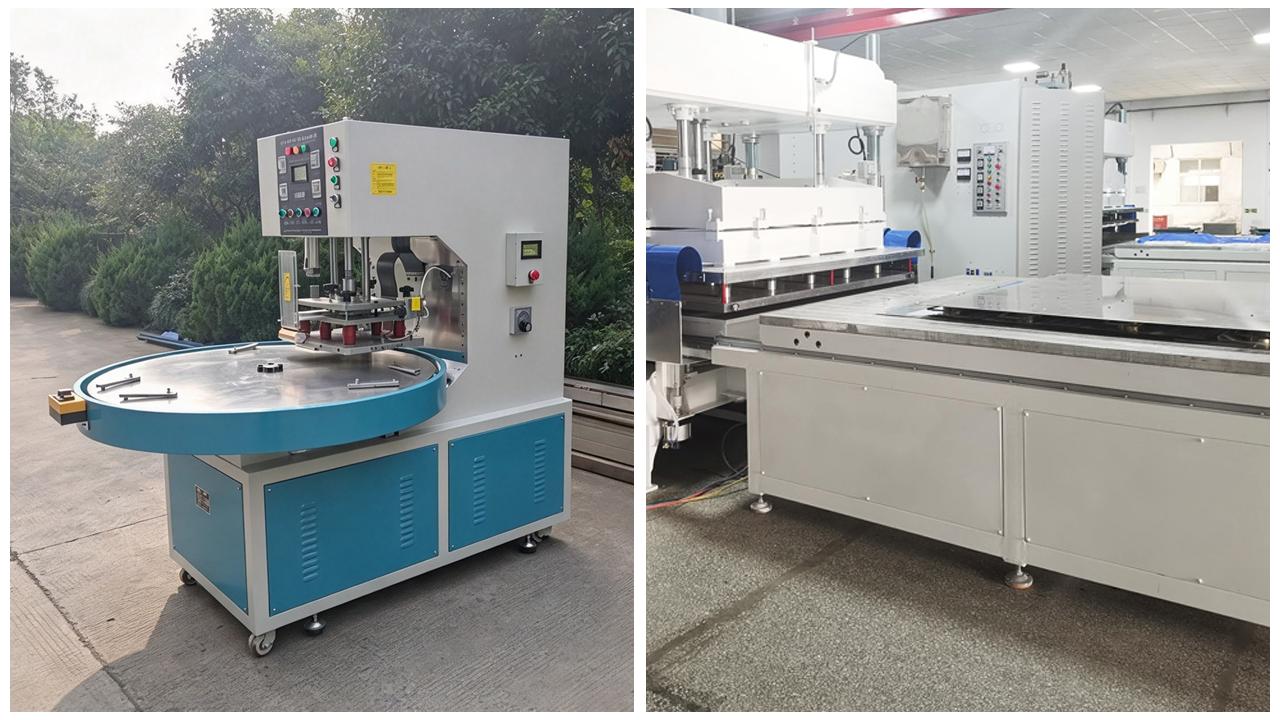
A rotary table RF welding machine is often a good choice for repetitive production where several stations can support loading, welding, and unloading in a continuous workflow. A sliding table RF welding machine is often suitable for products that benefit from straightforward front-loading access, flexible tooling, or a linear worktable arrangement.
Neither design is universally better. The most suitable machine depends on the product dimensions, welding process, operator access, number of operations per cycle, required production efficiency, and available factory space.
Choose a rotary table when a multi-station workflow can reduce handling delays or support simultaneous operations. Consider a sliding table when the product requires convenient positioning, frequent tooling changes, or a simple loading and welding sequence.
Before making a decision, compare actual cycle times, usable working areas, tooling layouts, safety arrangements, and sample-welding results from the proposed machine configuration.
Radio frequency RF welding, also known as high frequency welding, uses high frequency electromagnetic energy to join suitable thermoplastic materials.
During the welding process, a generator supplies radio frequency electromagnetic energy to electrodes positioned around the intended weld area. The alternating electric field interacts with the dielectric properties of compatible materials, allowing them to generate heat within the material. Under controlled pressure, the softened surfaces fuse and form a bonded seam.
This process differs from conventional heat sealing, which generally transfers heat from an externally heated tool or surface.
RF welding can create strong welds in suitable polar thermoplastics, including many PVC formulations and selected polyurethane materials. The actual result depends on the material formulation, thickness, electrode geometry, RF settings, pressure, and cooling conditions.
The rotary table and sliding table designs use the same basic principle. Their differences relate mainly to product positioning, workpiece movement, operator access, and how the machine fits into the wider production process.
A rotary table machine uses a worktable that turns between multiple positions. The number and purpose of the stations depend on the machine configuration.
A typical cycle may follow this sequence:
In suitable configurations, loading and unloading can take place while welding-related operations occur at another station. This arrangement can reduce idle time when the workflow is designed properly.
However, a rotary table does not automatically increase output. If loading, unloading, cooling, or inspection takes longer than the welding cycle, those operations may still limit the production rate.
Efficient repetitive production
Rotary tables can support a predictable sequence of operations. For products manufactured in large quantities with consistent geometry, the arrangement may reduce unnecessary handling and waiting time.
Potential for overlapping tasks
Where the machine design and safety system permit, operators may prepare one product while another is being welded. This can improve production efficiency when manual handling would otherwise leave the welding station idle.
Organized multi-station workflow
Different stations can be assigned to loading, welding, unloading, or other compatible tasks. This is useful when the production process benefits from a defined sequence.
Suitable for repeated product designs
Once the fixtures, electrodes, and process settings are established, a rotary table can support repeated production of similar products with consistent positioning.
More complex station planning
The table layout must account for product dimensions, operator reach, fixture placement, and the sequence of operations. A poorly planned layout can create bottlenecks rather than improve output.
Space and access considerations
The rotating structure and its operating envelope need sufficient floor space. The design must also provide safe access for loading, unloading, maintenance, and tooling changes.
Potentially greater setup requirements
For products with different shapes or welding sequences, fixture changes and station adjustments may take more time than expected. The machine's actual flexibility depends on its design.
Not ideal for every product geometry
Large, awkward, or irregular products may be difficult to position on a rotating fixture. Product size and operator handling should be evaluated before selecting this configuration.
A sliding table machine uses a linear movement mechanism to bring the workpiece into the welding area. Depending on the design, the table may move manually, pneumatically, hydraulically, or through a controlled drive system.
A typical cycle includes these steps:
The exact movement sequence and level of automation vary by model. Some machines use interchangeable fixtures, while others are configured around a specific product family.
Convenient product positioning
The linear worktable can provide straightforward access to the product during loading and unloading. This is useful when operators need to align several seams or position shaped components carefully.
Flexible tooling arrangements
Depending on the machine design, the table may accommodate different fixtures or electrode layouts. This can be helpful for manufacturers producing several related products or changing tooling regularly.
Suitable for varied product geometries
Sliding tables can be practical for products that are relatively large, irregularly shaped, or easier to position from the front of the machine.
Straightforward workflow
A loading position followed by a welding position can make the operating sequence easy to understand. This may simplify training and process standardization.
Handling time can limit output
If the operator must complete all loading, positioning, unloading, and inspection tasks around each welding cycle, handling time may reduce the machine's effective output.
Less opportunity for overlapping tasks in basic configurations
A simple single-table arrangement may require the operator to wait for the table to return before preparing the next item. More advanced designs may reduce this delay, but the capability depends on the machine.
Operator workflow affects consistency
If products are positioned manually, fixtures and work instructions must support repeatable placement. Inconsistent alignment can affect weld location and finished-product quality.
Large products may require additional handling
Heavy or bulky products can be difficult to move on a sliding table without suitable fixtures, support surfaces, or handling assistance.
| Comparison factor | Rotary table RF welding machine | Sliding table RF welding machine |
|---|---|---|
| Worktable movement | Rotates between designated stations | Moves linearly into and out of the welding area |
| Workflow | Can support multi-station operations | Often follows a loading-welding-unloading sequence |
| Production potential | Useful when tasks can overlap between stations | Depends heavily on welding and handling time |
| Product positioning | Best suited to products compatible with rotating fixtures | Useful when direct linear access simplifies positioning |
| Tooling changes | Depends on station layout and fixture design | May be convenient for applications using interchangeable fixtures |
| Operator access | Must account for the rotating table and station layout | Often provides direct access from the loading side |
| Space planning | Requires room for the table's rotation and operator access | Requires room for table travel and product handling |
| Typical production fit | Repetitive products with a structured multi-station workflow | Varied products or applications requiring straightforward linear handling |
| Main selection concern | Whether station coordination improves the overall cycle | Whether handling and table travel limit throughput |
These are general design tendencies, not fixed rules. Actual machine capabilities vary, and some models combine features that reduce the differences between the two arrangements.
Inflatable products can include air mattresses, inflatable boats, advertising structures, water sports equipment, and other sealed products made from compatible films or coated fabrics.
The choice between rotary and sliding table designs depends on the size of the product, the seam layout, and the way components must be positioned.
A rotary table may be a good option when the product has repeated weld locations, uses standardized fixtures, and can be processed through a predictable series of stations.
For example, a manufacturer producing the same small inflatable component in large quantities may benefit from a rotary arrangement that supports loading, welding, and unloading at separate positions.
A sliding table may be preferable when the product is large, has an irregular outline, or requires careful alignment of long seams. The linear worktable can make it easier to position a component relative to the electrode.
For large inflatable structures, however, the table size, product support, operator reach, and handling method must all be checked. A standard sliding table may not be appropriate without a suitable fixture or additional support.
In either configuration, creating strong welds depends on material compatibility, seam design, process settings, and testing. Table movement alone does not determine seam quality.
Products such as medical bags may require consistent seals along defined edges, around ports, or at specific joining locations. Other medical device components may use formed thermoplastic parts, flexible films, or multi layered constructions.
The equipment choice should begin with the product's material specification and quality requirements.
A rotary table can be suitable for repeatable products where several stations help organize loading, welding, and unloading. It may also support standardized fixtures for repeated production.
A sliding table can be useful when the product requires precise positioning, different fixture arrangements, or convenient access for inspection and handling.
For medical device production, neither table design automatically guarantees compliance or high quality. The complete manufacturing process may need validated welding parameters, documented inspections, traceability, leak or strength testing, and other controls defined by the product's intended use and applicable quality requirements.
If the product contains multiple layers, coatings, or different material combinations, test the complete construction. Material compatibility should not be assumed based on the outer layer alone.
Production efficiency depends on the entire cycle, not just the duration of the RF welding stage.
A simplified production cycle may include:
The total cycle time can be expressed as:
Total cycle time = loading and positioning + machine movement + welding and holding + unloading and other required operations
The actual sequence may overlap some tasks, so this expression is a planning model rather than a universal timing formula.
Imagine a product requires 8 seconds of welding and holding. On a basic sliding table, loading and unloading together take another 7 seconds, producing a theoretical cycle of 15 seconds.
The theoretical output is:
3,600 ÷ 15 = 240 cycles per hour.
If a rotary table arrangement allows loading and unloading tasks to overlap with the welding cycle, the overall cycle may approach the longest station time rather than the sum of all station times. However, the real result depends on table indexing, operator availability, safety interlocks, and other operations.
This example illustrates why buyers should compare demonstrated production cycles instead of relying on the machine type alone.
For a fair comparison, use the same product, material, electrode, weld-quality requirements, and production assumptions for both machine designs.
Measure the product's overall dimensions, active welding area, seam length, and number of weld locations. Confirm that the proposed machine has enough working space and suitable tooling access.
RF welding uses high frequency electromagnetic energy to generate heat within compatible thermoplastic materials. Not all plastics respond well to this process. Confirm the material grade and test representative samples before finalizing equipment.
Define the number of finished products required per hour or shift. Include handling time, expected downtime, inspection, and planned maintenance in the production estimate.
If the factory manufactures several products, consider how often fixtures and electrodes must change. Ask the supplier how tooling is installed, aligned, stored, and adjusted.
Determine whether manual loading is sufficient or whether the production line would benefit from automated feeding, unloading, indexing, or inspection. Automation should address a measurable production need rather than add complexity without a clear benefit.
Check the full movement envelope of the table, including safe access for loading, unloading, maintenance, and tooling changes. Ensure that the layout supports the intended operator workflow.
The machine should have appropriate guarding, interlocks, RF protection, and operating controls for its design and application. Confirm the supplier's safety documentation and maintenance requirements.
Request trials using the actual product or a representative sample. Evaluate seam appearance, strength, dimensions, leak resistance where applicable, and consistency over repeated cycles.
Choosing based only on advertised speed. A fast table movement does not guarantee a fast production cycle. Evaluate loading, welding, holding, unloading, and inspection together.
Assuming rotary tables are always more productive. A rotary table helps when its stations support an efficient workflow. If loading or another operation is slow, the advantage may be limited.
Assuming sliding tables are only for low-volume work. A properly designed sliding table with suitable fixtures and automation can support demanding production requirements. Actual performance depends on the complete system.
Ignoring product size and handling. A machine may have sufficient welding capacity but still be unsuitable if the operator cannot position the product comfortably or safely.
Comparing machines with different test conditions. Production claims are only meaningful when material, product, weld requirements, and cycle definitions are comparable.
Overlooking changeover costs. Frequent product changes can affect output. Include fixture replacement, setup, tuning, and first-piece verification in the assessment.
A rotary table machine moves fixtures between positions by rotating the worktable. A sliding table machine moves the worktable linearly into and out of the welding area. The main difference is workpiece handling and workflow organization, not the RF welding principle itself.
It can be faster when loading, welding, and unloading tasks can overlap effectively. However, actual production speed depends on the machine configuration, operator workflow, material, tooling, and cycle requirements. A rotary table does not guarantee higher output in every application.
Yes. A sliding table RF welder can support high-volume production when its working area, handling method, welding cycle, and tooling meet the target output. Automation and fixture design may further improve performance.
Either design can work for compatible inflatable products. Rotary tables may suit repetitive components with standardized fixtures, while sliding tables may be useful for larger or irregular products that require careful positioning. Product trials help establish the better option.
The appropriate choice depends on the bag dimensions, material construction, seal layout, required production rate, and quality controls. Rotary and sliding table designs can both be suitable when the machine supports the required process capability and documentation.
It can join certain multilayer constructions when the materials and interfaces are compatible with RF welding. Results depend on the individual layers, coatings, thicknesses, and electrode design. The complete material construction should be tested rather than assuming compatibility from one layer.
High frequency electromagnetic energy creates an alternating electric field. In suitable materials, dielectric losses convert part of that energy into heat within the material. Pressure and controlled process conditions then help the softened surfaces form a bonded seam.
Not by itself. Weld quality depends on material compatibility, electrode geometry, RF settings, pressure, cooling, and repeatable product positioning. A rotary table may help organize production, but the welding process must still be properly developed and controlled.
Cycle time depends on loading, positioning, table movement, RF heating, pressure holding, cooling, unloading, and inspection. The relative importance of each stage varies by product and machine design.
Many machines can be configured for more than one product, provided the working area, generator capacity, tooling, and process settings are suitable. Frequent changes may require interchangeable fixtures, setup procedures, and validation of the new welding conditions.
Run both configurations using comparable products, materials, tooling, and acceptance criteria. Measure total cycle time, good products per hour, rejection rate, changeover time, operator workload, and downtime. These figures provide a more useful comparison than nominal machine speed alone.
Provide product drawings, material specifications, thickness, seam dimensions, target production volume, expected cycle time, quality requirements, and details of any existing fixtures or automation. Representative product samples can help the manufacturer recommend and test a suitable configuration.
Rotary table and sliding table RF welding machines use the same radio frequency welding principle but support different production workflows. A rotary table can help organize repetitive, multi-station operations, while a sliding table can provide direct access and flexible positioning for products with varied geometries.
The best machine depends on the product, material, tooling, production target, operator workflow, and required weld quality. Rather than choosing by table design alone, compare complete production cycles and test both configurations under realistic conditions.
For manufacturers working with inflatable products, medical bags, medical devices, and other compatible thermoplastic materials, the right RF welder should provide consistent welding performance, manageable changeovers, appropriate safety features, and the output required by the production line.