For cooperation and more details, feel free to email us or call directly for consultation.

Home > News & Blog > Blog > RF Welding Machines for Packaging
RF welding machines for packaging use high-frequency electromagnetic energy to join compatible thermoplastic materials and create sealed seams. Also known as radio frequency welding or high-frequency welding machines, they are used in packaging applications where consistent seam formation, leak resistance, and repeatable production are required. Depending on the material and package design, RF welding can support flexible packaging, liquid-containing pouches, specialty bags, and other products made from suitable thermoplastic films or coated materials.
Shanghai Junjingsai Automation Machinery Co., Ltd. provides RF welding equipment and customized welding solutions for industrial applications. With experience dating back to 2002, the company develops machinery for manufacturers seeking reliable joining processes, repeatable production results, and equipment configurations suited to their packaging requirements.
RF welding machines for packaging are industrial machines that use a high-frequency electric field to generate heat inside compatible dielectric materials. The materials are positioned between electrodes, where controlled RF energy, pressure, and cooling create a bonded seam.
Unlike conventional heat sealing, which transfers heat from a heated surface to the packaging material, RF welding generates heat within suitable materials through dielectric losses. This difference can support efficient seam formation in certain multilayer or flexible packaging structures, provided the material formulation is compatible with the process.
RF welding is not suitable for every packaging film. Material composition, thickness, coating, package structure, and required seal performance must be evaluated before selecting the equipment.
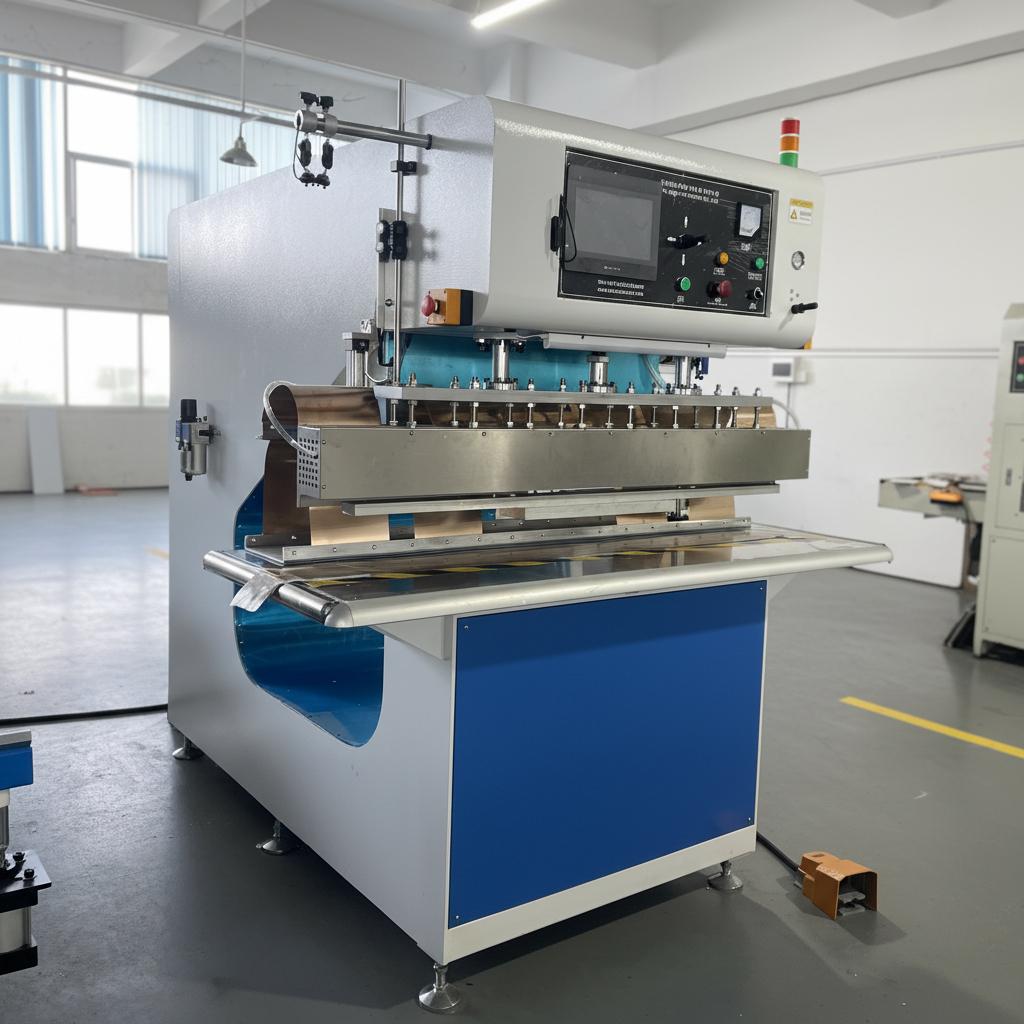
The RF welding process combines electromagnetic energy, mechanical pressure, and controlled timing to create a repeatable joint. A typical production cycle includes the following steps.
The packaging components are aligned between the welding electrodes or within a dedicated fixture. Accurate positioning helps maintain consistent seam width, package dimensions, and sealing geometry.
The RF generator produces a high-frequency electric field across the material in the welding area. Compatible polar thermoplastics respond to this field by generating internal heat through dielectric losses.
The electrodes apply pressure while the material reaches the required welding condition. The softened material surfaces bond together to form a seam. Welding time, RF power, electrode design, and pressure must be matched to the packaging material and product structure.
The joint is allowed to stabilize under appropriate conditions before the electrodes release the finished package. Suitable cooling helps the seam retain its shape and withstand subsequent handling.
Finished packages can be checked for seam appearance, dimensional accuracy, seal strength, and leakage performance, depending on the application. Packaging intended for liquid containment or other demanding uses may require additional product-specific validation.
RF welding equipment serves a wide range of packaging applications where compatible materials and the required seam characteristics align with the process.
RF welding can be used for selected flexible packaging structures, specialty pouches, and industrial bags made from RF-weldable materials. The process can create defined seam patterns and repeatable joints for products that require consistent construction.
For suitable material structures, RF welding can form seams intended to resist leakage. The finished package must be tested under its actual filling conditions, including the relevant liquid, pressure, temperature, and handling requirements.
Some medical bags and industrial containment products use compatible thermoplastic materials that can be joined by RF welding. These applications may require controlled manufacturing procedures, documented validation, and testing against applicable product specifications. A welding machine alone does not establish medical-device compliance or sterility.
Specially designed electrodes and fixtures can create package seams with defined shapes, corners, channels, or other product-specific features. Custom tooling depends on package geometry, material compatibility, and the required production volume.
RF welding and conventional heat sealing both join packaging materials, but they use different heating mechanisms. The best choice depends on the material, package design, production target, and required seal performance.
RF welding generates heat within compatible dielectric materials using a high-frequency electromagnetic field. It can be suitable for selected polar thermoplastics, including certain PVC formulations, and can produce shaped seams with purpose-designed electrodes.
Potential advantages include controlled seam geometry and the ability to weld compatible materials without relying solely on heat transferred from a hot surface. However, material compatibility must be confirmed, and the process requires suitable RF equipment, tooling, and operating controls.
Heat sealing typically uses heated bars, plates, or other heated elements to soften and join compatible packaging layers. It is widely used with many thermoplastic films and laminates, depending on their sealant layers and construction.
Heat sealing is often a practical choice for packaging materials that respond well to externally applied heat. It may be better suited than RF welding when the material structure is not compatible with dielectric heating.
Manufacturers should compare material compatibility, required seal strength, leakage requirements, package dimensions, cycle time, tooling cost, and integration needs. Representative samples should be tested before committing to a production process.
Many packaging lines use forms fills seals machinery to produce packages from rollstock or preformed materials. In a typical form-fill-seal process, the equipment forms a package, introduces the product, and closes the package in a coordinated production sequence.
RF welding can be considered for compatible packaging structures when a particular seam or package feature benefits from dielectric welding. However, it does not automatically replace the sealing unit on a standard form-fill-seal machine. The packaging material, machine layout, filling method, and required output determine whether RF welding can be integrated into the line.
During forming filling operations, the packaging material is shaped into a pouch, bag, or other package configuration before or during product loading. The forming method must maintain accurate dimensions and present the sealing areas correctly.
Filling sealing systems must coordinate product dosing with package closure. Where RF welding is used, the design must account for the position of the product, contamination risks at the seam, material handling, and the time needed to complete and stabilize the joint.
RF welding equipment may be designed as a standalone station, a semi-automatic system, or part of a customized production line. Integration planning should consider:
The appropriate configuration depends on the product and target output. A production trial helps determine whether RF welding meets the required cycle time and quality standards.
High speed packaging requires coordinated material handling, repeatable machine movements, and a stable sealing process. RF welding machines can be configured for automated or semi-automated production, but achievable output depends on the package design and the time required to establish and stabilize each seam.
Factors that affect production speed include material thickness, electrode area, seam length, welding time, cooling time, loading method, and inspection requirements. Complex package geometries or multiple welding positions may require additional process time.
Manufacturers evaluating high-speed packaging machinery should assess the complete production cycle rather than relying on the rated speed of an individual machine component. Trials using representative packaging materials and realistic operating conditions provide a more useful estimate of production capacity.
Shelf life depends on the product, packaging material, storage conditions, and the package's ability to maintain its required barrier and closure performance. For compatible packaging materials, RF welding can produce consistent seams that help limit leakage and preserve package integrity.
However, a strong welded seam does not automatically extend shelf life. The package must also provide suitable barriers against moisture, oxygen, light, or other environmental factors when these are relevant to the product. Material permeability, closure design, filling hygiene, storage temperature, and distribution conditions all affect product stability.
To assess shelf-life performance, manufacturers should combine seal-integrity testing with the relevant package-barrier evaluations and product-specific shelf-life studies. For food, pharmaceutical, and medical applications, applicable hygiene and regulatory requirements must also be addressed.
Selecting packaging machinery requires an understanding of the actual production task, not just the machine category. The following factors help determine whether RF welding is suitable.
Identify the exact polymer, formulation, thickness, coatings, and number of layers. RF welding generally works best with compatible polar thermoplastics. Materials that are not suitable for dielectric heating may require conventional heat sealing, ultrasonic welding, or another joining method.
Provide package drawings, dimensions, seam layouts, and representative samples. The design affects electrode shape, pressure distribution, welding area, and the possibility of automating material positioning.
Define the required seal strength, leak resistance, pressure resistance, and durability. Different packages need different test methods. For example, a pouch that contains liquid may need leakage testing, while another package may require peel-strength or tensile testing.
Estimate daily output, target cycle time, shift patterns, and the level of automation required. These details help determine whether a manual, semi-automatic, or fully automated configuration is appropriate.
Consider how many package sizes or designs the machine will process. Interchangeable electrodes and fixtures may support multiple products, but each configuration must be validated for its material and geometry.
RF equipment should include suitable guarding, interlocks, and controls designed for the machine configuration. Routine maintenance should cover electrodes, fixtures, electrical components, cooling systems where fitted, and other items specified by the manufacturer.
Reliable packaging production requires defined process parameters and repeatable inspection procedures. A seam that looks acceptable may still fail under pressure, during transport, or after extended storage.
A practical quality-control plan may include:
Test methods and acceptance criteria should be established according to the product specification and relevant industry requirements. For demanding applications, testing should reflect the conditions the finished package will experience during filling, storage, transportation, and use.
Shanghai Junjingsai Automation Machinery Co., Ltd. has developed industrial welding equipment since 2002. Through HFWelders, the company provides RF welding machinery and customized solutions for applications involving compatible thermoplastic materials.
For packaging projects, equipment planning can start with the product structure, material samples, package dimensions, seam requirements, and expected output. This information helps determine whether RF welding is appropriate and what type of machine, tooling, and automation may be required.
Rather than selecting equipment based on rated speed alone, manufacturers should evaluate seam quality, process stability, changeover needs, maintenance access, and compatibility with the wider packaging line.
Looking for RF welding machines for packaging production? Share your packaging drawings, material specifications, sample products, target output, and seal-performance requirements with HFWelders.
The technical team can review material compatibility, assess the welding process, and discuss a suitable machine configuration. Where RF welding is not appropriate for the material or package design, the process should be reassessed before equipment selection.
RF welding machines for packaging use high-frequency electromagnetic energy to generate heat within compatible thermoplastic materials. Pressure and controlled cooling help form bonded seams for suitable bags, pouches, and specialty packaging products.
RF welding is commonly used for PVC and selected other polar thermoplastics. Suitability depends on the exact formulation, thickness, coating, and package construction. Samples should be tested before choosing the process.
RF welding generates heat within compatible materials through dielectric losses, while conventional heat sealing transfers heat from a heated surface. The right method depends on material compatibility, package design, seal requirements, and production needs.
Potentially, yes. RF welding can be integrated into a customized packaging line when the material, package geometry, feeding system, and cycle time are suitable. Standard form-fill-seal machinery does not necessarily support RF welding without design changes.
They can support automated production, but achievable speed depends on material thickness, seam size, welding and cooling time, package handling, and inspection requirements. Production trials help establish realistic cycle-time expectations.
RF welding can help create consistent seams in compatible packaging materials, supporting package integrity. Shelf life also depends on barrier properties, product characteristics, filling hygiene, storage conditions, and closure performance. It must be verified through appropriate testing.
Yes, for suitable materials and package designs, RF welding can produce seams intended to resist leakage. The finished package should undergo appropriate leak, pressure, or other integrity tests based on its intended use.
A machine may process multiple package sizes if its working area, electrode system, fixtures, and controls support the required configurations. Changeover time and process validation should be considered when evaluating multiple products.
RF welding uses an electromagnetic field to generate heat in compatible dielectric materials. Ultrasonic welding uses mechanical vibrations to generate heat at the joint. Material properties, joint geometry, package design, and production requirements determine which method is more suitable.
Provide the material specification, thickness, package dimensions, seam drawing, required seal performance, target production volume, automation requirements, and available factory space. Sample materials and finished-package drawings help the equipment supplier evaluate feasibility and recommend a suitable configuration.